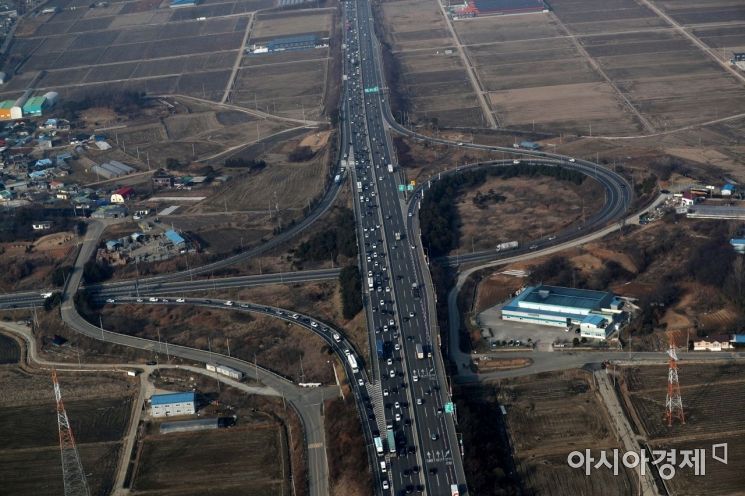
 On the 23rd, one day before the Lunar New Year holiday, vehicles were lined up moving on the southbound lanes of the Seohaean Expressway as seen from a police helicopter. (Aerial photography cooperation = Seoul Metropolitan Police Agency Aviation Unit Lieutenant Kim Hong-gyu, Kim Doo-su) / Photo by Moon Ho-nam munonam@
[Asia Economy Reporter Yu Je-hoon] As traffic volume increases during the Lunar New Year holiday, a major national holiday, the Automobile 10-Year-Old Citizens' Union (Citizens' Union) introduced the 'Communication Driving Method' for safe driving during the holiday period.
According to the Citizens' Union on the 11th, the recurring types of traffic accidents during the Lunar New Year holidays are drunk driving and crossing the center line. According to insurance accident data from the 2017-2019 Lunar New Year holidays, the number of victims caused by drunk driving and center line violations increased by 26.3% and 24.8%, respectively.
This is interpreted as being due to many cases of driving after drinking with family and relatives met during the holiday, and an increase in traffic violations caused by different driving environments such as congestion due to increased traffic volume.
Due to the winter season characteristics of the Lunar New Year holiday, vehicle breakdowns caused by cold weather are also not uncommon. The main causes include starting failure batteries, single-eye lighting devices, tire air pressure issues, and lack of fluids (antifreeze, engine oil, washer fluid). In fact, more than half of the emergency dispatch services by insurance companies from December to January are known to be due to battery failures.
The possibility of drowsy driving due to long-distance driving is also high. In particular, scarves or thick clothing worn for warmth can rather reduce movement and reflexes. The Citizens' Union emphasized that it is best to prepare comfortable clothes and shoes, maintain the car interior temperature at around 21-23 degrees Celsius to prevent drowsiness during long drives, and ventilate the car interior 1-2 times every hour.
Im Gi-sang, the representative of the Citizens' Union, said, "In the United States, Australia, and New Zealand, driving on the highway at night for 2 hours is classified as dangerous driving equivalent to drinking two glasses of alcohol," adding, "Although drowsiness comes from long-distance driving, due to COVID-19 and social distancing, highway rest areas or drowsy driving rest stops may be bypassed, but it is better to take simple stretching or rest inside the car at these rest stops or drowsy driving shelters."
The Citizens' Union also emphasized the importance of communication driving for safety. First, the Citizens' Union stated that driving behaviors such as following large trucks or buses should be avoided. Unlike passenger cars, large trucks and buses use air brakes, and due to their weight and size, quick braking is structurally difficult. In congested holiday traffic sections, if an accident occurs, large vehicles may only have minor contact accidents, but passenger cars can suffer major accidents.
The Citizens' Union said, "The misconception that following behind large vehicles is safer is a dangerous false belief," and added, "It is safest to keep designated lanes and maintain a safe distance from passenger cars while driving."
Using smartphones while driving is also prohibited. In the United States, Europe, Japan, and other countries, the increase in traffic accidents caused by smartphones has become a social issue. Pedestrians and other drivers also pose potential accident risks due to holding smartphones in their hands or ears. The Citizens' Union stated, "Smartphone use should be left to passengers, and unnecessary use while driving should be refrained from."
Additionally, the Citizens' Union advised that in case of an accident, reporting to the police and insurance company should come before disputes. The Citizens' Union said, "Since most traffic accidents occur due to mutual fault, it is forbidden to unilaterally admit fault by writing a confession or handing over your driver's license or vehicle registration to the other party," and added, "Victims should report to the police and insurance company rather than arguing at the accident scene, and should not agree to towing unconditionally but first confirm free towing with the insurance company and decide on the towing location, distance, and cost."
© The Asia Business Daily(www.asiae.co.kr). All rights reserved.

















