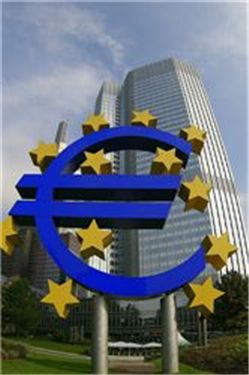
 European Central Bank (ECB) headquarters located in Frankfurt, Germany
[Asia Economy Reporter Yujin Cho] The European Union Commission (EC) has further downgraded its economic growth forecast for this year. It is analyzed that the recovery speed of the European region, which was most exposed to the impact of COVID-19, is expected to be slower than anticipated.
On the 11th (local time), the EC predicted that the Gross Domestic Product (GDP) of the Eurozone region will grow by 3.8% this year. This is a 0.4 percentage point downward revision from the forecast of 4.2% released in November last year. Among member countries, Germany, which has the largest economy, is expected to have a GDP growth rate of 3.2% this year.
The reason the EC expects a slower economic recovery is due to prolonged movement restrictions caused by delays in vaccine distribution. At the end of last year, as the resurgence of COVID-19 intensified, the Eurozone economy entered a double-dip phase, making it difficult to be optimistic about an early recovery due to extended lockdown measures and delayed vaccinations.
While the United States and the United Kingdom have recorded vaccination rates of around 10% and 16% respectively, the average vaccination rate of the four major Eurozone countries (Germany, France, Italy, Spain) remains at just over 3%.
Earlier, the European Central Bank (ECB) warned that downside risks to the economy are increasing. Christine Lagarde, President of the ECB, warned on the 8th (local time) during a meeting with members of the European Parliament that "due to delays in vaccine distribution and uncertainties about variant viruses, the Eurozone is facing serious downside risks."
She said that the intensity of the recession will depend on the vaccination results, the timing of easing movement restrictions, and the capacity for policy response. She added, "With the rapid increase of variant viruses and the extension of large-scale lockdown measures, the Eurozone economy is expected to continue to experience significant contraction," urging that "it is important to continue coordinating monetary and fiscal policies."
At the monetary policy meeting held last month, the ECB decided to keep the benchmark interest rate at the current level (0%) and to expand the bond purchase size of the Pandemic Emergency Purchase Programme (PEPP) by 500 billion euros to 1.85 trillion euros. This response places more emphasis on expanding asset purchases and fiscal policy cooperation rather than interest rate changes, based on the judgment that economic recovery will be slow.
Among major countries worldwide, the Eurozone, which was most exposed to the impact of COVID-19, showed a weak double-dip pattern with a GDP growth rate of -0.7% quarter-on-quarter in the fourth quarter of last year. The large-scale lockdown and the resulting slowdown in the tourism service sector pushed the Eurozone economy, which had rebounded in the third quarter of last year, back into a recession phase.
Germany, leading the Eurozone economy, barely avoided a double-dip with 0.1% growth, but France and Italy, where the tourism service industry has a high proportion, recorded -1.3% and -2.0% respectively, increasing the overall decline of the Eurozone.
The Wall Street Journal (WSJ) analyzed that the Eurozone, which has fallen into a double-dip phase, faces increased uncertainty about early economic recovery, and that vaccination results will be a key variable for economic rebound.
© The Asia Business Daily(www.asiae.co.kr). All rights reserved.
![Clutching a Stolen Dior Bag, Saying "I Hate Being Poor but Real"... The Grotesque Con of a "Human Knockoff" [Slate]](https://cwcontent.asiae.co.kr/asiaresize/183/2026021902243444107_1771435474.jpg)















