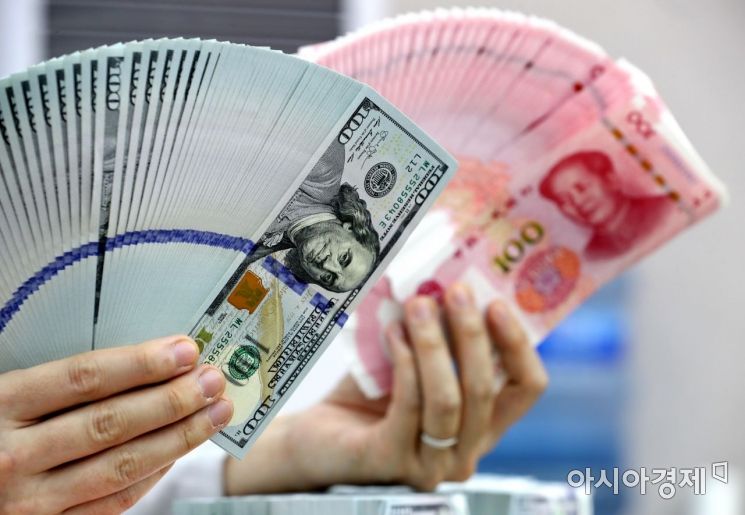
 On the 5th (local time), the U.S. Department of the Treasury designated China as a currency manipulator. This is the first time in 25 years since the Clinton administration in 1994 that the U.S. has designated China as a currency manipulator. On the 6th, an employee at the KEB Hana Bank Counterfeit Response Center in Euljiro, Seoul, is organizing U.S. dollar and Chinese yuan bills. Photo by Moon Honam munonam@
[Asia Economy Reporter Junho Hwang] As early as the 4th of next month, China's central government's Two Sessions (the National People's Congress and the Chinese People's Political Consultative Conference) will take place. This year's Two Sessions are attracting significant attention from investors as they are held in the first year of the 14th Five-Year Plan, which will guide China's economy for the next five years. Ebest Securities summarized the Two Sessions of 31 local governments held in January and presented a '2021 NPC Preview.'
Local Governments Show Confidence in the Economy

Through the Two Sessions, local governments in China expressed confidence in this year's economy. The average annual GDP growth rate forecast by local governments was over 7.1%. Compared to last year's targets, 10 regions raised their goals while 2 lowered them. Compared to 2019, before COVID-19, 16 regions lowered their targets, but the average across all regions increased by about 0.1%.
Also, a prominent theme in the local governments' Two Sessions was 'R&D/Advanced Technology Investment.' The annual average R&D investment target of local governments is 15.2%, higher than last year's investment growth rate of 11.8%. Zhejiang Province plans to increase R&D investment by more than 12% annually during the 14th Five-Year Plan period. Shanghai City plans to set the R&D ratio to GDP at 4.1% this year. The key industries to be fostered include semiconductors and AI.
Ebest Securities evaluated that China’s economy, which has passed the Lewis turning point, is seeking revitalization through changes driven by R&D. The Lewis turning point refers to the stage in a country's economic development, based on industrialization, when surplus rural labor is fully absorbed into urban factories. Since Chinese workers' wages have already risen and productivity growth has slowed, it is considered that China has passed the Lewis turning point. Overcoming manufacturing limitations at the Lewis turning point involves enhancing total factor productivity through R&D investment and defending growth by expanding domestic demand. Notably, these local governments' growth strategies align with the central government's dual circulation growth strategy.
Domestic Market Confirmed by COVID-19
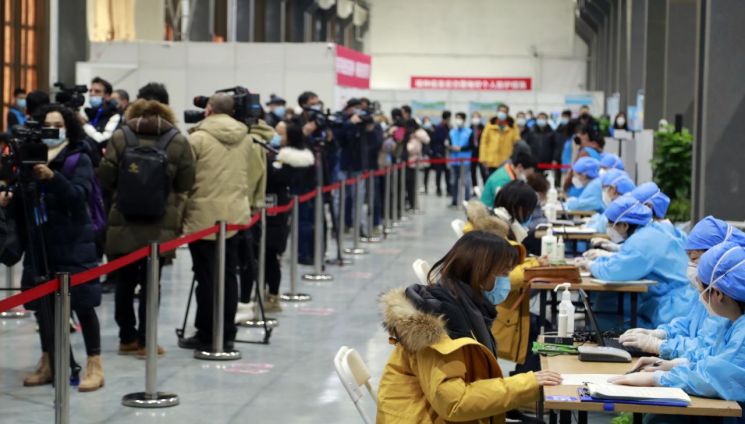
One notable point from the local governments' Two Sessions is that the retail sales target was set at an average annual growth of 8.6%. This exceeds last year's target by 1.0 percentage point and approaches the 2019 pre-COVID-19 target of 8.9%.
The ability to set such high targets stems from recognizing changed consumption trends. Local governments confirmed that consumption trends have shifted toward domestic demand due to COVID-19. Last year, duty-free sales in Hainan Province grew by 1.27 times. The nationwide import volume of consumer goods increased by 8.2% annually. Local governments plan to create an environment to sustain these consumption trends and absorb overseas consumption (about 5.3% of domestic consumption). Eleven regions, including Beijing, plan to build international consumption centers, and some areas intend to promote rural revitalization and regional specialty zones to encourage rural plus travel consumption.
Jinyoung Choi, a China/Commodities researcher at Ebest Securities, stated, "China's changes based on the dual circulation growth strategy have begun," and added, "Through the local governments' Two Sessions, we should look beyond this year's direction and consider the next five years."
Meanwhile, this year marks the 100th anniversary of the founding of the Communist Party of China and the first year of the 14th Five-Year Plan (2021?2025). As the first year of building a socialist modernized country, it is a very important year for China.
© The Asia Business Daily(www.asiae.co.kr). All rights reserved.
![Clutching a Stolen Dior Bag, Saying "I Hate Being Poor but Real"... The Grotesque Con of a "Human Knockoff" [Slate]](https://cwcontent.asiae.co.kr/asiaresize/183/2026021902243444107_1771435474.jpg)


















