[COVID-19 in Court Statistics②] Divorce Rates Also Decline Amid Economic Downturn
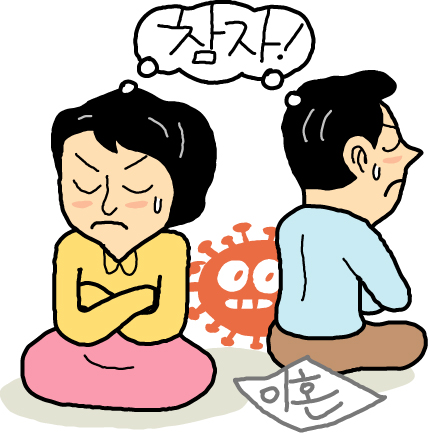
[Asia Economy reporters Seongpil Cho and Daehyun Kim] Park Hyesun (36, pseudonym), who has been married for four years, considered divorce last year. During an argument with her husband over childcare, he suddenly started swearing and threw objects at her. Since their marriage, her husband had been indifferent to housework and parenting. Witnessing his violent behavior made her seriously contemplate divorce. Although she sought counseling, she soon gave up on the idea. Park had been working while raising children but quit her job after giving birth and has since devoted herself solely to caring for their 4-year-old son. She said, "During the difficult times of the COVID-19 pandemic when finding a job was hard, I couldn't bring myself to raise the child alone."
Despite an increase in family conflicts due to COVID-19 last year, divorce filings actually decreased. According to the Monthly Court Statistics Report, the number of divorce lawsuits filed nationwide last year was 45,228, down by 2,346 from 47,574 the previous year. The actual number of divorces (based on Statistics Korea data) also fell by 4.4%, with 97,331 cases recorded up to November last year compared to 101,662 in the same period the year before. While the term Covidivorce emerged globally to describe a surge in divorces due to the pandemic, South Korea showed the opposite trend.
The reasons for the subdued COVID-19 divorce trend in South Korea include ▲a decrease in the number of marriages ▲frequent court recesses due to COVID-19 ▲and the financial burden of divorce. Experts focus particularly on the economic reasons related to divorce costs. A judge from the Financial Court said, "In South Korea, women still tend to be economically dependent on men, and with reduced employment opportunities and income levels due to COVID-19, this has likely acted as a deterrent to deciding on divorce." Professor Yuntae Kim of Korea University’s Department of Sociology also noted, "During wars or economic recessions, the burden of living independently increases, which tends to reduce divorce rates."
On the other hand, divorce-related consultations at specialized institutions have increased. According to monthly consultation statistics compiled by the Korea Legal Counseling Center for Family Affairs, the number of divorce-related consultations showed a rising trend every month from January to December last year. In January this year, 31.7% of the total 5,250 consultations were related to divorce. The main reason cited was increased conflicts due to couples spending more time together at home because of the expansion of remote work. A survey conducted by the job portal Incruit last year targeting 805 adults found that about half of parents (46.5%) experienced family conflicts over childcare issues after COVID-19. The reasons for family conflicts included "frequent clashes and fights due to being at home all the time" (29.6%) and "children struggling due to lack of outings" (30.0%).
Experts express concern over the phenomenon of reduced divorces despite ongoing conflicts. They warn that prolonged COVID-19-related disputes over housework, childcare, and education could intensify latent social conflicts. Professor Kim said, "This should not be viewed solely as an individual or ethical issue of the (parents), but requires support from the government and society," adding, "Especially vulnerable families, such as low-income households, need more assistance." Professor Hangseop Choi of Kookmin University’s Department of Sociology stated, "Families plunged into economic crises due to the natural disaster of COVID-19 face difficulties felt by all members, from children to the head of the household."
© The Asia Business Daily(www.asiae.co.kr). All rights reserved.
![Clutching a Stolen Dior Bag, Saying "I Hate Being Poor but Real"... The Grotesque Con of a "Human Knockoff" [Slate]](https://cwcontent.asiae.co.kr/asiaresize/183/2026021902243444107_1771435474.jpg)
















