If Passed by the National Assembly Next Month, 'Retroactive Application' Possible
Shareholders Dissatisfied with Dividends Predict Lawsuit Rush
Shareholders May Sue If They Believe They Have Been Harmed
[Asia Economy Reporter Sung Ki-ho] As the government plans to submit a class action bill to the National Assembly next month, concerns are growing that financial companies will become the 'primary targets.' This is because financial authorities have recommended a 'dividend payout ratio within 20%,' which could lead shareholders who believe they have suffered damages to file class action lawsuits against the CEOs of financial firms. Critics point out a paradoxical situation where financial companies suffer due to the government's class action policy coinciding with the financial authorities' pressure on dividends. Therefore, voices are calling for mechanisms to prevent financial companies from being harmed due to conflicts between financial authorities' policies and the law.
According to the National Assembly and financial circles on the 5th, the Ministry of Justice plans to submit a draft bill for the Class Action Act (tentative name) to the National Assembly next month. This bill was announced for legislative notice last September. The bill, proposed separately by Baek Hye-ryun, the floor leader of the National Assembly's Legislation and Judiciary Committee (Democratic Party), and Oh Ki-hyung of the same party, aims to make it easier for shareholders to file lawsuits for damages arising from 'principal-agent relationships.'
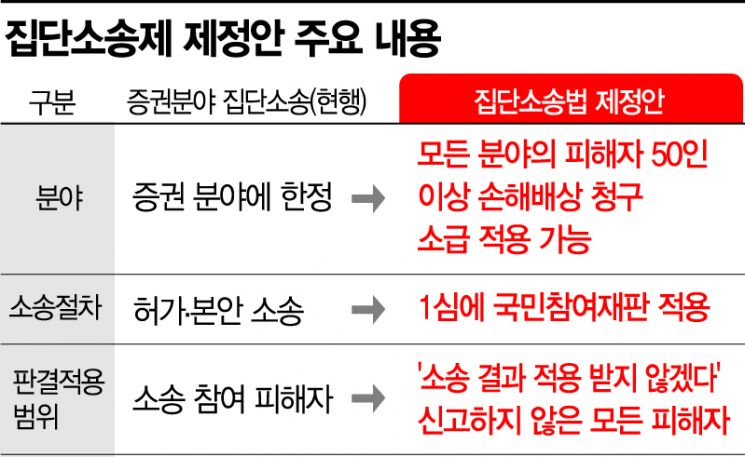
The class action system is currently implemented in the securities sector, but the government’s proposal includes expanding it to all sectors. A bigger issue is that 'retroactive application' is possible. Although the Ministry of Justice has set the enforcement date of the Class Action Act as six months after its promulgation, there is a prevailing view that retroactive application could lead to class action lawsuits by shareholders of financial companies dissatisfied with dividend restrictions. Professor Jang Young-soo of Korea University Law School said, "Since the legislative process is still underway and it is uncertain whether courts will accept such lawsuits, it is difficult to make definitive statements," but added, "Because the government’s proposal targets all sectors for class actions, lawsuits regarding dividend restrictions on financial companies could also occur."
Financial Companies Review Various Legal Risks Amid Shareholder Backlash
The government's dividend reduction coincides with financial companies' earnings announcements, intensifying controversy. Critics argue it is excessive government intervention in corporate management and infringes on shareholders' rights and property. Recently, a petition on the Blue House's public petition board criticized the government's dividend restriction pressure, stating it "only drove away foreign and institutional investors."
The financial sector expects a significant reduction in dividend payout ratios this year due to financial authorities' dividend restraint recommendations and political pressure for profit-sharing. Last year, among major financial holding companies, Woori Financial Group had the highest dividend payout ratio at 27%, followed by KB Financial Group at 26%, Hana Financial Group at 26%, and Shinhan Financial Group at 25%. In fact, KB Financial Group, which announced its earnings the day before, limited its dividend payout ratio to 20% in line with the recommendation.
In response to strong backlash from some shareholders, financial companies have begun legal reviews. A financial holding company official said, "The investor relations (IR) department is receiving numerous inquiries from shareholders regarding dividends," adding, "There is a possibility of legal risks such as lawsuits and complaints, so we are currently reviewing the matter internally."
Experts advise that measures should be established during the legislative process to protect financial companies from damages caused by policies. Professor Jang said, "Once lawsuits begin, companies will inevitably suffer significant damage regardless of the trial outcome," and emphasized, "In the bill review process, in-depth discussions on retroactive application and burden of proof should take place."
Professor Sung Tae-yoon of Yonsei University’s Department of Economics criticized, "It is highly inappropriate for dividends, an important criterion for evaluating corporate value, to be determined not by shareholders' interests but unilaterally by authorities," and added, "It is not right for authorities to decide the dividend payout ratio itself."
© The Asia Business Daily(www.asiae.co.kr). All rights reserved.

















