KB and Other Financial Holding Companies Likely to Lower Dividend Payout Ratios
Experts Say "Dividend Intervention Against Market Logic"
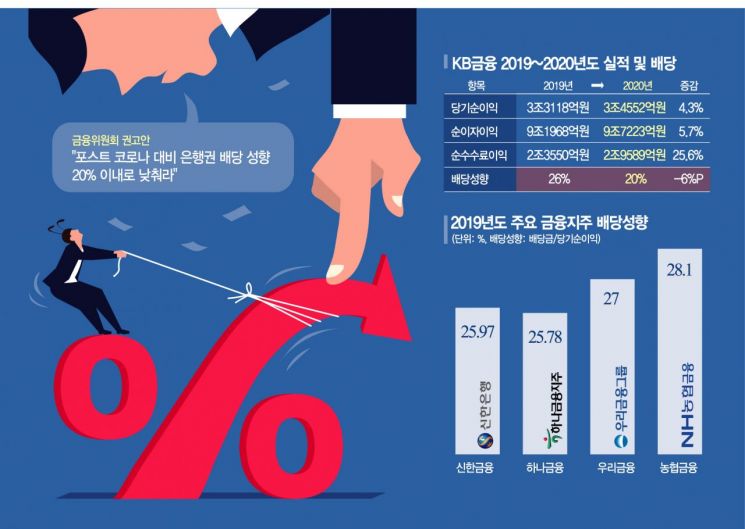
[Asia Economy Reporters Sunmi Park, Hyojin Kim] KB Financial Group, which posted record-high earnings, lowered its dividend payout ratio to below 20% as recommended by financial authorities. As a result, other financial holding companies such as Shinhan, Hana, and Woori, scheduled to announce their earnings on the 5th, are also expected to make similar dividend decisions. Facing unprecedented pressure from financial authorities to cut dividends, financially strong holding companies are considering various shareholder return policies, including share buybacks, to appease angry shareholders. However, some shareholders who feel harmed by external intervention appear poised to file complaints against management and initiate lawsuits, suggesting potential repercussions ahead.
◆Financial Holding Companies Struggle to Appease Shareholders=Among the five major domestic financial holding companies, KB Financial was the first to announce its earnings. Despite a 4.3% increase in net profit to KRW 3.4552 trillion last year, it actually reduced dividends. The dividend was set at KRW 1,770 per share, down 20% from KRW 2,210 in 2019. The total dividend amount was KRW 689.7 billion, with a payout ratio (dividends/net income) of 20%. The payout ratio also dropped 6 percentage points from 26% in 2019 to 20% in 2020.
The decision to set the payout ratio at 20% precisely aligns with the guidelines presented by the Financial Services Commission. Earlier, the commission recommended that domestic banks lower their dividend payout ratios to within 20% by June this year as a COVID-19 response measure. The intent was to strengthen banks’ capital management to enhance loss absorption capacity amid the prolonged pandemic. While verbal recommendations on dividends had been made before, this is the first official directive. KB Financial indicated that "due to the need for conservative capital management and support for the real economy, the dividend level was temporarily reduced compared to the previous year," implying that the decision considered the recommendation.
With KB Financial accepting the financial authorities’ recommendation despite record earnings, other financial holding companies such as Shinhan, Hana, and Woori, which will announce earnings simultaneously, are highly likely to decide on dividends at similar levels. The atmosphere is that they have no choice but to comply given the ‘special recommendation’ from the authorities.
However, NH Nonghyup Financial’s situation differs. Nonghyup Financial’s payout ratio was 28.1% in 2019, and due to its organizational structure, most dividends go to cooperative members, primarily farmers. Reducing the payout ratio to within 20% would mean less support for farms struggling due to COVID-19. A senior official at Nonghyup Financial said, “Since dividends are linked to farmers’ interests, we plan to persuade the authorities by presenting special circumstances ahead of the earnings announcement on the 16th.”
The intervention in dividend policy by financial authorities, which contradicts capital market logic, has left financial holding companies with the challenge of appeasing angry shareholders who did not receive performance rewards despite record profits. This is because shareholder defections could hinder stock price gains. Like KB Financial, which is considering interim dividends and share buybacks, other financial holding companies are likely to actively implement shareholder return policies in the second half of the year that they could not carry out in the first half.
◆Experts: "Violation of Shareholder Rights... Excessive Intervention"=Experts criticize the financial authorities’ dividend restriction recommendation as an excessive intervention that undermines the value enhancement of companies (financial holding companies) and shareholders. Sung Tae-yoon, a professor of economics at Yonsei University, said, “Dividend, an important criterion for evaluating corporate value, being decided not by shareholders’ interests but unilaterally by the authorities’ standards is highly inappropriate,” adding, “It is not right for the authorities to decide the payout ratio itself.”
Kim Sang-bong, a professor of economics at Hansung University, also pointed out, “Are financial holding companies or banks government property?” He further criticized, “Since it is difficult to gauge the extent of losses or defaults due to the implementation of loan principal repayment deferrals for small business owners, they are being forced to excessively increase loss absorption capacity.”
There are also forecasts of potential litigation. If some shareholders believe that financial companies have been harmed by the government or political circles, they may file criminal complaints against management for breach of fiduciary duty or initiate shareholder derivative lawsuits under commercial law. Some financial companies are internally reviewing related laws due to concerns about shareholder backlash.
A senior official at a financial holding company said, “Direct intervention by authorities in dividends is no different from openly infringing on core areas of corporate activities and management,” expressing concern that “While managing the COVID-19 situation is important, excessive intervention like this could misdirect the financial industry’s trajectory.” Another official pointed out, “If dissatisfaction grows mainly among foreign shareholders who did not receive proper dividends despite record earnings due to external interference, it could spread as a trust issue in the domestic financial market,” adding, “This will be a representative case where shareholder value is damaged by financial authorities’ administrative control.”
© The Asia Business Daily(www.asiae.co.kr). All rights reserved.
![Clutching a Stolen Dior Bag, Saying "I Hate Being Poor but Real"... The Grotesque Con of a "Human Knockoff" [Slate]](https://cwcontent.asiae.co.kr/asiaresize/183/2026021902243444107_1771435474.jpg)
















