51 Confirmed Cases Related to Kondaehunting Pocha
283 People Caught in Illegal Entertainment Venue Raids Within a Week
Civilians Demand Measures Against Illegal Entertainment Businesses
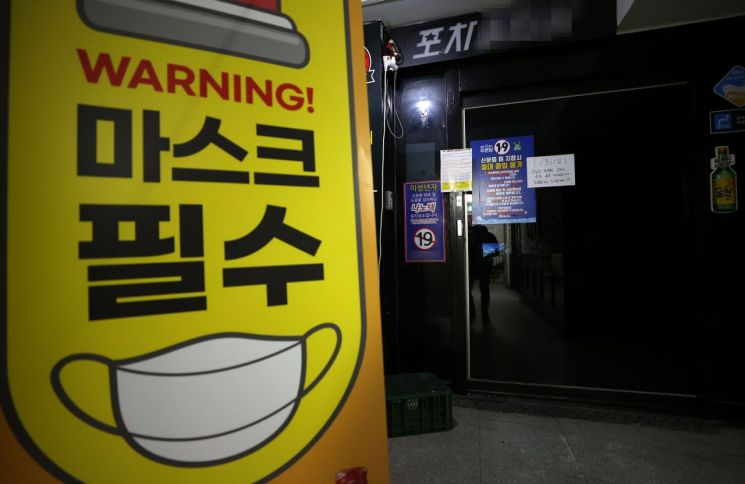 On the afternoon of the 4th, the door of a pojangmacha near Konkuk University Station in Gwangjin-gu, Seoul, where multiple COVID-19 cases occurred, is closed.
 [Image source=Yonhap News]
[Asia Economy Reporter Heo Midam] "I understand that it's difficult, but what about those who have been following the quarantine rules diligently until now?"
As the spread of COVID-19 in South Korea shows no signs of slowing down, some entertainment establishments have recently been engaging in 'tricky operations,' causing social issues. For example, they register as regular restaurants but actually operate as clubs where people can dance, or they serve customers during prohibited early morning hours.
As business owners continue to cleverly evade police crackdowns and operate irregularly, calls for strong measures against them are growing.
Recently, the 'Pochakkeutpanwang Konkuk Branch' located in Gwangjin-gu, Seoul, which caused a large cluster infection of COVID-19, was revealed to have violated quarantine guidelines by engaging in 'tricky operations,' sparking public criticism.
The establishment was originally registered as a regular restaurant, but according to health authorities, it was actually operated as a prohibited type of entertainment facility such as a sensory pub or hunting pocha (drinking spot).
Customers were found to have danced there and moved between tables on the 2nd and 3rd floors while drinking. In particular, some customers did not wear masks properly or violated the 'ban on private gatherings of five or more people,' thus breaking quarantine rules.
As a result, after the first confirmed case was reported on the 29th of last month, a total of 51 people had tested positive as of the 4th. Accordingly, the Seoul city government imposed a fine of 1.5 million won for failing to properly enforce mask-wearing inside the establishment and decided to suspend the business for two months for violating the Food Sanitation Act by allowing dancing in a regular restaurant.
 A notice prohibiting gatherings is posted in front of a karaoke room in Seoul. The photo is unrelated to specific expressions in the article. [Image source=Yonhap News]
Some voices express concern that this cluster infection related to the hunting pocha might become "a second Itaewon cluster infection incident." According to the disclosed movement paths of confirmed cases, some infected individuals visited other sensory pubs and hunting pochas.
Kim (27), a university student living near Konkuk University Station, said, "There are many pubs nearby where you can dance. Especially given the nature of pubs, I expected that quarantine rules would not be followed and that something like this would happen someday." He added, "I'm worried that the cluster infection will continue to spread centered around our area."
There are quite a few entertainment facilities that have violated the assembly ban order and operated illegally. According to the National Police Agency on the 1st, a total of 283 people (43 cases) were caught during the 'intensive crackdown on illegal operations such as unlicensed entertainment facilities' conducted last week (January 25?31).
Earlier, a regular restaurant in Gangnam-gu, Seoul, was caught on the 31st of last month operating an unlicensed club with a DJ box, special lighting, and a stage. On the 26th of last month, 31 people including business owners who locked their doors to avoid inspections and continued operations in Gwanak-gu, Seoul, were caught for violating the Infectious Disease Control and Prevention Act.
Additionally, on the 16th of last month, 60 people including owners of three entertainment establishments in the same building in Songpa-gu, Seoul, who secretly operated for reserved customers, were arrested in a large-scale crackdown.
As entertainment establishments' 'tricky operations' run rampant, public criticism among citizens is also rising. Especially with the cluster infections involving a variant virus that is more transmissible than the existing virus, voices expressing concern about a '4th wave' are emerging.
Office worker Kim (28) said, "I don't understand why they insisted on illegal operations despite knowing the high risk of infection in this situation. No matter how difficult it is economically, all other self-employed people are enduring and waiting for COVID-19 to calm down." He expressed frustration, saying, "It seems very selfish. I don't know how many people suffered because of the cluster infection that occurred in Itaewon last year."
He continued, "With the variant virus also entering, everyone needs to be even more careful. If this continues, the number of confirmed cases might exceed 1,000 again." He added, "Measures are needed against entertainment facilities that operate illegally to prevent another large-scale outbreak, and each citizen must also strictly follow social distancing."
Health authorities have also warned that a 4th wave could come this spring. Yoon Tae-ho, head of the Central Disaster and Safety Countermeasure Headquarters' quarantine team, said on the 4th, "There is concern that the outbreak could come again in March or April. Experts and health authorities cannot completely rule out this possibility and must prepare."
He added, "Social distancing and rapid epidemiological investigations to quickly cut off the chain of infection are almost the only means, and securing hospital beds is considered a major axis in preparing for the outbreak."
© The Asia Business Daily(www.asiae.co.kr). All rights reserved.


















