Appointment of Committee Members and Organization of Office Units Must Be Completed
Official Implementation in July... Pilot Operation Possible Before Then
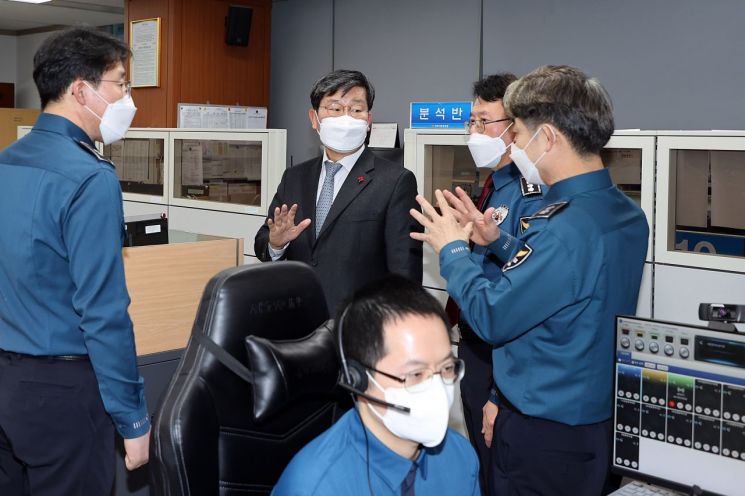 Minister Jeon Hae-cheol of the Ministry of the Interior and Safety is inspecting the preparation status for the promotion of autonomous police at the Chungbuk Provincial Police Agency in Cheongju, Chungbuk, and encouraging the police officers.
 [Image source=Yonhap News]
[Asia Economy Reporter Lee Gwan-joo] As local governments nationwide accelerate preparations for the introduction of autonomous police, attention is focused on the formation of city and provincial autonomous police committees (Autonomous Police Committees) that will command the autonomous police. Since they oversee police affairs closely related to residents' daily lives, the success or failure of autonomous police depends on how the committee members are selected and how the administrative organization is structured.
According to the National Police Agency and local governments on the 5th, the official implementation date of the autonomous police system is July 1. However, once the autonomous police committee members are appointed and the administrative organization is established, pilot operations can be conducted before that date through consultations with the police. It is reported that many local governments have set a goal to conduct pilot operations for one to two months starting in May, improve any shortcomings, and officially launch in July.
The fastest progress is being made in Gangwon-do. On the 1st, Gangwon-do became the first local government nationwide to complete the formation of a recommendation committee to nominate autonomous police committee members. Gyeonggi-do recently announced research results for organizing the Autonomous Police Committee’s administrative organization. The Gyeonggi Research Institute, which conducted the study, proposed installing administrative offices for the Autonomous Police Committee at both the Gyeonggi Southern and Northern Police Agencies, deploying a total of about 190 personnel. In the case of Busan City, on the 4th, an advisory group for autonomous police consisting of about 20 experts from various fields was launched and held its first meeting.
The key to the successful establishment of autonomous police lies in the selection of Autonomous Police Committee members and the composition of the administrative organization. Although there are some external checks such as consultations with the national police and external recommendations, local governments are granted considerable discretion in operation. In particular, regarding the administrative organization supporting the Autonomous Police Committee, the organization, staffing, and operation are to be determined by city and provincial ordinances after hearing the opinion of the Commissioner General of the National Police Agency. Therefore, the completeness of autonomous police can vary greatly depending on the plans each local government sets. Due to the nature of police work, 'political neutrality' is also required. Professor Lee Woong-hyuk of Konkuk University’s Department of Police Science emphasized, "Currently, the structure inevitably allows strong influence from city and provincial governors on the Autonomous Police Committee," adding, "Autonomous police must be organized to exclude partisanship and to align with the purpose of providing resident welfare and customized public safety services, regardless of the political advantages or disadvantages of the governors."
© The Asia Business Daily(www.asiae.co.kr). All rights reserved.

















