Revealing Shift in Alliance-Centered Diplomatic Strategy
Review of Global US Military Posture
Suspension of Support for Attacks in Yemen
No Mention of North Korea or Iran
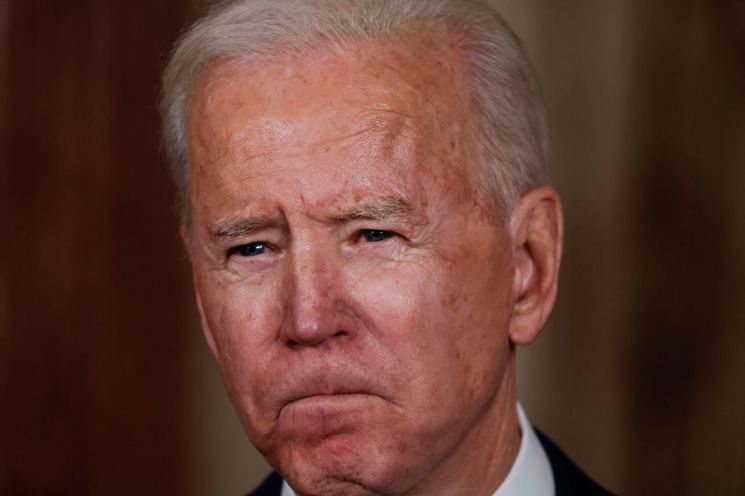
[Asia Economy New York=Correspondent Baek Jong-min] On the 4th (local time), U.S. President Joe Biden visited the State Department for the first time since his inauguration and presented his foreign policy to the world. President Biden focused on pressure against China, Russia, and Myanmar, but did not mention North Korea or Iran.
In a speech at the State Department that afternoon, President Biden said, "America is back. America's alliances are one of our greatest assets," adding, "Leading with diplomacy means standing shoulder to shoulder once again with our allies and key partners, and engaging adversaries and competitors diplomatically."
President Biden explained that over the past two weeks, he had spoken with the closest leaders from the UK, Germany, France, Japan, and Korea, which was aimed at reshaping the practice of alliances and cooperation and rebuilding the strength of democratic alliances that had been weakened by neglect and abuse over the past four years.
President Biden focused on announcing changes in the new administration's foreign policy that day.
First, he announced a review of the posture of U.S. troops stationed worldwide and a halt to the redeployment of U.S. troops stationed in Germany during this period. Led by Defense Secretary Lloyd Austin, the review of the global U.S. military posture aims to ensure that the U.S. military aligns appropriately with foreign policy and national security priorities.
To this end, he announced the suspension of the troop redeployment to Germany decided by the Trump administration while the review is underway.
President Biden also took active measures to pressure China, Russia, and Myanmar, with whom the U.S. has recent conflicts.
Regarding the Myanmar coup, President Biden emphasized, "The Burmese military must relinquish power, release detainees, lift communication restrictions, and exercise restraint in violence," strongly advocating for the restoration of democracy.
He also strongly criticized Russian President Vladimir Putin's attempted poisoning and detention of his opponent Alexei Navalny. President Biden demanded Navalny's unconditional immediate release and stated, "We will not hesitate to impose appropriate costs and defend U.S. interests regarding Russia."
Regarding China, President Biden said, "We will compete with China based on strength, but we are ready to cooperate when it aligns with America's national interests." Earlier, Jake Sullivan, National Security Advisor at the White House, also asserted that "the U.S. must address China's human rights and trade violations."
Regarding Middle East issues, President Biden mentioned that all support for offensive operations in Yemen would be halted, but support necessary for Saudi Arabia to defend its sovereignty would continue.
President Biden announced that he would raise the annual refugee cap to 125,000 and sign a presidential memorandum to protect the rights of sexual minorities worldwide.
Meanwhile, President Biden did not mention North Korea or Iran in his speech that day.
© The Asia Business Daily(www.asiae.co.kr). All rights reserved.

















