Discussion on M&A Challenges
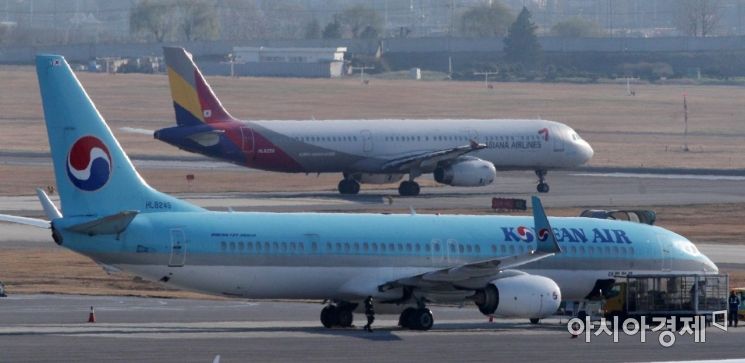 As the court's decision on Korean Air's acquisition of Asiana Airlines approaches, on the 30th, Korean Air and Asiana Airlines passenger planes were moving toward the runway at Gimpo Airport apron in Gangseo-gu, Seoul. The Seoul Central District Court is expected to deliver a ruling today or tomorrow on the injunction request filed by activist private equity fund KCGI against Hanjin KAL to prohibit the issuance of new shares. If the court dismisses the injunction request, the acquisition process will accelerate, but if the injunction is granted, the acquisition is likely to be canceled. Photo by Kim Hyun-min kimhyun81@
[Asia Economy Reporter Dongwoo Lee] A study has found that if Korean Air acquires and merges with Asiana Airlines, the combined supply seat share including their low-cost carrier (LCC) subsidiaries would exceed 70%. There are calls for an analysis of market monopoly by separating long-haul and medium/short-haul routes during the restructuring process.
On the 3rd, Professor Moon-Gil Yoon of the Department of Business Administration at Korea Aerospace University stated at the 'Korean Air-Asiana Airlines Acquisition and Merger (M&A) Issues' forum hosted by Democratic Party lawmaker Yongwoo Lee and others, "The combined share of Korean Air, Asiana Airlines, and their three LCC subsidiaries is 72.9% based on total supply seats," adding, "Although the ratio of domestic carriers to foreign carriers is about 2 to 1 in total supply, the domestic supply ratio is 88 to 12, showing the domestic carriers' market dominance is significantly higher."
Professor Yoon explained, "Since domestic carriers supply overwhelmingly more seats to their own country, analyzing based on domestic supply seats would further reduce the proportion of foreign carriers in total supply."
He added, "The reduction in consumer welfare should be limited to domestic consumers," and "The determination of monopoly or oligopoly should be based on the scale supplied domestically, not on the total supply seats of domestic and foreign carriers."
Earlier, Professor Kwan-Hwi Lee of Seoul National University's Department of Business Administration criticized the Industrial Bank of Korea's support method for Korean Air's acquisition and merger with Asiana. He particularly raised concerns about the bank's decision to invest in common stock through a third-party allotment rights issue in Hanjin KAL.
Professor Lee said, "Although the three-party alliance had the upper hand in the shareholding battle, the Industrial Bank's intervention through common stock investment diluted shares, allowing Chairman Won-tae Cho's shareholding to surpass the three-party alliance," adding, "Hanjin KAL's debt ratio is low at 43.7%, and the 800 billion KRW injected by the bank through the rights issue could have been fully financed by debt. Therefore, it is questionable whether the common stock investment was absolutely necessary."
He continued, "There is reasonable suspicion about why the rights issue allocation to KCGI was not allowed, and whether the Industrial Bank had alternatives to avoid the shareholding dispute but still chose to get involved in this fight."
However, Professor Lee explained that neither the three-party alliance nor Chairman Won-tae Cho opposes Korean Air's acquisition of Asiana Airlines, so the current deal and shareholding competition are separate issues.
Legislative Research Officer Ji-won Kang of the National Assembly Research Service emphasized the need to carefully examine route-specific market shares, slot shares, and the substitutability of direct and connecting flights when the two companies merge.
Officer Kang pointed out, "Korean Air President Woo Ki-hong's statement that there is no concern about monopoly because Korean Air and Asiana Airlines hold a 38.5% slot share at Incheon Airport is based on limited information when judging monopoly," and argued, "In domestic routes, it is necessary to consider concerns about collusion and easier information exchange between the two companies and their LCC subsidiaries."
© The Asia Business Daily(www.asiae.co.kr). All rights reserved.
![Clutching a Stolen Dior Bag, Saying "I Hate Being Poor but Real"... The Grotesque Con of a "Human Knockoff" [Slate]](https://cwcontent.asiae.co.kr/asiaresize/183/2026021902243444107_1771435474.jpg)
















