[Asia Economy Reporter Ji-hwan Park] Deloitte Korea Group cited Deloitte Global's 2021 Deloitte Resilience Report, which forecasts that global CXOs (Chief Experience Officers) expect disruptive transitions like COVID-19 to occur periodically, with climate change anticipated to be the greatest threat to corporate management activities within the next decade. This report contains the results of a survey conducted over three months from July to September last year, targeting 2,260 CXOs across 21 countries worldwide.
The majority of global CXOs who responded to this survey indicated that large-scale disruptive transitions like COVID-19 will continue to occur in the future. 52% of CXOs answered that disruptive transitions like COVID-19 will "occur occasionally." The proportion who responded that such transitions will "occur periodically and continuously" was 10%, meaning that a total of 62% foresee large-scale disruptive transitions happening in the future. Only 37% of CXOs responded that disruptive transitions of this scale would not happen again.
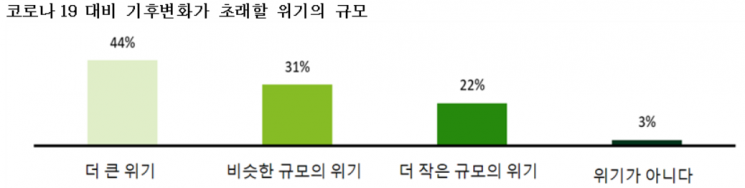
Among various potential disruptive transitions in the future, global CXOs identified 'climate change' as the biggest factor threatening business resilience. 47% of global CXOs pointed to climate change as the most important social issue companies must address within the next 10 years, which is 5 percentage points higher than global health and disease concerns (42%) heightened by COVID-19, indicating that climate change is perceived as a serious challenge threatening corporate management. Notably, 44% of global CXOs responded that climate change is a greater crisis than COVID-19, and 31% said it is a crisis of a similar level, meaning 75% of the surveyed global CXOs consider climate change a crisis exceeding COVID-19. In contrast, only 3% of global CXOs answered that climate change is not a crisis, showing a stark contrast.
Global CXOs identified 'flexibility and adaptability' as the most necessary capabilities for companies to adapt and respond to disruptive transitions. When asked what the most important work characteristic is in preparing for disruptive transitions like COVID-19, 54% of global CXOs answered 'flexibility and adaptability.' Flexibility and adaptability refer to an organizational culture where employees take on new tasks beyond their existing duties and accept the necessary retraining and changes in work methods. Global CXOs considered these qualities more important than technical skills (40%) and job expertise (30%).
Punit Renjen, CEO of Deloitte Global, emphasized, "Companies now face the difficult choice of pursuing new ways of operating and fundamental strategic changes to prepare for global health crises, socio-political instability, and climate change. Only companies that anticipate future disruptions and plan and invest accordingly can grow."
Jong-sung Hong, CEO of Deloitte Korea Group, added, "Although companies have faced many difficulties due to COVID-19, they must prepare for pandemic-level threats such as climate change in the future. The work capabilities of flexibility and adaptability are expected to be emphasized even more going forward."
© The Asia Business Daily(www.asiae.co.kr). All rights reserved.

















