Manufacturing Purchasing Managers Index Declines... Signs of Anomalies in Domestic Consumption Sector
[Asia Economy Beijing=Special Correspondent Jo Young-shin] There are prospects that the resurgence of COVID-19 in China could hamper the Chinese economy. Bloomberg News reported on the 31st (local time) that the increase in COVID-19 cases in China could weaken the recovery trend of the Chinese economy.
Bloomberg cited China's January Manufacturing Purchasing Managers' Index (PMI) as evidence. In fact, the January manufacturing PMI announced by the National Bureau of Statistics of China was 51.3, slightly down from 51.9 in the previous month. This is lower than the market forecast of 51.5 compiled by Bloomberg.
The decline in the non-manufacturing PMI, which reflects trends in services and other sectors, was even greater. The January non-manufacturing PMI was 52.4, down 3.7 percentage points from 55.7 in the previous month. This indicates abnormal signs in the domestic demand (consumption) sector that supports the Chinese economy. The PMI, which shows economic trends, indicates expansion when above the baseline of 50 and contraction when below.
Zhao Qinghe, an analyst at the National Bureau of Statistics of China, said, "The recent resurgence of COVID-19 has clearly affected production and activities of some companies in the industrial sector," adding, "The upcoming Chunjol (Lunar New Year) holiday will also influence this trend."
Above all, with the Chinese government implementing measures such as movement restrictions ahead of one of China's biggest holidays, the Chunjol holiday, there is a high possibility that the non-manufacturing PMI next month will be significantly affected.
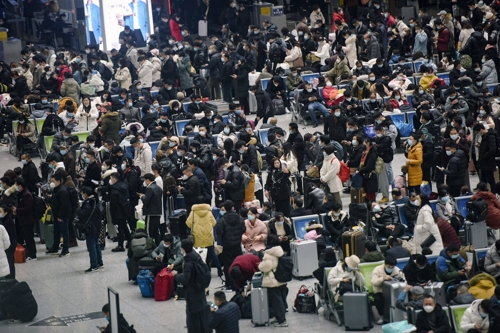
Xinhua News Agency reported on the 1st that the number of railway passengers was only 3.08 million on the 28th, when the Chunjol holiday began, and the number of passengers on the 29th and 30th was only 2.93 million and 2.96 million, respectively. Xinhua stated that this is about one-quarter of the same period last year. Although the official Chunjol holiday period in China this year is seven days from February 11 to 17, Chinese people usually take an additional two weeks off before and after the official holiday period. The number of air passengers decreased even more than railway passengers. On the 28th of last month, the number of passengers using Beijing Capital International Airport was 37,600, a sharp drop of about 87% compared to 273,600 the previous year.
Bloomberg explained, "It is true that the Chinese economy is in an expansion phase, but it suddenly lost momentum this month," adding, "The resurgence of COVID-19 and movement restrictions during Chunjol affect consumption more than manufacturing."
© The Asia Business Daily(www.asiae.co.kr). All rights reserved.

















