"'Church, I'm fed up' sentiment acknowledged with responsibility"…Protestant apology
Protestant-led COVID spread…Citizens say "Protestants are really too much"
379 confirmed cases at multiple unlicensed alternative education facilities run by IM Mission
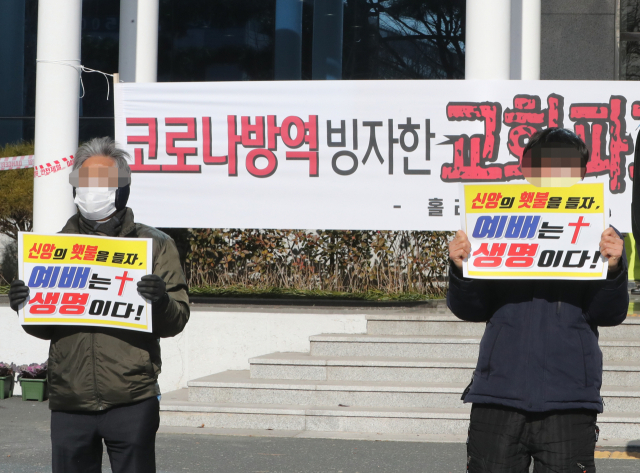 On the morning of the 7th, worshippers at Segyero Church in Gangseo-gu, Busan, which sparked controversy by forcibly holding in-person services, are protesting the quarantine authorities' measure for 'non-face-to-face worship.'
 [Image source=Yonhap News]
[Asia Economy Reporter Han Seung-gon] As the spread of COVID-19 originating from Protestant churches intensifies and public criticism grows, related organizations such as the National Council of Churches in Korea (NCCK) have called for self-reflection within Korean churches and issued an apology. They bowed their heads in apology to the quarantine authorities, citizens, and self-employed people.
However, public sentiment remains cold. Especially as hundreds of confirmed cases have emerged related to numerous unlicensed alternative education facilities operated by a missionary organization, citizens' anger is mounting. Some are venting their frustration, saying that the current COVID-19 outbreak is essentially a crisis caused by Protestantism.
The number of COVID-19 cases originating from Protestant churches continues to rise. As of the previous day (31st), a total of 379 people were confirmed positive at unlicensed educational facilities operated by the IM Mission. This is 11 more than the 368 cases reported by the Central Disease Control Headquarters (CDCH) on the 30th.
As a result, since last year, starting with the Shincheonji Church of Jesus, the Temple of the Tabernacle of the Testimony (Shincheonji), followed by Seoul Sarang Jeil Church led by Pastor Jeon Kwang-hoon, the missionary group InterCP (BTJ World Center), unlicensed educational facilities operated by the IM Mission, and some churches, COVID-19 cluster infections have continued, leading to social criticism of the Protestant community.
On the 29th, joint organizations and civic groups such as the National Council of Churches in Korea (NCCK), the Korea YMCA National Council, and the Korea YWCA Federation held a joint press conference at the Korean Church Centennial Memorial Hall, stating, "We feel a deep sense of responsibility in the face of the public sentiment that says 'just hearing the word church is tiresome,'" and "We confess that all Korean churches are not free from the sins of those who, in the name of 'religious freedom,' ignore the dedication of medical staff and quarantine authorities, disregard public interest, and threaten the safety of local communities, and we apologize to the public."
They bowed their heads, saying, "It is a tragic reality that the Korean church is now perceived as a major force harming public health," and "We cannot even raise our heads before small business owners, citizens, public officials, and medical staff who have been striving to overcome the pandemic situation as soon as possible."
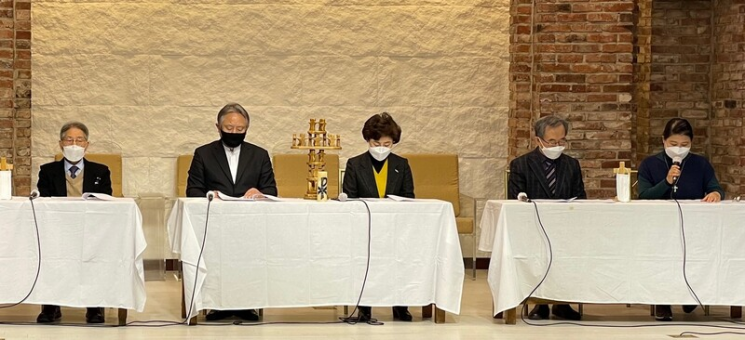 From the left in the photo: Ahn Jae-woong, Chairman of the Korea YMCA National Council; Lee Hong-jung, General Secretary of the NCCK; Won Young-hee, President of the Korea YWCA Federation; Shin Dae-gyun, Director of the Korea YMCA National Council; and Lee Eun-young, Vice President of the Korea YWCA Federation, are holding an apology press conference. Photo by the National Council of Churches in Korea
However, despite such apologies from the Protestant community, public reactions remain cold. This appears to be due to anger over numerous violations of quarantine rules by many Protestant groups, including Shincheonji.
Kim, a man in his 40s who said he confirmed the apology from Protestant-related organizations through the news, expressed frustration, saying, "(Because of Protestantism) hasn't COVID-19 already spread? How many times is this apology? Is it over just by apologizing? It's really too much of a nuisance."
Another office worker in his 30s, Park, raised his voice regarding specific compensation for damages. Park said, "The government should claim various damages at the national level," and pointed out, "This is not the first or second time; at this point, it seems they only think about themselves."
The number of confirmed cases originating from Protestant churches continues to increase. As of the previous day (31st), additional patients related to the IM Mission were reported among existing COVID-19 cluster infections. Among 40 unlicensed alternative education facilities of the IM Mission across 11 cities and provinces nationwide, six facilities in five cities and provinces reported 11 more confirmed cases than the previous day, totaling 379 confirmed cases.
According to quarantine authorities, regarding the church 2 and IM Mission unlicensed alternative education facilities in Buk-gu, Gwangju, one additional COVID-19 case related to Buk-gu Ace TCS (Two Commandment School, a dormitory-type American elementary and middle school entrance program) was confirmed. Additionally, four others related to Gwangsan-gu Gwangju TCS and one additional transmission related to a camp were confirmed, totaling six new cases, bringing the cumulative confirmed cases to 190.
Regarding the Jesus Replica Camp held in Gwangju, the cases include three from Ulsan Handayeon Research Institute, seven from Bethlehem TCS in Yangsan, Gyeongnam, three related to visitors to Seoul, and five related to visitors to Gyeonggi.
At the unlicensed alternative education facility TCS in Anseong, Gyeonggi, five more cases were confirmed, bringing the cumulative total to 13. Including 176 cases related to the IM Mission headquarters in Daejeon (136 at IEM unlicensed alternative education facilities and 40 at MTS), the cumulative confirmed cases total 379.
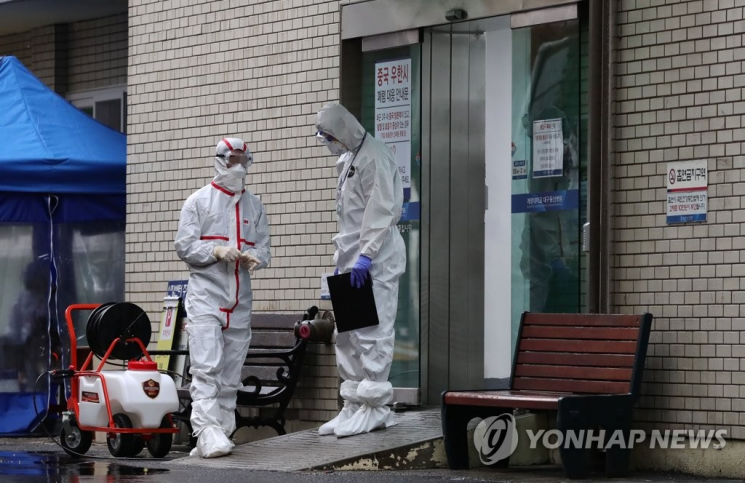
Meanwhile, trust in Korean Protestant churches amid the COVID-19 crisis has significantly declined, according to surveys.
According to the "General Public Evaluation of Government COVID-19 Quarantine Measures" survey released on the 29th by the Protestant polling agency Pastoral Data Research Institute, 76% of respondents said they "do not trust or hardly trust" Korean churches. Only 21% responded that they "trust very much or somewhat." This survey was conducted online from the 12th to the 15th among 1,000 general citizens.
Compared to the "Social Trust in Korean Churches" survey conducted by the Christian Ethics Movement, a church organization, in January last year before the full-scale spread of COVID-19, where 32% responded that they "trust very much or somewhat," trust in Korean churches has dropped by 11% in just one year.
When responses indicating "trust" were divided between Protestants and non-Protestants, 70% of Protestants said they trusted, while only 9% of non-Protestants did, showing a stark contrast. In the same survey, 86% of respondents said that the state can restrict religious freedom for the public good.
This is a significant increase compared to the 59% who said restrictions were possible in the "Post-COVID-19 Church Ecosystem Landscape Change Survey" conducted by the Presbyterian Church of Korea (Hapdong) in August last year.
The research institute emphasized, "In a situation where trust in the church is at rock bottom, there seems to be no special way to change social perceptions related to the church," adding, "There appears to be no other way than to sincerely and continuously practice the church's original functions and social roles, starting with small actions, over the long term."
© The Asia Business Daily(www.asiae.co.kr). All rights reserved.



















