[Asia Economy Reporter Ji Yeon-jin] The recent wild fluctuations in domestic and international stock markets are analyzed to be due to concerns about irrational overheating in the stock market caused by the short-selling issue of the US 'GameStop.'
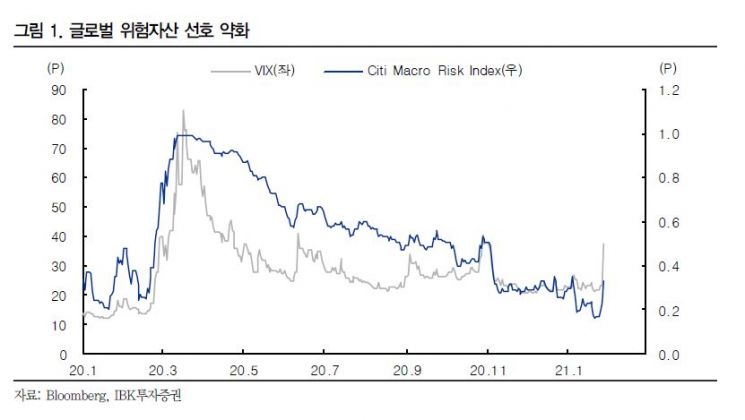
According to the securities industry on the 31st, the VIX, which represents the expected volatility reflected in the option prices of the US S&P 500 index, surged to the level of late November last year.
In Korea, the KOSPI also repeatedly surged and plunged by over 2% last week, breaking below the 3000 mark.
So-eun Ahn, a strategist at IBK Investment & Securities, said, "Although several negative factors were highlighted, the impact related to the US game distributor 'GameStop' stock price was significant," adding, "Individual investors aggressively bought stocks that US hedge funds had taken short positions on, driving up prices, and the resulting losses for hedge funds raised concerns about forced sales of other stocks."
As a result, the risk asset preference sentiment that dominated the stock market at the beginning of the year is inevitably weakening, and the market can be easily shaken by even small factors that weaken expectations for economic recovery or stimulus measures.
However, since the driving forces behind this year's stock market rally are low interest rates and expectations for economic recovery this year, the possibility of a stock market crash like past bubble bursts is considered low. Strategist Ahn noted, "The accommodative stance of the US Federal Reserve was reaffirmed through the January Federal Open Market Committee (FOMC) meeting," and "additional stimulus measures are being pursued mainly in the US, and despite various controversies, global COVID-19 vaccinations are continuing."
The industry advises paying attention to domestic and international economic indicators to be announced early next month. Since the start of vaccinations in advanced countries at the end of last year, some indicators such as consumption and investment have improved, but the spread of variant viruses and COVID-19 vaccine supply disruptions are expected to weaken this trend. With lockdown measures in parts of Europe and Asia being strengthened and extended, mobility indices have contracted, and since economic indicators have fluctuated depending on the intensity of social distancing and lockdown measures after the COVID-19 crisis, this could also pose a burden on the stock market.
© The Asia Business Daily(www.asiae.co.kr). All rights reserved.
![Clutching a Stolen Dior Bag, Saying "I Hate Being Poor but Real"... The Grotesque Con of a "Human Knockoff" [Slate]](https://cwcontent.asiae.co.kr/asiaresize/183/2026021902243444107_1771435474.jpg)
















