[Asia Economy Reporter Byunghee Park] After China became communist in 1949, many Chinese people migrated to Hong Kong over several decades. Wong Kar-wai's film In the Mood for Love, released in 2000, is set in a 1962 Hong Kong apartment where people who migrated from Shanghai live together. Wong Kar-wai himself was born in Shanghai in 1958 but moved to Hong Kong in 1962 and grew up there.
After the 1989 Tiananmen Square incident, many Chinese people migrated to Hong Kong on a large scale because hopes for democratization in China faded. Over several years following the Tiananmen incident, more than one million Chinese moved to Hong Kong. The incident also heightened Hong Kong residents' concerns about the return of Hong Kong to China. Films such as A Better Tomorrow (1990), Chungking Express (1995), and Comrades: Almost a Love Story (1997) were released in abundance.
In December 1984, the United Kingdom and China signed the Hong Kong handover agreement, which came into effect in 1985. After signing the agreement, the UK began issuing British National Overseas (BNO) passports to Hong Kong residents starting in 1987. Hong Kong people were disappointed because the allowed stay period in the UK was only six months. They could neither work nor settle there.
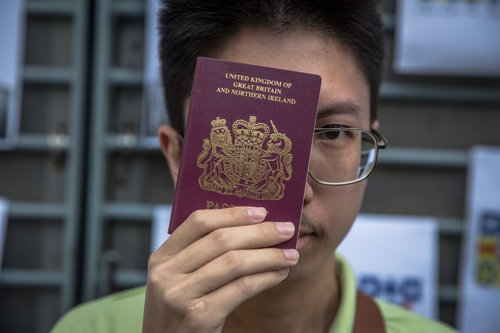 A supporter of the Hong Kong pro-democracy protests is holding up a British National (Overseas) (BNO) passport. [Image source= EPA Yonhap News]
After China regained Hong Kong in July 1997, it tried to appease Hong Kong residents by emphasizing the "One Country, Two Systems" principle declared at the time of the handover agreement. However, in 2003, China’s attempt to enact the Hong Kong National Security Law sparked protests from Hong Kong residents, and conflicts with Hong Kong citizens continued with the 2014 Umbrella Movement and the 2019 Fugitive Offenders Ordinance (Extradition Law). After failing to enact the National Security Law through the Hong Kong government in 2003, China passed the Hong Kong version of the National Security Law (Security Law) last May through the National People's Congress (NPC), China's legislative body. This established a basis for the Chinese government to directly intervene in Hong Kong's internal affairs and to monitor and punish anti-China forces within Hong Kong. With the implementation of the Hong Kong Security Law, the "One Country, Two Systems" framework effectively collapsed, and evaluations emerged that Hong Kong's democratization had ended.
The UK has opposed the Hong Kong Security Law. When the NPC passed the law, the UK amended its immigration law in July last year, declaring it would grant full British citizenship status to Hong Kong residents holding BNO passports. It promised that they could live, work, and study in the UK for five years. Furthermore, after five years of residence, they would be eligible to apply for citizenship and could obtain it after one more year, allowing permanent residence in the UK. This opened an opportunity for Chinese who had fled to Hong Kong to escape again to the UK. The BNO is expected to become a catalyst for the "HK-exit" (Hong Kong + Exit) movement.
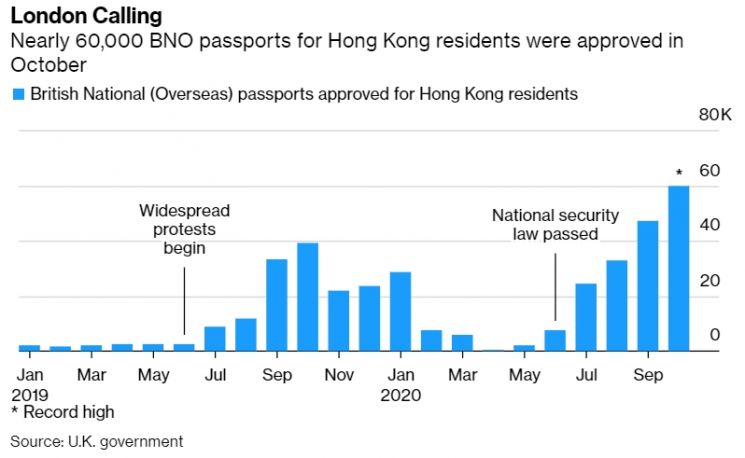
After the UK amended the BNO-related law, the number of Hong Kong residents applying for BNO passports surged. According to Bloomberg News, 60,000 people newly applied for BNO passports in October last year alone, marking a record high.
The UK Housing Authority estimates that out of Hong Kong's population of 7.5 million, up to 5.4 million people may qualify to migrate to the UK. It estimates that 2.9 million hold BNO passports, and their children and families number about 2.5 million.
Hong Kong residents can apply online for either a 30-month or 5-year BNO. The application fee for the 5-year BNO is ?350 (about 540,000 KRW) per person. Applicants must also pay a separate immigration health surcharge to use UK medical services. For the 5-year BNO, adults pay ?3,120 each, and those under 18 pay ?2,350 each. For a family of four including two children, the total BNO application cost amounts to about ?12,000 (approximately 18.36 million KRW). Additionally, applicants must prove they can secure housing in the UK for at least six months through bank accounts, employment, or rental income.
The UK and China are disputing, each accusing the other of violating the Hong Kong handover agreement. China claims the UK is breaking its promise not to grant Hong Kong residents UK residency rights after the handover. The UK counters that China has violated the principle of "One Country, Two Systems" promised at the time of the handover by infringing on Hong Kong's freedom and autonomy.
It is difficult to predict how many Hong Kong residents will migrate to the UK using the BNO. The UK has presented various scenarios ranging from a minimum of 10,000 to over one million migrants over the next five years. The most likely scenario estimates that 322,400 people will move to the UK in the next five years, which is expected to generate an economic effect of about ?2.9 billion for the UK.
The Hongkongers in Britain Association estimates that the number of migrants will exceed 600,000 over three years. A Hong Kong media outlet pointed out on the 6th that 53 pro-democracy figures were arrested for violating the Hong Kong Security Law, predicting that the harsher China's crackdown on democratization becomes, the more people will migrate to the UK.
© The Asia Business Daily(www.asiae.co.kr). All rights reserved.


















