Increasing Environmental Regulations and Growing Interest in Future Cars
GM to Stop Producing Diesel and Gasoline Engines by 2035
Hyundai to Sell Only Electric Vehicles in the US, China, and Others from 2040
[Asia Economy Reporter Changhwan Lee] As the transition to electric vehicles (EVs) accelerates among major global automakers, the farewell to internal combustion engine (ICE) vehicles is also approaching rapidly. With environmental regulations tightening worldwide and consumer interest in future vehicles growing, automakers are proactively responding to the EV transition.
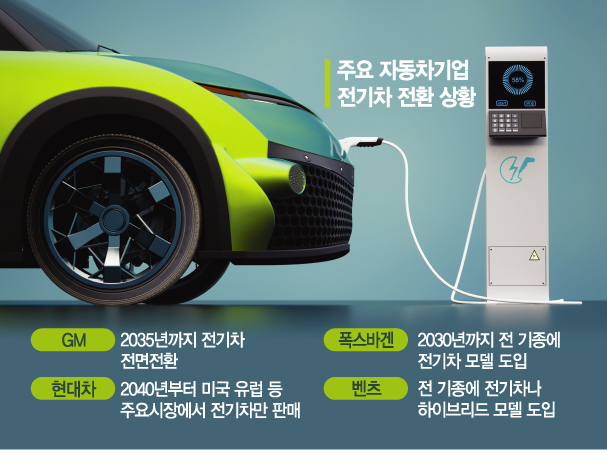
On the 28th (local time), GM, a leading American automaker, announced plans to globally cease production and sales of gasoline and diesel engine vehicles by 2035. GM plans to produce only electric vehicles after 2035, except for commercial heavy trucks using internal combustion engines.
Currently, about 98% of GM's sales and profits come from selling fossil fuel-powered vehicles, but the company plans to generate profits solely from EVs in the future. GM will invest $27 billion (approximately 30.2 trillion KRW) in research and development (R&D) over the next five years, including EV batteries and autonomous driving technologies.
The EV transition is a challenge not only for GM but for all automakers. Hyundai Motor Company is also rapidly advancing its EV transition, comparable to GM. At the 'CEO Investor Day' held online on the 10th of last month, Hyundai announced that from 2040, it will stop selling pure internal combustion engine vehicles in major markets such as the United States, Europe, and China, and will sell only electrified vehicles centered on EVs.
Hyundai Motor Group already ceased developing new diesel engines at the end of last year. It is being evaluated as rapidly restructuring its corporate structure around eco-friendly vehicles. In March, it plans to focus on the EV market by launching the 'Ioniq 5,' the first EV to apply the dedicated EV platform 'E-GMP.'
Germany's Daimler, the parent company of Mercedes-Benz, announced it would release electric or hybrid models for each Mercedes-Benz model by 2022, and Volkswagen plans to introduce EV models for each model by 2030. American automaker Ford plans to invest more than $11.5 billion (approximately 13 trillion KRW) in EVs by 2022.
The share of EVs in the automotive market will reach 30% by 2030
The reason automakers are rushing to transition to EVs is that sales are growing faster than expected. Market research firm SNE Research analyzed that EV demand will continue to grow at an average annual rate of 19%, accounting for 30% of the automotive market by 2030, ten years from now. Market research firms expect that after 2040, more than half of the vehicles sold worldwide will be EVs.
The acceleration of the EV transition is also related to carbon neutrality policies of various countries concerned about environmental pollution. China plans to stop producing conventional internal combustion engine vehicles by 2035, and Japan is expected to phase out gasoline vehicles from the market by the mid-2030s.
In South Korea, the Presidential Advisory Body on Climate and Environment proposed last October to stop selling internal combustion engine vehicles around 2035?2040.
However, it is expected that the full commercialization of EVs will vary by country depending on the spread of charging infrastructure and industrial development speed. Lee Ho, a senior researcher at the Korea Automotive Technology Institute, said, "While EVs are rapidly spreading, the expansion of charging infrastructure is somewhat delayed," adding, "Rapid expansion of charging infrastructure is necessary to prevent bottlenecks in the spread of EVs."
© The Asia Business Daily(www.asiae.co.kr). All rights reserved.
![Clutching a Stolen Dior Bag, Saying "I Hate Being Poor but Real"... The Grotesque Con of a "Human Knockoff" [Slate]](https://cwcontent.asiae.co.kr/asiaresize/183/2026021902243444107_1771435474.jpg)
















