[Kim Seon-ju, Senior Researcher at the Agency for Defense Development] Since the 1990s, rapid advancements in the electronics industry and aerospace technology have made the radar environment more diverse and complex. Continuous improvements in the stealth capabilities of military aircraft targets and the installation of increasingly sophisticated and precise electronic warfare equipment have enhanced the concealment of the aircraft themselves, among other various changes.
▲ The Advent of Phased Array Radar= Along with changes in target environments, the operational environment of radar has also become very complex. The widespread use of communication devices utilizing electromagnetic waves has resulted in constant electromagnetic interference signals. In the case of shipborne radar, the operational environment shifted from open ocean to coastal operations, leading to the appearance of clutter?signals reflected from objects other than radar targets?which had not been previously considered. These environmental changes have hindered the radar’s target detection capabilities. There was a demand for functions capable of quickly detecting and tracking long-range targets such as stealth targets and actively responding to the surrounding environment. To meet these demands, the ‘Phased Array’ radar was developed.
Phased array technology uses phase shifters arranged for each radiator element that forms the electromagnetic wave, allowing the phase of the electrical signal applied to each radiator to be adjusted moment by moment as desired, thereby changing the beam direction of the entire antenna. As shown in the figure below, if the signal from the rightmost radiator is generated first and a constant phase difference is introduced between adjacent array elements with delayed generation, the antenna beam can be steered at a certain angle. Since the phase is changed electronically, this method is distinguished from the conventional mechanical rotation beam steering and is called Electronically Scanned Array (ESA).
Because phased array antennas can electronically and rapidly change the beam steering angle, they enable the implementation of various algorithms that were impossible with previous methods. Among these, the most notable is the Radar Resource Management (RRM) algorithm, which pursues software-based multifunction radar. Radar resource management is an algorithm that optimizes the priority of tasks, radar resources (beam, time, and processing capacity), and radar parameters according to the situation, based on the radar or higher-level system’s decision on the radar mission (What to do) and how to execute it (How to do), using radar and other information (other sensors and operator requirements, etc.).
For example, for targets approaching at high speed or performing abrupt maneuvers, the task priority is set to the highest level, and the tracking cycle is operated quickly to acquire high-quality target information. In other words, radar resources are planned (scheduled) and executed in real time according to the determined mission. Through this repetitive process, the radar effectively performs multiple functions.
▲ Passive vs. Active Phased Array: What’s the Difference? Depending on whether the antenna includes the function of generating or amplifying the final power in the array system, phased arrays are classified into passive phased arrays, which do not include power amplifying elements, and active phased arrays, which have power amplifiers inside the antenna.
Passive phased arrays are systems where a single high-power amplifier, such as a vacuum tube, is separated from the antenna. Most phased array systems developed before the widespread use of semiconductor amplifiers fall into this category. Since power must be distributed from a single high-power transmitter to each radiator and phase shifter, components capable of operating at high power are required. This results in power loss, which ultimately limits the system’s detection and tracking performance and may cause reliability issues due to the high power.
Efforts to replace the single high-power transmitter with ultra-high-frequency semiconductor devices began in the late 1970s when the U.S. Department of Defense invested heavily in research and development of its own active electronically scanned array (AESA) systems. Such semiconductor technology advanced in the 1990s through development efforts and shared results among some European countries, leading many nations recently to develop small, low-power semiconductor transmit/receive modules. These small semiconductor modules integrate high-power amplifiers for transmission, low-noise amplifiers for reception, and phase and amplitude control functions common to both transmission and reception.
▲ Small Semiconductor Transmit/Receive Modules Come Together= AESA systems consist of hundreds or thousands of small semiconductor transmit/receive modules depending on the application. To use an analogy, if a large cart is to be pulled by a single ox, that corresponds to the passive array concept; if thousands of mice share the work, that corresponds to the active array concept. Although the pulling force of a single mouse is minimal, if thousands of mice move in unison, they can accomplish a great task. Therefore, in AESA systems, it is crucial to precisely manage and control multiple small transmit/receive modules to work in perfect coordination. Most military radars developed worldwide today for ground (sea)/shipborne/airborne applications are of the AESA type.
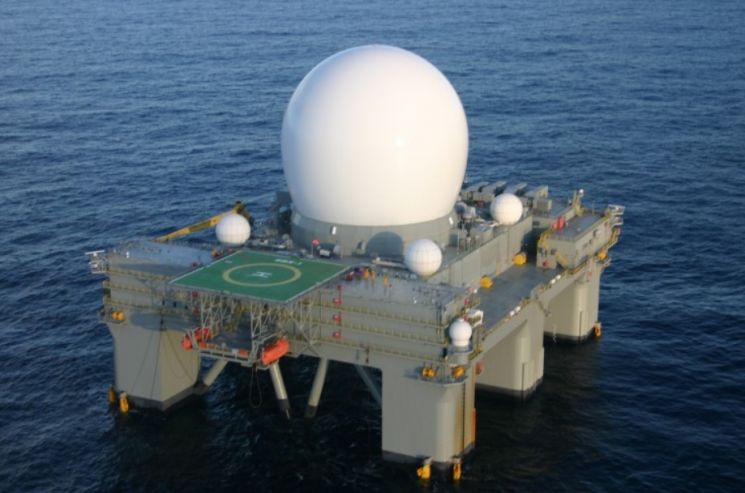
For example, the U.S. sea-based X-band radar (SBX: Sea Based X-band) is a mobile radar base that floats on water and can propel itself, designed to operate under strong winds and high waves. It serves as a core sensor of the U.S. ballistic missile defense system and can be deployed near the Japanese coast in emergencies. It consists of approximately 45,000 X-band transmit/receive modules and has a detection range exceeding 2,000 km.
▲ Advantages of AESA Radar= AESA radar offers various advantages to actively cope with the recently changed target and operational environments. First, due to the semiconductor modularization of AESA, there is almost no electrical loss between the amplifier and the antenna, and the number of semiconductor transmit/receive modules can be increased within the allowable range of mechanical structure and heat dissipation systems. Increasing the antenna area and the number of semiconductor transmit/receive modules can significantly extend the radar’s detection and tracking range. This not only satisfies users’ demands to detect and respond first but also compensates to some extent for the reduction in detection range caused by target stealth.
Second, because the antenna beam direction can be changed rapidly, multiple functions or operational modes designed for the surrounding environment can be performed almost simultaneously, enabling multifunction or multi-mode operation. Additionally, independent beam operation policies can be applied to multiple targets with search beams, ensuring fast response times and accurate target information.
Finally, even if 5?10% of the configured semiconductor transmit/receive modules fail, the system’s performance degradation is minimal and does not cause critical damage such as total system shutdown. Moreover, antennas composed of semiconductors have more than five times the reliability of conventional system antennas.
© The Asia Business Daily(www.asiae.co.kr). All rights reserved.
![Clutching a Stolen Dior Bag, Saying "I Hate Being Poor but Real"... The Grotesque Con of a "Human Knockoff" [Slate]](https://cwcontent.asiae.co.kr/asiaresize/183/2026021902243444107_1771435474.jpg)
















