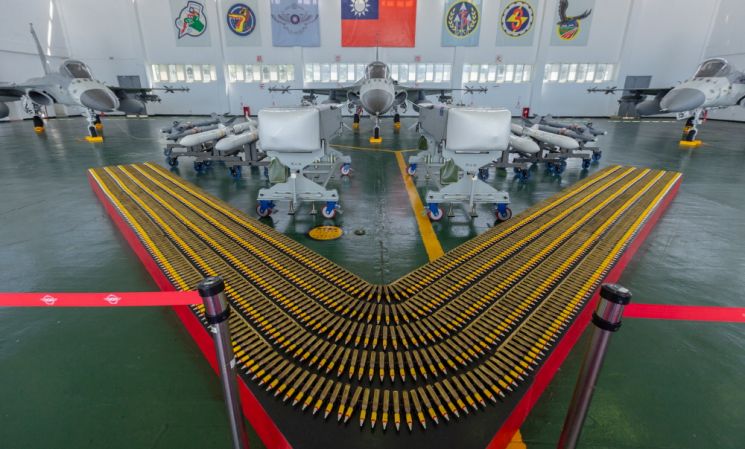
[Military Analyst Kim Daeyoung] On January 26 (local time), ahead of the Lunar New Year, the largest traditional festival in the Chinese-speaking world, the Taiwanese military revealed the IDF Jingguohao (IDF 經國號) fighter jet unit operating at Tainan Air Force Base to reporters from the Ministry of National Defense. This annual event held before the Lunar New Year serves as an opportunity to showcase the enhanced defense capabilities of the Taiwanese military.
The IDF Jingguohao fighter jets unveiled that day were equipped with the Wanjiantan (萬劍彈), a missile developed by Taiwan. Prior to this, on the 23rd and 24th, over 20 Chinese military aircraft had intruded into Taiwan’s Air Defense Identification Zone, escalating tensions between China and Taiwan. The Wanjiantan, which can carry up to two missiles on the IDF Jingguohao, was designed to strike Chinese military airbases located across the Taiwan Strait in times of emergency. The Wanjiantan, containing cluster munitions or submunitions to destroy runways and hangars, is named “Ten Thousand Swords.”
Boasting a maximum range of over 200 km, the Wanjiantan was developed by Taiwan’s National Chung-Shan Institute of Science and Technology, the country’s defense science research institute. According to Taiwanese media reports, production of the Wanjiantan took place from 2015 through last year, with a budget estimated at approximately 270 billion Korean won. However, the exact production quantity has not been disclosed. Until now, the domestically produced IDF Jingguohao fighter jets had only operated indigenous air-to-air missiles and lacked air-to-ground missiles for ground attacks. Under the Xiangzhan (翔展) program, from 2010 to 2017, the Aerospace Industrial Development Corporation (AIDC), also known as Hanxiang Aerospace Industry Co., Ltd., carried out performance upgrades on the IDF Jingguohao.
Through these upgrades, various avionics including radar were enhanced, and software necessary for weapon operation was strengthened. Along with this, approximately 120 upgraded IDF Jingguohao fighters gained the capability to operate the Wanjiantan. Prior to the development of the Wanjiantan, Taiwan had persistently requested the United States to sell the air-to-ground guided weapon JSOW (Joint Standoff Weapon), which is compatible with Taiwanese Air Force F-16 fighters. The JSOW, a glide-type air-to-ground weapon with a maximum range of 130 km, is guided by GPS and inertial navigation systems and carries either submunitions or a single high-explosive bomb depending on the variant.
However, due to its offensive nature, the United States had withheld the sale of the JSOW to Taiwan. As a result, the Taiwanese military independently developed the Wanjiantan, a domestic weapon comparable to the JSOW. Equipped with a turbofan engine, the Wanjiantan reportedly applies a special guidance method in addition to GPS and inertial navigation, significantly improving its accuracy. Furthermore, in an emergency, if the IDF Jingguohao launches the Wanjiantan from the median line of the Taiwan Strait, it can strike not only Chinese military airbases located in Fujian and Guangdong provinces but also major cities, making it a highly threatening weapon to China.
© The Asia Business Daily(www.asiae.co.kr). All rights reserved.
![Clutching a Stolen Dior Bag, Saying "I Hate Being Poor but Real"... The Grotesque Con of a "Human Knockoff" [Slate]](https://cwcontent.asiae.co.kr/asiaresize/183/2026021902243444107_1771435474.jpg)
















