Last Year's Sales Decreased by 12.1%
Impact of Demand Contraction Due to COVID-19 Pandemic
Shift to Profitability Focus Through Business Structure Optimization and High-Value Material Development
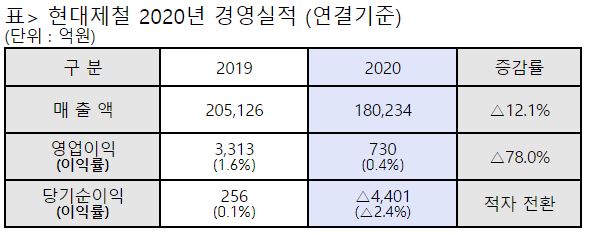
[Asia Economy Reporter Hwang Yoon-joo] Hyundai Steel announced on the 28th that its consolidated operating profit last year was 73 billion KRW, a 78% decrease compared to the same period the previous year. During the same period, sales dropped by 12.1% to 18.0234 trillion KRW, and the company turned to a net loss. Additionally, the operating profit margin fell by 1.2 percentage points to 0.4%.
Hyundai Steel explained that the decline in performance was due to the impact of the novel coronavirus disease (COVID-19) pandemic, which caused a contraction not only in the global economy but also in domestic demand industries overall, and that the total production volume decreased as a result of business structure optimization.
The global spread of COVID-19 led to shutdowns of major overseas subsidiaries in the first half of the year, which was also cited as a factor in profitability deterioration. However, it stated that production and sales activities have resumed in line with the recent global economic recovery, leading to improvements in sales and profitability.
Hyundai Steel declared that it will focus its capabilities on business structure optimization and the development and market penetration of high value-added products to transform into a "profitability-centered steel company." Last year, Hyundai Steel withdrew from less competitive sectors such as thin plate hot rolling facilities and color steel sheet facilities to pursue business structure efficiency. Additionally, it separated the forging business segment and launched Hyundai IFC, a forging-specialized subsidiary, which continues to maintain profitable management.
This year, the company plans to secure its core manufacturing competitiveness in steel. It aims to improve productivity in the hot rolling sector and modernize cold rolling facilities to further enhance the productivity and quality of automotive steel sheets. Furthermore, by establishing a mass production system for the '9% Ni thick plate' developed last year, Hyundai Steel plans to actively target the LNG propulsion ship and LNG storage facility markets, where demand is expanding in line with eco-friendly trends.
With global steel demand showing signs of recovery, marketing activities will also be strengthened. The company intends to actively reflect raw material price increases in product prices and improve profitability through expanded sales of high value-added products.
To this end, Hyundai Steel plans to respond swiftly to changes in demand markets such as the automotive industry and expand proactive sales focused on high value-added products. Since 2019, Hyundai Steel has continuously prepared materials needed for the electric vehicle era, showcasing the automotive material specialized brand 'H-SOLUTION' and the electric vehicle concept car ‘H-SOLUTION EV’ at the Shanghai Motor Show.
In addition, to strengthen competitiveness in the global automotive steel sheet market, Hyundai Steel is accelerating the development of new steel grades. Following the development of 48 steel grades in 2020, the company plans to develop 45 new grades this year, aiming to complete a total of 311 automotive steel grades cumulatively.
In the long steel segment, Hyundai Steel plans to actively respond to premium product demand in the construction steel market, supported by the recent modernization of the large rolling line at the Incheon plant. This modernization has increased production capacity by approximately 140,000 tons and enabled the production of high value-added new products such as ultra-thick and high-strength H-beams, which is expected to strengthen order competitiveness.
The company will also actively promote ESG activities to fulfill its social responsibilities. It plans to continue investing in coke dry quenching (CDQ) facilities to reduce carbon emissions and expand environmental investments using funds raised through green bond issuance. Once the CDQ facility, scheduled for completion in 2024, is operational, it is expected to reduce carbon emissions by up to 500,000 tons annually.
© The Asia Business Daily(www.asiae.co.kr). All rights reserved.
![Clutching a Stolen Dior Bag, Saying "I Hate Being Poor but Real"... The Grotesque Con of a "Human Knockoff" [Slate]](https://cwcontent.asiae.co.kr/asiaresize/183/2026021902243444107_1771435474.jpg)

















