A Comprehensive Survey of New Recruitment Status in 36 Public Enterprises
2000 Employees Reduced in 32 Public Enterprises
Main Causes: Decline in Retirees and Profit Deterioration
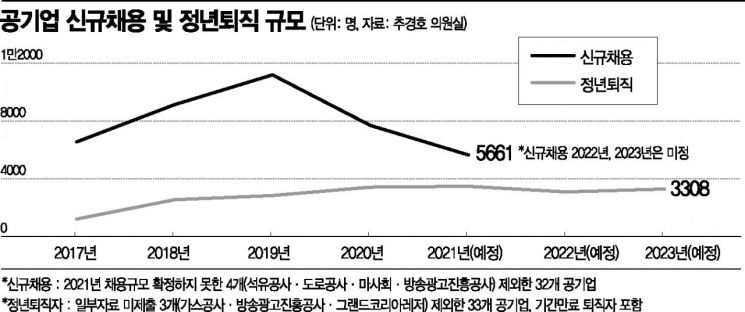
[Sejong=Asia Economy Reporter Joo Sang-don] This year, the scale of new hires in public enterprises is set to decrease by more than 2,000 compared to last year. Despite the government's pressure to "increase the scale of new hires," public enterprises are inevitably narrowing their recruitment due to a decline in retirees and worsening profits.
On the 28th, the office of Rep. Choo Kyung-ho of the People Power Party compiled the new hiring plans (including permanent positions with indefinite contracts) of 36 public enterprises (market-type and quasi-market-type) for this year. Among them, 32 companies plan to hire 5,661 employees this year. Four companies?Korea National Oil Corporation, Korea Expressway Corporation, Korea Racing Authority, and Korea Broadcast Advertising Corporation?have yet to finalize their hiring scales. Considering that the 32 public enterprises that disclosed their hiring scale recruited 7,704 people last year (including part-time workers), the reduction amounts to 2,043 employees.
Previously, the government announced that the total new hires in public institutions would increase by 1,000 from 25,000 last year to 26,000 this year. Given that public enterprises are reducing hires by over 2,000, quasi-governmental institutions and other public institutions, which are less preferred by job seekers compared to public enterprises, will have to shoulder the burden of hiring more than 3,000 employees.
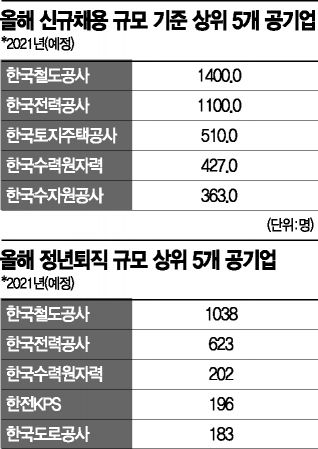
The public enterprise with the largest decrease in new hires this year is Korea Railroad Corporation (KORAIL). KORAIL plans to hire only 1,400 new employees, 563 fewer (-28.7%) than last year's 1,963. However, this hiring scale does not consider manpower demand from new projects, so the actual hiring number may increase. Korea Gas Technology Corporation will reduce new hires by 488.5, from 507.5 last year to 19 this year. The reduction rate of 96.3% is the highest among public enterprises.
The biggest reason for the decrease in new hires is profit decline. According to 'Alio,' the public institution management information disclosure system, the net profit of all public enterprises shrank from 9 trillion won in 2016 to 1.4 trillion won in 2019. Although Korea Electric Power Corporation (KEPCO) showed improved performance last year due to low oil prices, the situation this year is unpredictable. If oil prices rise, the performance of large public enterprises like KEPCO is likely to deteriorate again. KEPCO plans to reduce its hiring scale by 450, from 1,550 last year to 1,100 this year. Korea South-East Power will cut hires by more than half, from 157 last year to 70 this year.
The problem is that even if performance improves in the future, it will be difficult to continuously increase hiring. The scale of new hires in public enterprises is related not only to business but also to the number of retirees. A public enterprise official said, "New hires are basically determined by considering the expected number of retirees, so if the number of retirees decreases in the future, the scale of new hires will inevitably decrease as well," adding, "This year's new hiring scale reflects this as much as possible."
The number of mandatory retirement retirees in public enterprises is expected to peak this year and then decline. According to data submitted by 33 public enterprises, 3,434 employees retired last year, and this year the number will increase by 62 compared to last year. Next year, the number of mandatory retirees is expected to decrease to the 3,100 range.
Meanwhile, as public enterprises have increased their workforce by converting non-regular workers to regular employees, labor costs have risen. The total workforce reached 139,163 last year, approaching 140,000. Accordingly, labor costs in public enterprises increased from 10.6089 trillion won in 2018 to 11.9927 trillion won last year.
Rep. Choo Kyung-ho stated, "The current government has used public institutions as a means for 'job creation at all costs,' implemented unreasonable zero non-regular worker policies, and pursued a nuclear phase-out policy, which weakened the structure of public enterprises and only increased their size," adding, "It is now necessary to improve the efficiency of public enterprise management and focus on their core roles."
© The Asia Business Daily(www.asiae.co.kr). All rights reserved.
![Clutching a Stolen Dior Bag, Saying "I Hate Being Poor but Real"... The Grotesque Con of a "Human Knockoff" [Slate]](https://cwcontent.asiae.co.kr/asiaresize/183/2026021902243444107_1771435474.jpg)

















