Woori Bank to Uniformly Adjust Overdraft Limit to 50 Million KRW from 29th
K Bank to Raise Credit Loan Rates from 28th... Other Banks Also Considering Loan Reduction
Financial Authorities Hold Emergency Meeting with Deputy Heads of Major Banks on 26th: "Reduce Loan Targets"
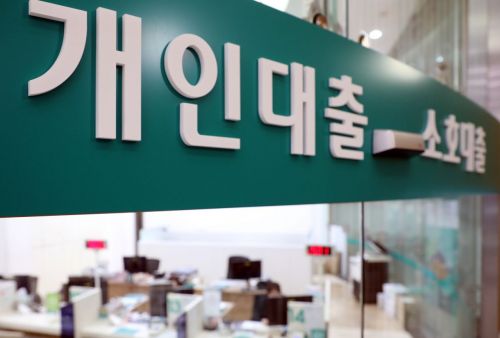
[Asia Economy reporters Kiho Sung and Wondara] In response to financial authorities' pressure to reduce unsecured loans, banks have been suspending new loans or cutting limits one after another. As the stock market surged at the beginning of the year and news of additional loan regulations within the first quarter stimulated preemptive demand, unsecured loans sharply increased this month, prompting authorities to tighten controls again, leading banks to implement reduction measures.
On the 28th, according to financial authorities and the financial sector, Woori Bank will lower the maximum limit of currently operating overdraft accounts to 50 million KRW. The change will take effect from the 29th of this month. The affected products include 10 major products such as 'Woori Main Transaction Employee Loan (previously 100 million KRW)', 'Woori Special Loan (previously 100 million KRW)', and 'Woori First Salary Unsecured Loan (previously 80 million KRW)'. Notably, the Woori Special Loan targets doctors, lawyers, and professionals. The reduced maximum limit applies only to new applications and limit increases.
Woori Bank, which had suspended sales of the non-face-to-face unsecured loan product 'Woori WON Workplace Loan' last year, resumed sales on the 7th of this month. However, from the 29th, the loan limit will be reduced from 200 million KRW in November last year to 50 million KRW.
Internet-only banks are also moving to reduce loans one after another. K Bank raised interest rates on unsecured loans and overdraft loans for employees by 0.2 percentage points and 0.1 percentage points respectively (based on the lowest interest rate) starting today. The maximum unsecured loan limit remains unchanged. Currently, K Bank's maximum unsecured loan limit is 250 million KRW, and the maximum overdraft loan limit is 150 million KRW. Since K Bank had suspended new loan issuance for all loan products for over a year until July last year, it appears to be managing unsecured loans primarily through interest rate hikes before reducing limits.
Earlier, KakaoBank also lowered the unsecured loan limit for high-credit employees from 150 million KRW to 100 million KRW starting the 22nd.
KakaoBank explained that this measure aims to increase mid-interest and mid-to-low credit loans, which are their key goals for this year.
Financial Authorities Demand Further Reduction of Loan Targets as January Loans Surge
Commercial and Internet Banks Introduce or Consider Loan Regulations One After Another
On the same day, Suhyup Bank also suspended new overdraft loan issuance for 'Sh The Dream Unsecured Loan' due to limit exhaustion. The resumption date has not been set. However, new loan applications for lump-sum or installment repayment methods excluding overdraft loans are still possible.
Shinhan Bank, Hana Bank, and NH Nonghyup Bank are also reviewing detailed adjustment plans to reduce unsecured loan targets.
This follows repeated pressure from authorities to cut loans. Previously, on the 26th, the Financial Supervisory Service (FSS) summoned vice presidents in charge of household loans from 17 banks for an emergency inspection meeting on household loans. This was the second meeting held this month since the 11th, conducted via video conference, where they strongly ordered banks to reduce loan targets.
An FSS official said, "At the meeting on the 11th, we had just received annual loan target data from each bank, so it was a request to manage well, but at this meeting, after reviewing those numbers, we asked banks with high targets to reduce them." The official added, "We will negotiate with banks that have excessive target growth rates," but "no specific dates for negotiations have been set."
Previously, the FSS held meetings with credit officers in September and November last year, as well as on the 11th of this year. Given the sharp increase in household loans last year and the expectation of increased loan demand due to 19 scheduled IPOs in January and February this year, it is interpreted as a sign that authorities intend to actively manage household loans.
© The Asia Business Daily(www.asiae.co.kr). All rights reserved.
![Clutching a Stolen Dior Bag, Saying "I Hate Being Poor but Real"... The Grotesque Con of a "Human Knockoff" [Slate]](https://cwcontent.asiae.co.kr/asiaresize/183/2026021902243444107_1771435474.jpg)











