Vaccine Distribution Delays and Worsening COVID-19 Situation...Concerns Over Weakening Recovery
Dollar Weakness Due to US Stimulus Spurs Euro Surge, Adding Pressure
Lagarde Strengthens Verbal Intervention, "Closely Monitoring Euro Exchange Rate Trends"
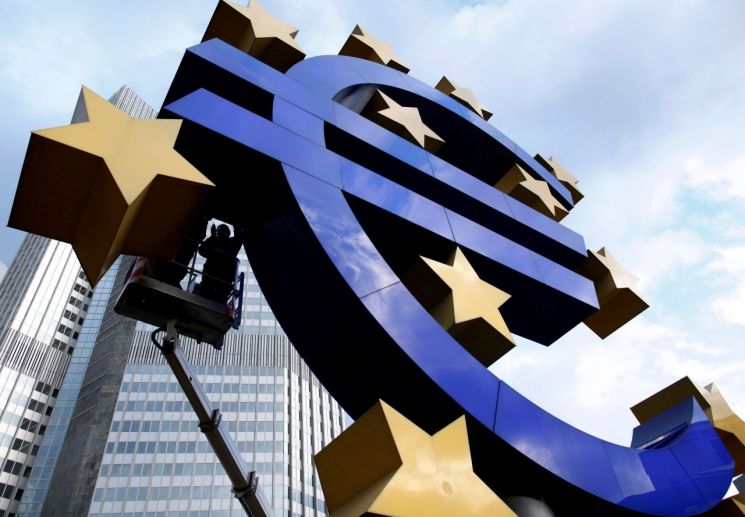
[Asia Economy Reporter Hyunwoo Lee] The European Central Bank (ECB) announced that it could deploy additional policy measures such as further interest rate cuts if necessary, due to the worsening COVID-19 situation and delays in vaccine distribution, which have led to a deteriorating outlook for Europe's economic recovery. This caused European stock markets to plunge across the board. Along with concerns over the economic recovery, the euro showed signs of a sharp rise relative to the dollar, which weakened due to recent stimulus measures by the U.S. Biden administration, interpreted as a move to actively intervene in exchange rate defense.
On the 27th (local time), major European stock markets closed with simultaneous sharp declines. The UK FTSE 100 index fell 1.30% from the previous closing price to 6,567.37, Germany's DAX 30 index dropped 1.81% to 13,620.46, and France's CAC 40 index also closed down 1.16% at 5,459.62. The pan-European Euro Stoxx 50 index ended trading down 1.57% at 3,536.38.
The worsening COVID-19 situation, the ECB's indication of possible interest rate cuts, and the German government's downward revision of this year's economic growth forecast combined to trigger the stock market plunge. On the same day, AstraZeneca announced that its vaccine production plans in Europe were delayed by more than two months, resulting in only 40% of the initially contracted initial supply being delivered. Additionally, the UK government extended lockdown measures until March, raising concerns about vaccine distribution delays and the worsening COVID-19 situation, which stirred investor fear. The German government also lowered its GDP growth forecast for this year from 4.4% to 3% due to the worsening COVID-19 situation, significantly dampening expectations for economic recovery.
The ECB's hint at possible interest rate cuts negatively impacted the stock market along with a decline in the euro exchange rate. On the same day, Klaas Knot, ECB Executive Board member and President of the Dutch Central Bank, said in an interview with Bloomberg News, "If necessary, interest rates could be lowered further below 0%," adding, "While Europe's economic recovery prospects are cautiously optimistic, relatively low production limits inflation, so interest rates may remain at lower levels in the near future," suggesting the possibility of rate cuts.
ECB President Christine Lagarde also stated, "We are closely monitoring euro exchange rate trends," which led to expectations of additional policies such as interest rate cuts soon, further worsening the economic outlook. The ECB is interpreted to have strengthened verbal intervention, wary of the euro's sharp rise relative to the dollar amid the COVID-19 crisis and recent U.S. Biden administration stimulus measures. Concerns about potential exchange rate conflicts between the U.S. and the EU are also rising.
Meanwhile, at the U.S. Federal Reserve (Fed), the Federal Open Market Committee (FOMC) dismissed the possibility of early tapering that had been circulating in the market, but anxiety increased. According to CNBC, Fed Chair Jerome Powell, at a press conference following the FOMC meeting, said, "We have not yet won the fight against COVID-19, and it will be difficult until herd immunity is achieved," emphasizing, "The benchmark interest rate remains at 0 to 0.25%, and bond purchases will continue at about $120 billion per month," ruling out early tapering.
However, Powell also acknowledged inflation risks that Wall Street had been concerned about, stating that the inflation target would soon be exceeded. He said, "Stimulus measures related to COVID-19 are temporarily driving asset prices up sharply," and "The 2% inflation target is expected to be exceeded in the short term."
© The Asia Business Daily(www.asiae.co.kr). All rights reserved.
![Clutching a Stolen Dior Bag, Saying "I Hate Being Poor but Real"... The Grotesque Con of a "Human Knockoff" [Slate]](https://cwcontent.asiae.co.kr/asiaresize/183/2026021902243444107_1771435474.jpg)
















