Ministry of Employment Announces December Business Labor Force Survey
Manufacturing Jobs Decrease by 74,000
Regular Positions Decline While Public Part-Time Jobs Increase
Wages Remain Similar, Working Hours Slightly Down
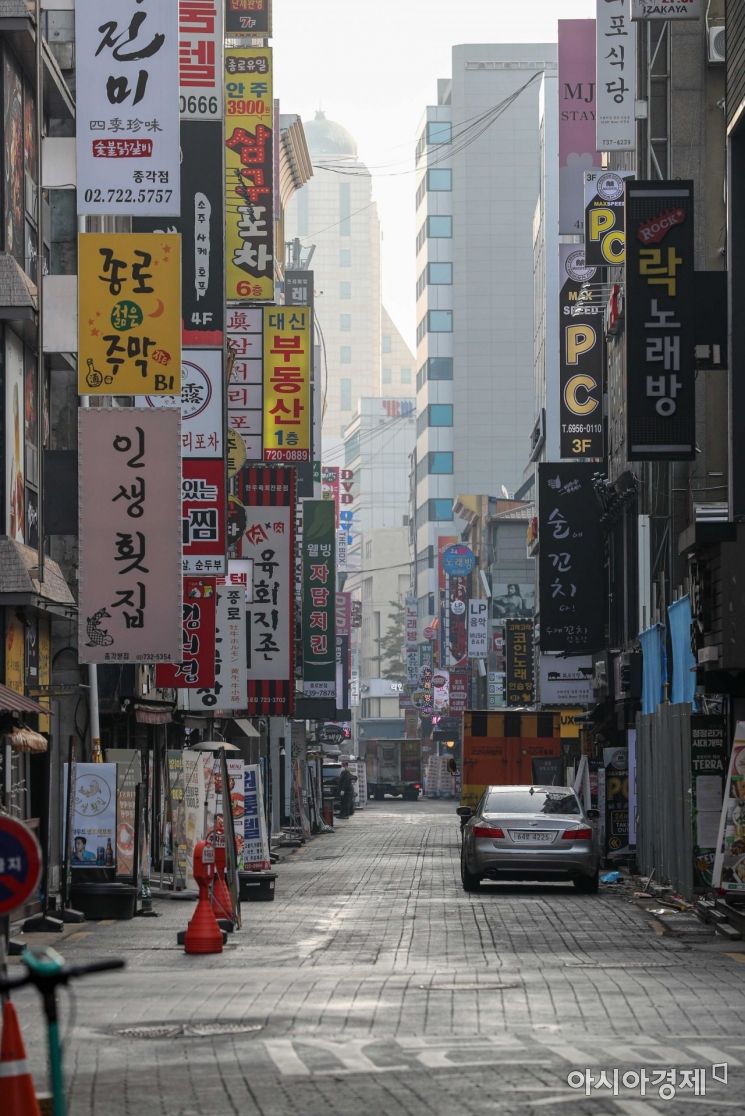 On December 28 last year, as the number of confirmed cases of the novel coronavirus infection (COVID-19) increased and stringent social distancing measures continued, the difficulties faced by self-employed people deepened, and the restaurant street in Jongno 2-ga, Seoul, appeared quiet. Photo by Jinhyung Kang aymsdream@
[Asia Economy Reporter Moon Chaeseok] Due to the resurgence of the novel coronavirus infection (COVID-19) and the economic downturn, jobs in manufacturing and food & accommodation sectors have sharply declined. In December last year, the decrease in the number of employed persons was the largest in 21 years since the 1998 foreign exchange crisis, with these industries being the most severely affected.
According to the Ministry of Employment and Labor's "December Business Survey" released on the 28th, the number of workers in manufacturing was 3,662,000, down 2% (74,000) compared to December 2019. The number of manufacturing workers turned negative in February and has been declining for 10 consecutive months. Since June, it has remained in the 70,000 range for seven consecutive months.
The accommodation and food service industry recorded the largest-ever decrease, dropping 17.5% (226,000) compared to the previous year. The business facility management, business support, and rental services industry, which includes travel and tourism, decreased by 5.8% (67,000) compared to the same month last year.
Although the government designated these industries as special employment support sectors and provided support such as employment retention subsidies, it failed to prevent job losses. With the extension of social distancing measures, concerns are rising that an unemployment crisis may begin in the accommodation and tourism sectors, which are virtually in a state of business suspension.
The number of workers employed at businesses with one or more employees was 18,469,000, down 0.6% (118,000) from the previous year. Since the number of business workers turned negative for the first time in March, it has been declining for 10 consecutive months.
The issue of "employment structure" also appears serious. The number of regular workers, who have employment contracts of one year or longer or work as permanent employees, continues to decline.
The number of regular workers was 15,535,000, down 0.7% (102,000) compared to the previous year. This is attributed to companies reducing hiring due to the COVID-19 situation, increased suspensions and leaves of absence, and rising unemployment.
Other workers, including freelancers and special-type workers (teukgo) who receive sales commissions based on performance without fixed salaries, decreased by 5% (58,000) to 1,102,000.
Temporary and daily workers decreased by 0.5% (8,000) to 1,784,000. The government's resumption of public administration job projects is the cause of the increase in temporary and daily workers. Public jobs are funded by taxpayers' money and are mostly short-term jobs lasting 2 to 3 months, often concentrated among middle-aged and older adults.
The government announced yesterday that it will provide 858,000 public jobs in the first quarter. Of this year's public job target of 1,042,000, it plans to provide 830,000 direct jobs (80%) and 28,000 social service jobs (44%) in the first quarter.
Wages were virtually frozen, and working hours slightly decreased. As of November last year, the total wage per worker at businesses with one or more regular employees was 3,298,000 KRW, up 2.4% (78,000 KRW) compared to the same month the previous year.
Regular workers' wages were 3,477,000 KRW, up only 2.3% (77,000 KRW) from last year, while temporary and daily workers' wages rose 7.1% (11,000 KRW) to 1,662,000 KRW.
The average monthly total wage for workers at businesses with 300 or more regular employees was 4,589,000 KRW, up 1.4% (61,000 KRW) from the previous year. For businesses with fewer than 300 employees, it was 3,045,000 KRW, up 2.5% (73,000 KRW).
An official from the Ministry of Employment and Labor explained, "Overall, the impact of COVID-19 is evident, and particularly the low wage increase rate at businesses with 300 or more regular employees is due to wage reductions in education services, transportation, and warehousing sectors."
As of November last year, the average working hours per worker at businesses with one or more regular employees was 162.8 hours, down 2.2% (3.6 hours) compared to the same month the previous year.
Regular workers worked an average of 169.8 hours, a decrease of 2.3% (4 hours) from the previous year.
The Ministry of Employment and Labor official said, "The working hours of regular workers are greatly affected by changes in the number of working days, but the number of working days in December last year was the same as in December 2019. Despite this, the 4-hour decrease in working hours appears to be due to the impact of COVID-19 and other factors."
© The Asia Business Daily(www.asiae.co.kr). All rights reserved.
![Clutching a Stolen Dior Bag, Saying "I Hate Being Poor but Real"... The Grotesque Con of a "Human Knockoff" [Slate]](https://cwcontent.asiae.co.kr/asiaresize/183/2026021902243444107_1771435474.jpg)
















