Ministry of Gender Equality Promotes Measures to Guarantee Diverse Family Forms
"Freedom to Form Desired Families" vs "Causing Confusion"
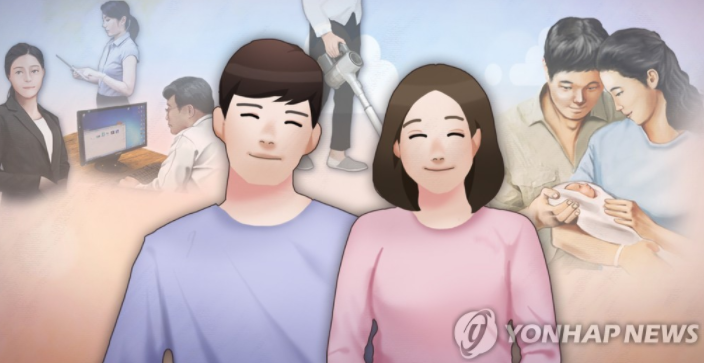 The government has announced plans to include unmarried couples and cohabiting partners as family members, sparking various opinions on the matter.
 [Image source=Yonhap News]
[Asia Economy Reporter Kim Young-eun] As the government announced plans to include unmarried couples and cohabiting partners as family members, opinions are divided between concerns and positive views. Some argue negatively, fearing that the traditional image of a four-person household might disappear.
The Ministry of Gender Equality and Family (MOGEF) announced on the 25th that through the "4th Basic Plan for Healthy Families" (2021?2025), it will promote a plan to recognize various family compositions outside the traditional marriage system and new family forms based on intimacy and care as "family" within legal systems.
According to Article 779 of the current Civil Code, the scope of family is defined as ▲spouses, direct blood relatives, and siblings ▲spouses of direct blood relatives living together, direct blood relatives of spouses, and siblings of spouses. However, this concept may cause policy discrimination and prejudice against cohabitants, unmarried individuals, and single-person households, and it has been pointed out that they do not receive family-related benefits or support in daily life or property matters. Therefore, this provision may be subject to change.
Additionally, the existing principle of prioritizing the father's surname when determining a child's surname may be changed to a system where parents decide through mutual agreement.
Although couples can currently choose the mother's surname when registering their marriage by mutual agreement, this decision must be made at the time of marriage registration before the child is born, which has been criticized for its lack of effectiveness.
MOGEF publicly disclosed the 4th Basic Plan for Healthy Families, which includes these points, through a non-face-to-face public hearing on the Korean Women's Development Institute's YouTube channel at 2 p.m. on the 26th. This plan has been established every five years since 2004 by MOGEF and will be applied from this year until 2025.
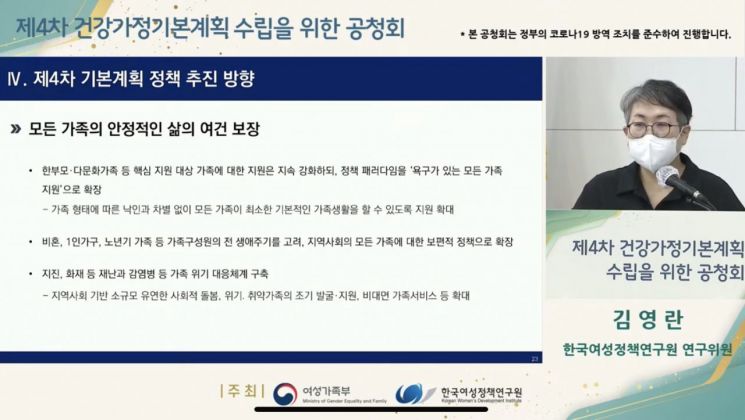 The "Public Hearing for the Establishment of the 4th Basic Plan for Healthy Families" was held online on the 26th. Photo by Korea Women's Development Institute YouTube channel video capture
At the non-face-to-face public hearing, Kim Young-ran, a researcher at the Korean Women's Development Institute, explained, "The direction of this plan is to support all families with needs without limiting policies to specific family types, enabling family life without stigma based on family form, and ensuring stable living conditions for all families. It has been expanded to include unmarried individuals, single-person households, and all households in local communities."
Among netizens who watched the public hearing video, various reactions followed, such as "This is a good direction. Everyone has the right to form a family in the way they want," "Let's live in step with the times. Obsessive fixation on the traditional family is making society sick," "It seems it will only cause confusion. The existing family will obviously be destroyed," and "Let's not blindly follow other countries. Even healthy families will be dismantled."
A (24) who heard the related news said, "I think the basic unit of society is the family, but the family structure seems to be collapsing too easily, and forming a family itself might be taken lightly," expressing concern, "Changes too far from the existing system may cause confusion and destroy family identity. Also, there will be many cases of abuse."
On the other hand, B (27) said, "I just think it's good that people have become a little freer to form families," emphasizing, "If someone wants to legally become family with someone, they can create a household, and those who don't can just live as before." They added, "I think it's good because people who currently don't have families or had difficulty forming families can now have families."
Experts evaluated the government's policy positively but suggested the need to prepare supplementary measures to minimize side effects.
Professor Kwak Geum-ju of Seoul National University's Department of Psychology said, "Due to social problems and changes, increasingly diverse family forms are emerging over time. I think it is welcome that legal family systems are becoming more flexible to reflect these changes."
Professor Kwak added, "However, while there are positive aspects, it is true that there are also concerns and skepticism. Rather than abruptly changing policies, supplementary measures should be prepared according to circumstances to allow gradual and long-term changes." She continued, "Although there are cases like France, where two adults living together are granted the same legal status as a legal marriage, even with such precedents, I believe supplementary measures should be prepared according to circumstances rather than abruptly changing policies. Gradual and long-term changes and measures are definitely necessary."
Meanwhile, MOGEF stated that after gathering discussed opinions, public feedback, and consultations with related ministries, the plan will be finalized and announced through the Cabinet meeting review scheduled for March.
© The Asia Business Daily(www.asiae.co.kr). All rights reserved.
!["The Woman Who Threw Herself into the Water Clutching a Stolen Dior Bag"...A Grotesque Success Story That Shakes the Korean Psyche [Slate]](https://cwcontent.asiae.co.kr/asiaresize/183/2026021902243444107_1771435474.jpg)

















