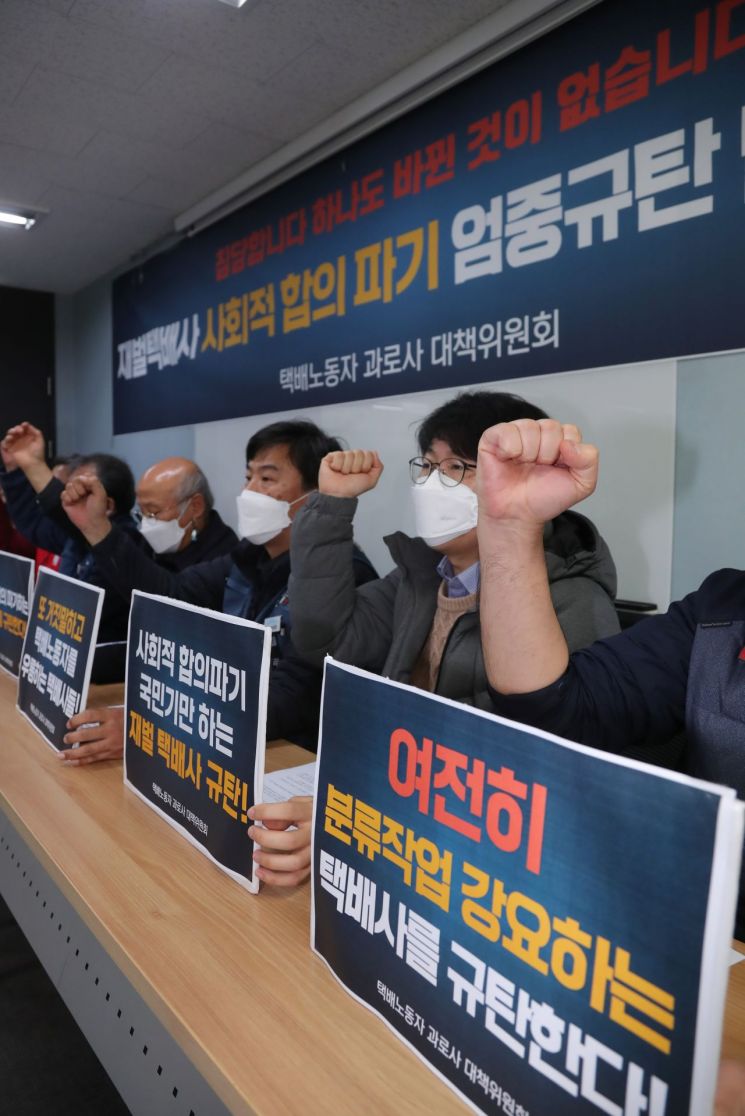
 Officials from the Task Force on Overwork Deaths of Delivery Workers held a press conference on the afternoon of the 26th at the National Service Industry Union Federation in Seodaemun-gu, Seoul, stating that delivery workers are facing a situation where they will be assigned to sorting tasks as before, and urging delivery companies to fulfill their social agreements.
 [Image source=Yonhap News]
[Asia Economy Reporters Donghoon Jeong, Dongwoo Lee] The delivery workers' union has decided to launch another general strike just six days after reaching a social agreement with delivery companies to improve working conditions.
On the 27th, the delivery workers' union announced, "In the union members' vote on the general strike held over two days from the 20th to the 21st, 97% of all members participated, and 91% voted in favor, passing the motion," adding, "We will begin a full-scale indefinite general strike on the 29th."
The union stated, "Delivery companies sent official letters to branches and sales offices instructing them to 'continue sorting work,'" and claimed, "The management broke the agreement just five days after signing the agreement on measures against death from overwork."
The reason the delivery workers' union decided to strike again was also due to the sorting work issue. Through the first social agreement, sorting work was excluded from the basic scope of delivery workers' duties, and delivery companies were required to deploy dedicated sorting personnel and bear the costs. If delivery workers inevitably perform sorting work, they are to be compensated accordingly. However, the principle is that delivery companies pay the sorting work costs, but they may share the costs in consultation with agency offices.
However, the union argued that the delivery sites have not changed even after the social agreement. They demanded, "The primary contractor delivery companies must recognize the union and have the delivery company and union representatives meet directly to conclude a labor-management agreement regarding sorting work." Most delivery drivers are special employment workers (special contract workers) who work as individual business owners under consignment contracts with delivery companies or agencies.
The union also stated, "Even though serious accidents such as death from overwork have occurred repeatedly at workplaces, delivery workers have only been able to focus on social agreements without ever dreaming of legally binding labor-management agreements to solve the problems, and despite repeated breaches of agreements by delivery companies, no one can effectively regulate this desperate situation."
In response, the Korea Integrated Logistics Association, representing 14 delivery companies, refuted the union's claim that the agreement was broken, stating it is not based on facts. According to the agreement, CJ Logistics has secured 4,000 sorting personnel, and Hanjin, Lotte, and others have secured 1,000 each, with additional personnel to be reviewed after discussions on structural improvement issues.
Some expect that since the union members participating in the strike account for about 10% of all delivery workers, there will be no confusion at the level of a 'logistics crisis.' The union members belonging to four delivery companies?CJ Logistics, Korea Post, Hanjin Delivery, and Lotte Delivery?number about 5,500. Although the union declared a strike, there is speculation that the government and ruling party may negotiate again with the union, preventing the situation from becoming extreme.
© The Asia Business Daily(www.asiae.co.kr). All rights reserved.

















