Hong Nam-ki, Deputy Prime Minister, Emphasizes "Many Issues to Review and the Need for Careful Consideration"
"We cannot prepare measures today, legislate tomorrow, and disburse the day after tomorrow"
[Sejong=Asia Economy reporters Kim Hyun-jung and Jang Se-hee] When the loss compensation system for small business owners and self-employed individuals is actively discussed in the February extraordinary session of the National Assembly, the rent support mentioned by Kwon Chil-seung, Minister-designate of the Ministry of SMEs and Startups, and the retroactive application of last year's damage amount revealed by Prime Minister Chung Sye-kyun are expected to become key issues. Inside and outside the government, opinions are also being raised that a Loss Compensation Committee composed of relevant ministries, experts, and stakeholders should be established to prepare a realistic compensation plan.
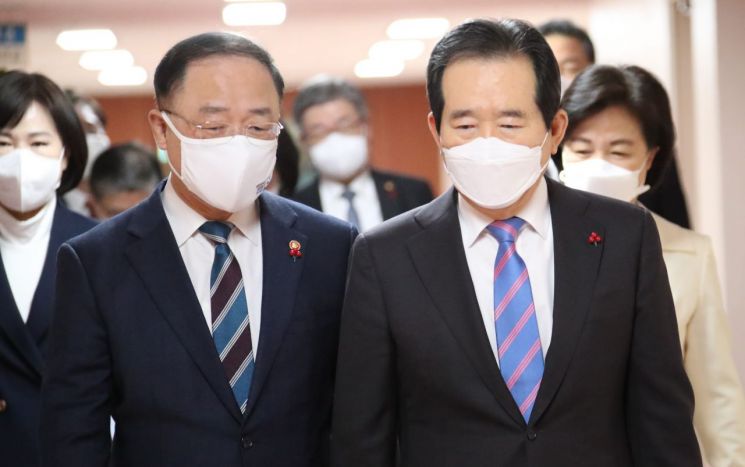
According to statements from National Assembly and government officials on the 27th, the ruling party and government are currently deliberating on the legalization of the loss compensation system along with whether to apply retroactive compensation for last year's damage caused by the novel coronavirus disease (COVID-19). The previous day, Prime Minister Chung stated at the 'Prime Minister-Deputy Prime Minister Council' that the recent discussions on the loss compensation system were aimed at establishing grounds for compensation based on government administrative orders, not with retroactive application in mind, reflecting awareness of the rapidly deteriorating public opinion.
The ruling party immediately distanced itself from Prime Minister Chung's remarks. Min Byung-duk, a member of the Democratic Party of Korea who proposed a related bill to compensate up to 70% of the lost sales amount, said on a radio program on the 27th, "It is problematic to only compensate for the future without compensating for past damages," emphasizing, "I think it is right to compensate for damages retroactively, even if the amount is somewhat smaller."
The previous day, Democratic Party lawmaker Lee Dong-joo also proposed that the scale of loss compensation for businesses subject to business restrictions or bans be set at 90% of the actual income reduction. Lee claimed that the loss scale of affected industries compared to 2019 reached 44.9 trillion won, and proposed compensating 40.4 trillion won, which is 90% of that amount. This is a proposal to specify the compensation amount and apply it retroactively in addition to the previously proposed related bill.
Prime Minister Chung's statement on 'no retroactive application' reflects the 'certain range manageable by the budget' mentioned by President Moon Jae-in. In fact, whether to apply retroactively is closely linked to the issue of securing funding. Although plans to raise funds through deficit bond issuance and fund formation are being discussed, the required funds could approach up to 25 trillion won per month depending on retroactive application, compensation targets, and criteria.
Rent support is in the same context as compensation for sales losses. Since Minister-designate Kwon is considered a core figure of the pro-Moon faction, the issue of rent support is likely to be given significant attention during National Assembly discussions.
Additionally, there is growing support for the argument that after establishing at least a minimum legal basis for compensation, a separate Loss Compensation Committee should be launched and operated externally, composed of multiple ministries, experts, and stakeholders to discuss detailed matters. This is based on the judgment that it is difficult to implement compensation closest to the actual damage amount through uniform laws or enforcement ordinances, given the differences in sales variance and damage scale by industry, business size, and region. A government official explained, "While it is possible to establish a causal relationship and the extent of sales decline for each individual business, uniform institutionalization carries a high risk of legal liability due to potential disputes," adding, "Judgment and verification through a committee could be the most realistic approach." The government also prepared compensation plans through the Central Accident Response Headquarters Loss Compensation Review Committee of the Ministry of Health and Welfare during the Middle East Respiratory Syndrome (MERS) outbreak in 2015 to compensate private medical institutions.
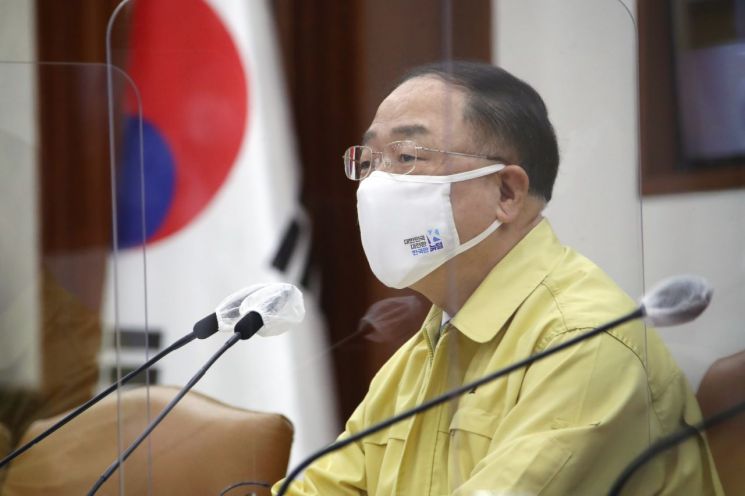
However, the government is refraining from commenting on specific directions for the loss compensation system. Hong Nam-ki, Deputy Prime Minister and Minister of Economy and Finance, presiding over the Emergency Economic Central Countermeasures Headquarters meeting and Innovation Growth Strategy meeting on the morning of the same day, stated, "There are many issues to review regarding the loss compensation problem, including institutionalization methods, targets, criteria, costs, funding, and foreign cases, and careful consideration is needed to address public acceptance and budget feasibility," emphasizing, "We cannot prepare measures today, legislate tomorrow, and disburse the day after tomorrow."
© The Asia Business Daily(www.asiae.co.kr). All rights reserved.
![Clutching a Stolen Dior Bag, Saying "I Hate Being Poor but Real"... The Grotesque Con of a "Human Knockoff" [Slate]](https://cwcontent.asiae.co.kr/asiaresize/183/2026021902243444107_1771435474.jpg)












