Market Focuses on 'Special Supply Measures'
Announcement Expected Early Next Month... Final Negotiations Underway
Increasing Supply in Station Areas Signals Housing Stability
Expanded Volume in Seoul and Other Metropolitan Areas
However, Concerns Over Limited Impact on Housing Prices
Population Concentration in Capital Region Worsens Housing Issues
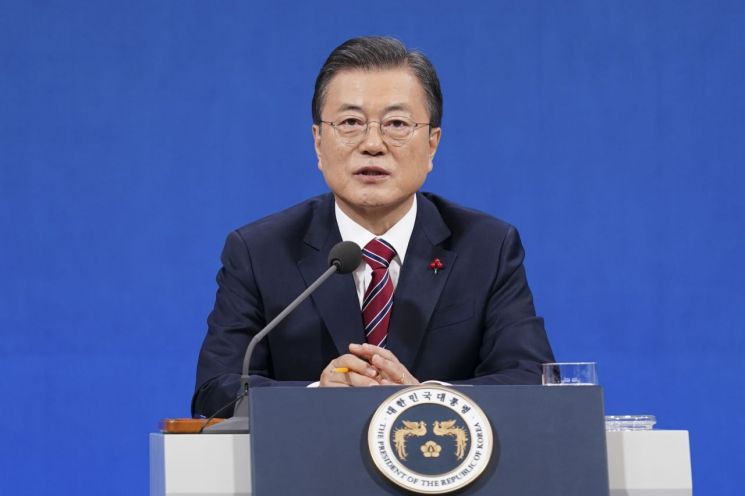 President Moon Jae-in is answering a reporter's question at the New Year's press conference held at the Blue House Chunuchu-gwan on the 18th. (Photo by Yonhap News)
[Asia Economy Reporter Moon Jae-won] The government is set to unveil a plan early next month to massively increase housing supply in downtown areas of Seoul and other metropolitan areas. The plan is expected to include building high-quality apartments desired by consumers near well-connected subway stations and maximizing the use of remaining idle land for housing supply purposes. However, discussions are reportedly underway to exclude development methods targeting specific areas, such as high-density development in the Gangnam area.
According to sources inside and outside the government on the 27th, the Ministry of Land, Infrastructure and Transport, the Ministry of Economy and Finance, and the Seoul Metropolitan Government plan to finalize and announce the metropolitan housing supply measures early next month. This is the "extraordinary supply measure that exceeds market expectations" President Moon Jae-in announced at the New Year's press conference on the 18th, promising to release it before the Lunar New Year holiday. Although the announcement schedule mentions next week, given the large volume, releasing it during the week that includes the Lunar New Year holiday is also being seriously considered.
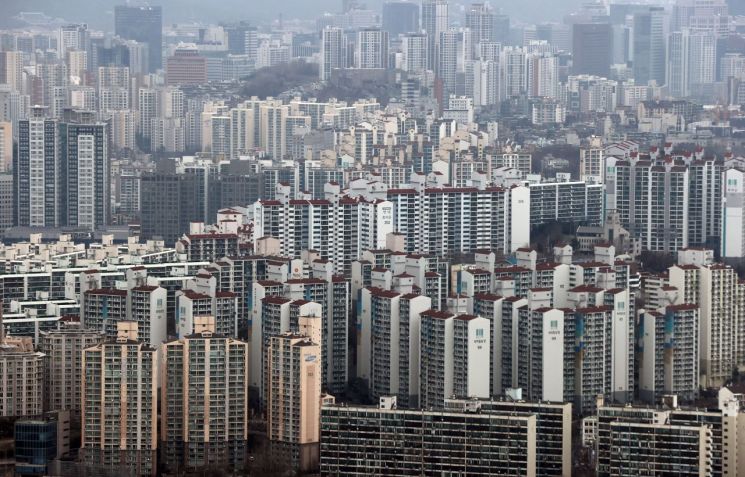
The measures will mainly focus on increasing public participation through public redevelopment and development around subway stations, as well as new housing site development. A representative plan involves public institutions such as the Korea Land and Housing Corporation (LH) participating to develop high-density areas around subway stations in downtown Seoul and the metropolitan area, semi-industrial zones, and low-rise residential areas. To this end, floor area ratios will be raised, various building regulations relaxed, and some of the increased supply will be used for public rental housing.
Since most areas around subway stations are composed of commercial buildings or low-rise buildings, it is difficult to supply large apartment complexes or large-sized units. Therefore, building many standalone residential-commercial mixed-use apartments near subway stations is a likely approach. In particular, a large supply of small-sized apartments near subway stations is expected for newlyweds, young people, and one- to two-person households.
A government official said, "Currently, most housing demand is concentrated on high-quality apartments within the city," adding, "This measure will send a signal that good apartments close to workplaces will be sufficiently supplied in the future."
In addition, the so-called 'public owner-occupied housing,' including land leasehold housing and repurchase condition housing, which Minister of Land, Infrastructure and Transport Byeon Chang-heum has advocated for since his academic days, will be introduced in earnest. Land leasehold housing lowers the sale price by selling only the building while the public retains land ownership, and repurchase condition housing limits capital gains by requiring homeowners to sell the house back to public institutions later.
Some have mentioned the possibility of high-density development in the Gangnam area, but it is expected to be difficult. Increasing the floor area ratio of idle land such as the Seoul Trade Exhibition Center (SETEC) site in Daechi-dong, Gangnam-gu, which has been mentioned several times, has the advantage of enabling more housing supply in good locations. However, this could further overheat surrounding housing prices and provoke strong local opposition to the introduction of public housing.
Since President Moon described it as an 'extraordinary measure,' the market expects a supply of at least 200,000 households. However, it is already difficult to discover new housing sites despite several supply plans, and since speed and execution are prioritized this time, it is still unclear how many units can be realized early. A government official said, "The situation is not one with much leeway," adding, "We are approaching this from the perspective of reviewing the entire existing supply system and creating a new supply model."
Experts predict that even if the plan includes a large volume of supply, stabilizing housing prices will not be easy. There are concerns that significantly increasing supply in Seoul and Gyeonggi Province could weaken the regional balanced development policy and intensify population concentration in the metropolitan area. Professor Lim Jae-man of Sejong University's Department of Real Estate said, "Focusing on metropolitan downtown development could draw population nationwide and worsen the housing problem," adding, "Increasing supply alone without improving the structure where money flows into real estate will solve nothing."
© The Asia Business Daily(www.asiae.co.kr). All rights reserved.
![Clutching a Stolen Dior Bag, Saying "I Hate Being Poor but Real"... The Grotesque Con of a "Human Knockoff" [Slate]](https://cwcontent.asiae.co.kr/asiaresize/183/2026021902243444107_1771435474.jpg)












