KAMA "Compact and Small Cars, Production Reduced Due to High Labor Costs... Need to Increase Added Value"
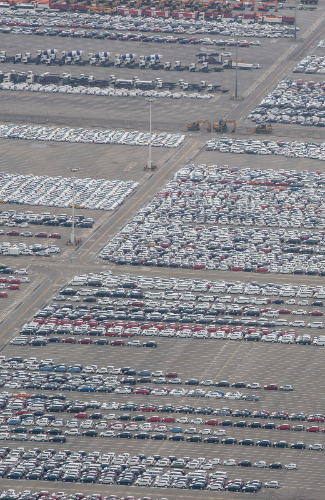 Export vehicles are waiting to be loaded at Pyeongtaek Port in Gyeonggi Province on the 11th, two days before Chuseok, the largest traditional holiday of the Korean people. (Aerial photography cooperation: Sergeant Lee Yong-gil, Aviation Unit, Seoul Metropolitan Police Agency; Inspector Park Hyung-sik, Northern Gyeonggi Provincial Police Agency) / Photo by Kang Jin-hyung aymsdream@
[Asia Economy Reporter Yu Je-hoon] Over the past five years, the proportion of compact and subcompact cars in the domestic automobile market has shrunk to about half, while the share of large vehicles and recreational vehicles (RVs) has increased significantly.
The Korea Automobile Manufacturers Association (KAMA) announced on the 27th that this was the result of analyzing changes in demand by vehicle class in the domestic automobile market from 2015 to 2020.
According to KAMA, RV sales have increased sharply by vehicle type. The share of sedan sales decreased from 58.6% to 47.7%, while the RV segment increased by more than 10 percentage points from 41.4% to 52.3% during the same period. This preference for RVs is not limited to the domestic market. In the U.S. market, the sedan share dropped from 43.2% to 23.5%, while the RV share rose significantly from 56.8% to 76.5% during the same period.
The growth of the RV segment is driven by the rapid expansion of urban-type and multipurpose small sport utility vehicles (SUVs), increased demand for large SUVs with spacious interiors and convenience, and the continued popularity of mid-size SUVs such as the Santa Fe and Sorento. For small SUVs, various models have been launched since 2015 starting with the Tivoli, followed by the Stonic, Seltos, Niro, Kona, Trailblazer, and XM3, while new premium brands such as the Palisade and GV80 have appeared in the large SUV segment.
By vehicle class, the reduction in the share of compact and subcompact cars and the expansion of the large vehicle segment were prominent. The share of compact and subcompact sedans decreased by nearly half from 28.8% in 2015 to 15.7% last year, and the mid-size segment also declined from 15.8% to 12.3%. In contrast, the large segment increased from 14.0% to 19.8%.
This decline in the sales share of compact and subcompact vehicles is interpreted as a shift in consumer preference toward SUVs or mid-size and larger sedans. KAMA explained that another main reason is that domestic companies, burdened by high labor costs and unable to match the prices of mid- and large-sized vehicles, are reducing production scale.
For example, in the case of automaker A, a large vehicle with a production rate of 70 units per hour (UPH) and an average price of 36 million KRW generates daily sales of 20.2 billion KRW (based on 8 working hours). In contrast, small cars with a UPH of 93 units and an average price of 19 million KRW generate daily sales of 14.1 billion KRW, which is 30.2% lower than that of large vehicles.
Jung Man-ki, chairman of KAMA, emphasized, "Recent consumer demand trends are shifting toward larger, eco-friendly, and personalized vehicles, so companies’ marketing strategies must also shift toward premiumization and differentiation according to market changes." He added, "Even for compact and subcompact cars, considering the high labor costs of our companies, strategies should change toward increasing added value."
© The Asia Business Daily(www.asiae.co.kr). All rights reserved.
![Clutching a Stolen Dior Bag, Saying "I Hate Being Poor but Real"... The Grotesque Con of a "Human Knockoff" [Slate]](https://cwcontent.asiae.co.kr/asiaresize/183/2026021902243444107_1771435474.jpg)
















