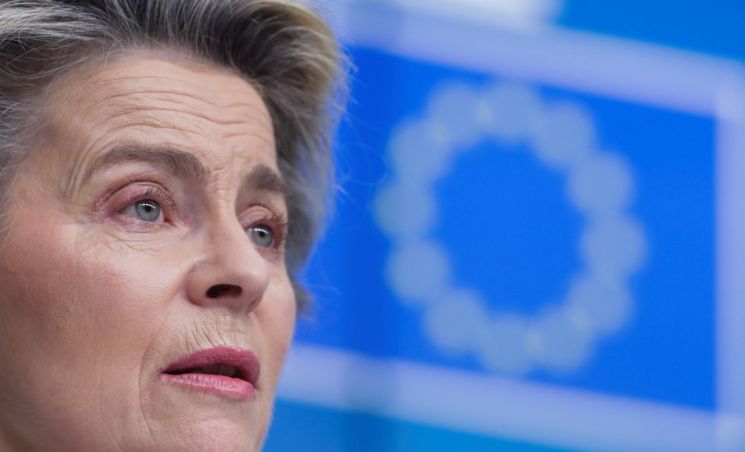
[Asia Economy Reporter Cho Hyun-ui] As the supply of new coronavirus disease (COVID-19) vaccines dwindles in Europe, calls for export controls outside the region are growing louder. The proposal is to require prior approval for exporting vaccines produced within European Union (EU) member countries to non-member countries. Some have criticized this measure as 'vaccine nationalism.'
According to the Financial Times on the 26th (local time), Jens Spahn, Germany's Minister of Health, urged, "Belgium should require pharmaceutical companies to obtain prior approval when exporting vaccines to non-member countries." Belgium hosts production facilities of multinational pharmaceutical companies AstraZeneca and Pfizer, which developed COVID-19 vaccines.
Not only Germany but also at the EU level, discussions are underway about a 'transparency mechanism' that would require prior notification when exporting vaccines produced within the region to countries outside Europe. If this system is implemented, EU member states will be able to share information on the export status of vaccines produced within the region. Minister Spahn explained, "This is not European prioritization but a call for fair distribution."
However, opposition voices are not insignificant. UK Prime Minister Boris Johnson emphasized, "The development of COVID-19 vaccines is a model of multinational cooperation," adding, "Personal protective equipment, medicines, and vaccines should not be subject to export restrictions." Valdis Dombrovskis, Vice President of the European Commission, also stated, "Instead of forcing prior notification, pharmaceutical companies should simply provide export-related information."
In Europe, since AstraZeneca announced on the 22nd that it would reduce its first-quarter supply to Europe to about half of the originally contracted amount, calls for export restrictions outside the region have intensified. Following Pfizer's announcement of supply delays due to expansion construction at its production facilities, AstraZeneca's decision to cut supplies has made Europe desperate to secure vaccine supplies.
Ursula von der Leyen, President of the European Commission, reportedly pressured Pascal Soriot, CEO of AstraZeneca, during a phone call the previous day, saying, "There is no reason for delays in vaccine supply," and urged, "Please find solutions using all possible flexibility to prevent supply delays," according to major foreign media such as the UK daily The Independent and The New York Times. Some countries, including Italy, Poland, and Austria, have announced plans for legal action against vaccine manufacturers.
Meanwhile, the UK, which was the first country in the world to start vaccinations, reported that the cumulative death toll exceeded 100,000 on the same day. The UK is the fifth country after the United States, Brazil, India, and Mexico to surpass 100,000 COVID-19 deaths, and the first European country to do so.
© The Asia Business Daily(www.asiae.co.kr). All rights reserved.
![Clutching a Stolen Dior Bag, Saying "I Hate Being Poor but Real"... The Grotesque Con of a "Human Knockoff" [Slate]](https://cwcontent.asiae.co.kr/asiaresize/183/2026021902243444107_1771435474.jpg)
















