[Asia Economy Yeongnam Reporting Headquarters Reporter Park Saeyan] Changwon City in Gyeongnam Province is introducing hydrogen trams in line with fine dust reduction and the government's Green New Deal policy.
On the 26th, Changwon City announced that it is promoting the introduction of urban and metropolitan railroads to provide public transportation services suitable for the scale of a special city and to realize the Green New Deal and carbon neutrality.
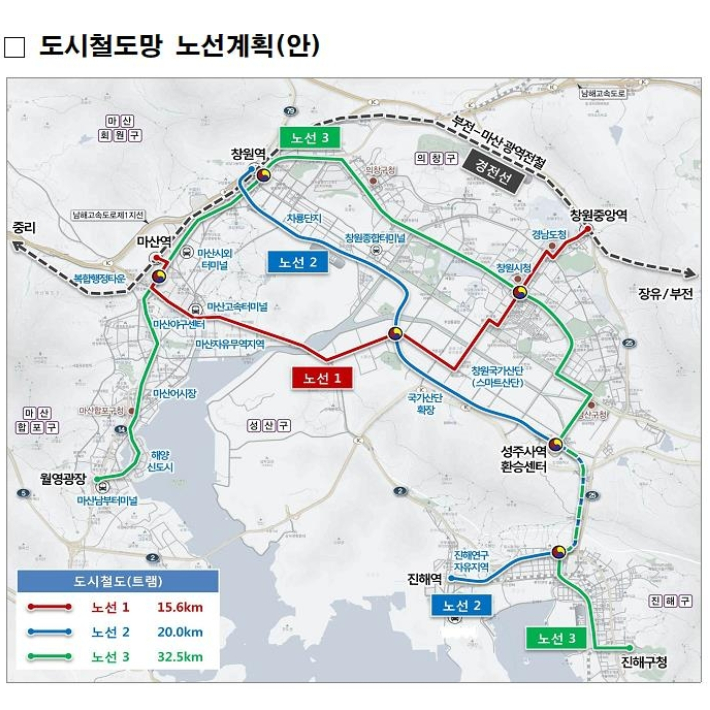
As a measure to expand public transportation infrastructure linked to Changwon's core hydrogen industry, the city proposed to Gyeongnam Province plans for three urban rail (hydrogen tram) lines and one metropolitan railroad line extending the Busan Metro Hadan?Noksan line to Jinhae.
This request was made to establish route plans suitable for Changwon City's urban and transportation characteristics within the urban railroad network construction plan formulated by Gyeongnam Province.
In Changwon, the rate of private car usage exceeds 60%, causing not only socio-economic losses such as annual parking problems, traffic congestion, and increased household transportation costs but also environmental issues like increased greenhouse gas and fine dust emissions.
Accordingly, Changwon City plans to build a BRT (Bus Rapid Transit) system in the short term and introduce urban rail in the mid to long term to activate eco-friendly transportation means and establish a transportation system centered on public transit.
The three urban rail lines will operate as hydrogen trams in the form of streetcars linked to the hydrogen industry cluster.
Line 1 runs 15.6 km from Masan Station to Changwon Central Station, connecting the KTX station-centered Smart National Industrial Complex and Masan Free Trade Zone, forming a commercial and business public transportation axis between Masan and Changwon.
Line 2 operates the Jinhae Line as urban rail over a 20.0 km section from Changwon Station to Jinhae Station, connecting the planned national industrial complex expansion specialized for the hydrogen industry and the Jinhae Research Free Zone.
Line 3 covers 32.5 km between Wolyeong Square and Jinhae District Office, the busiest public transportation route, with a BRT construction project underway on the 18.0 km section from Yukho Square to Gaeumjeong Intersection.
The Noksan?Jinhae metropolitan railroad extends the Busan Metro Hadan?Noksan line by 7.2 km to the Jinhae Ungdong area, expected to have a population inflow effect as a new port hinterland city in Jinhae.
The ‘Gyeongnam Province Urban Railroad Network Construction Plan,’ including the routes proposed by Changwon City, will be finalized after approval application to the Ministry of Land, Infrastructure and Transport, public hearings, consultations with related and expert organizations, and review by the National Transportation Committee.
Choi Youngcheol, Director of the Safety, Construction, and Transportation Bureau of Changwon City, stated, "Urban rail projects take more than 10 years from planning to opening, so preparation is necessary now to ensure the city's sustainability," adding, "As we actively encourage the introduction of trams, we will do our best to build an eco-friendly transportation system."
© The Asia Business Daily(www.asiae.co.kr). All rights reserved.

















