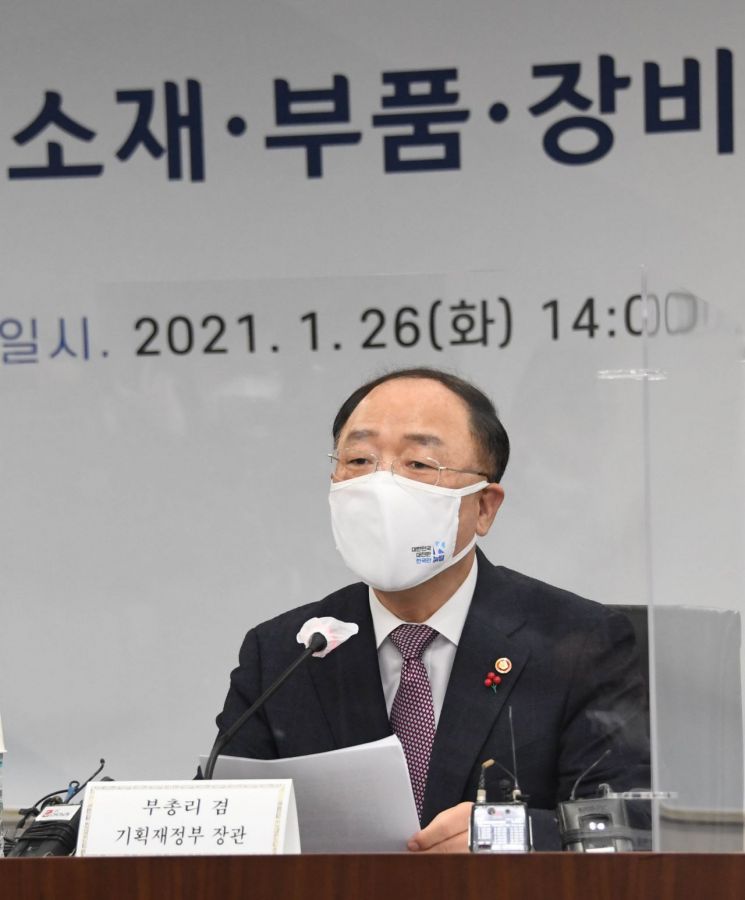
 Hong Nam-ki, Deputy Prime Minister and Minister of Economy and Finance, is delivering opening remarks while presiding over the '6th Committee on Strengthening Competitiveness of Materials, Parts, and Equipment' held at the Korea Federation of SMEs in Yeouido, Seoul on the 26th.
[Sejong=Asia Economy Reporter Kim Hyunjung] Deputy Prime Minister and Minister of Economy and Finance Hong Nam-ki stated on the 26th that the supply stabilization of the top 20 priority core items for Japan in the materials, parts, and equipment (SoBuJang) industry will be completed this year.
On the same day, Deputy Prime Minister Hong held a meeting of the Materials, Parts, and Equipment Competitiveness Enhancement Committee at the Korea Federation of SMEs in Seoul and said, "Following the completion of supply stabilization for the three major items last year, we will firmly complete the supply stabilization of the top 20 priority core items for Japan this year."
He emphasized, "We will unwaveringly achieve supply stabilization of the entire top 100 core items for Japan by 2024," adding, "We will not only stabilize SoBuJang supply but also proactively enter the global value chain as a 'value chain creator'." He further stated, "We will expand cooperation projects, which have so far been centered on domestic companies, to global cooperation including overseas demand companies and research institutions."
He also said, "We will further strengthen the linkage between the two major pillars of future growth engines, the 'Korean New Deal, BIG3 (future cars, bio-health, system semiconductors) + DNA (data, network, AI),' and key SoBuJang policies," adding, "When promoting key SoBuJang policies such as R&D, specialized complexes, top companies, and cooperation projects, we will actively consider the utilization of digital and green New Deal and BIG3, DNA sectors."
In particular, he announced that four cooperation projects between demand and supply companies for the development of BIG3 core items such as communication transmission and reception materials and parts for future cars, titanium materials for bio and medical use, and system semiconductors for electric vehicle inverters will be given priority approval. The government plans to support the approved projects with R&D, funding, tax benefits, manpower and infrastructure, and special regulations on environment and labor.
The overall target for cooperation project approvals this year is set at "20 plus alpha." Deputy Prime Minister Hong expressed expectations, saying, "If the cooperation projects are successfully promoted, they will greatly contribute not only to attracting private investment worth 1.4 trillion won by 2025 but also to expanding the market in the BIG3 sectors."
Regarding previous policies to strengthen SoBuJang competitiveness, he assessed, "Supply stabilization of core SoBuJang items has clearly improved," adding, "Despite Japan's export regulations, there were no production disruptions, and semiconductor exports even showed an increasing trend amid the COVID-19 pandemic." He continued, "Institutional measures that allow consistent implementation of SoBuJang competitiveness enhancement policies have been successfully established, and voluntary 'solidarity and cooperation' movements within the industrial ecosystem have greatly expanded."
© The Asia Business Daily(www.asiae.co.kr). All rights reserved.
![Clutching a Stolen Dior Bag, Saying "I Hate Being Poor but Real"... The Grotesque Con of a "Human Knockoff" [Slate]](https://cwcontent.asiae.co.kr/asiaresize/183/2026021902243444107_1771435474.jpg)
















