Solution Report <21> Interview with Professor Hwang Heon, Department of Bio-Mechatronics, Sungkyunkwan University
Startup H5 Founded Based on Solar Panel Cleaning and Monitoring Technology
Development of Cleaning Robots and Panel Regeneration Nanomaterials... "Recycling Must Precede Solar Facility Expansion"
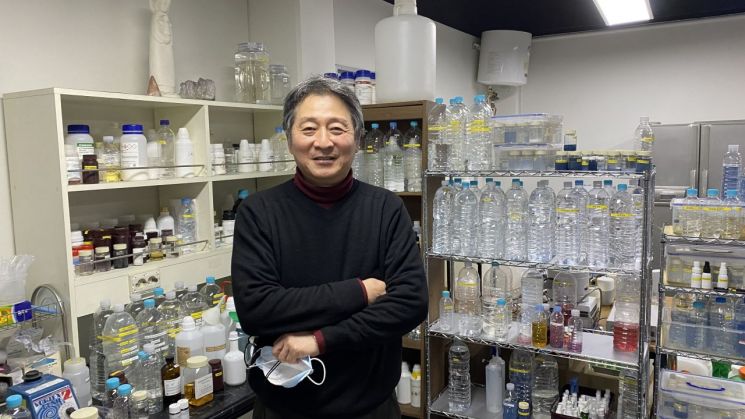 Professor Hwang Heon of the Department of Biomechatronics at Sungkyunkwan University recently founded the startup H5 based on solar panel cleaning and monitoring technology, embarking on entrepreneurship. He explained that the background of the startup was due to concerns about the indiscriminate spread of solar panels without preparation for waste resources. Photo by Kim Heeyoon
[Asia Economy Reporter Kim Heeyoon] “As solar power generation systems expand, concerns about panel waste generation and recycling need to be addressed. Currently, the system is like scrapping a car immediately after replacing it. It could be recycled through the used car market, but it is not.”
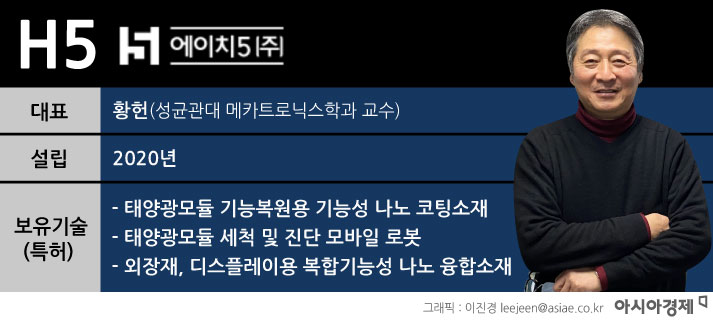
Hwang Heon, a robotics expert and professor in the Department of Bio-Mechatronics at Sungkyunkwan University, recently founded the startup H5 based on solar panel cleaning and monitoring technology. This was due to concerns about the indiscriminate spread of solar panels without prior preparation despite technological innovation. According to the solar power industry, about 200 tons of panel waste were generated last year. Professor Hwang said, “The disposal deadline for solar panels distributed since 2004 is approaching, but discussions on recycling are lukewarm, let alone disposal standards. This situation prompted me to take on the challenge of developing recycling technology with a sense of crisis.”
Currently, there is only one domestic facility for processing solar panel waste located in Jincheon, Chungbuk. The government is constructing a panel recycling center with an annual capacity of 3,600 tons at the Jincheon Technopark in Chungbuk, aiming for completion this year. So, where have all the end-of-life solar panels gone so far? Professor Hwang pointed out, “The reality is that they go to scrap metal processing companies, are landfilled, or their whereabouts are unknown.”
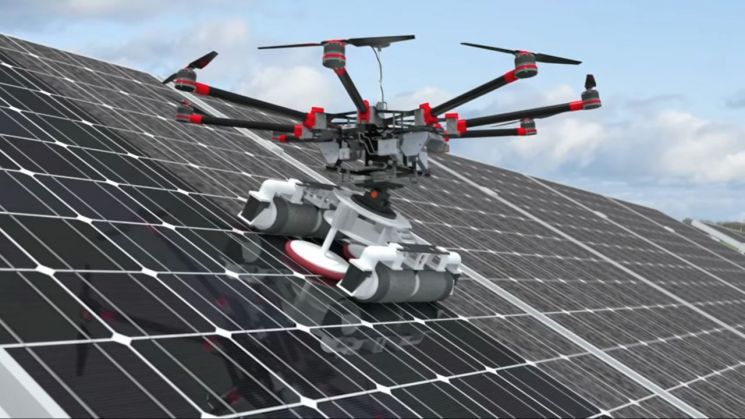 The solar panel cleaning robot developed by Professor Hwang removes contaminants from the panel surface to improve power generation efficiency while simultaneously detecting any damage to the panels, enhancing the convenience of panel management. Photo by H5 provided
Development of Solar Panel Cleaning Robots to Improve Power Generation Efficiency
Solar panels are typically manufactured with a lifespan of 15 to 20 years. After installation, to maintain power generation efficiency, weekly water cleaning, monthly current inspections, and biannual high-pressure cleaning are required to prevent overheating. However, Professor Hwang explains that it is practically impossible to regularly maintain panels installed on building rooftops, roofs, or rugged mountainous terrain. He added, “Cleaning by humans wiping the panel surface with water is difficult to manage properly. In urban areas, panels are densely installed, and in remote mountainous areas, they are widely spread, so they are often neglected, leading to decreased power generation efficiency and shortened lifespan.” The technologies developed to address this are cleaning diagnostic robots and cleaning coating nanomaterials.
The solar robots developed in small and medium sizes operate like household robot vacuum cleaners but are designed to move regardless of location or terrain, including steep slopes and uneven panel gaps. Professor Hwang said, “We also developed drone-based mobility technology to be used on offshore solar panels. By using robots to clean panels when needed, power generation efficiency increases, and at the same time, information on damaged parts of the panels can be obtained, improving management convenience.” Considering that if one panel connected in series is damaged, it affects the power generation of the same array (a unit of 18?20 modules connected in series), the system is equipped with a diagnostic system.
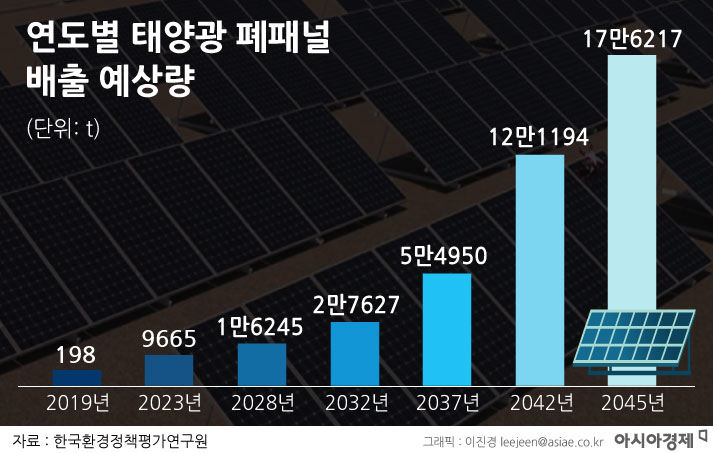
Solar Panel Surface Coating Nanomaterials Restore 90% of Original Function After Regeneration
Nanomaterials that restore nearly 90% of functionality through solar panel surface cleaning and coating are also noteworthy. Professor Hwang’s research team applied a superhydrophilic surface treatment technology using nanomaterials to remove organic contaminants accumulated on panels and minimize dust adhesion. At the same time, ultraviolet-curable coating improved the output of aged solar panels by 3?10%, experimentally proving that cumulative power generation can increase by up to 20%. Professor Hwang emphasized, “Operating solar panels can be regularly maintained with cleaning robots to improve power generation efficiency, and aged panels at the end of their lifespan can be fully collected at recycling centers and treated with surface treatment technology to secure recycled panel resources comparable to new panels.”
With the government’s Green New Deal policy, the share of solar energy is gradually increasing. According to the Ministry of Trade, Industry and Energy, the proportion of solar energy in new renewable energy will exceed half, rising from 40.4% in 2020 to 50.9% in 2030. The Korea Environment Institute predicts that domestic solar panel waste will reach 9,665,000 tons in 2023, 58,369,000 tons in 2033, and 1,553,595,000 tons in 2045. Professor Hwang said, “It is urgent for our government to establish policies for collection and recycling systems like Europe’s solar panel waste management system.” He added, “Through H5’s solar panel regeneration technology, I want to contribute to processing panels currently exported as waste to Africa and other regions into usable panels to help energy-deprived areas.”
© The Asia Business Daily(www.asiae.co.kr). All rights reserved.



















