Unable to Close Due to Investment Loss, Even 'Temporary Closure' and Conversion to 'Dalbang'
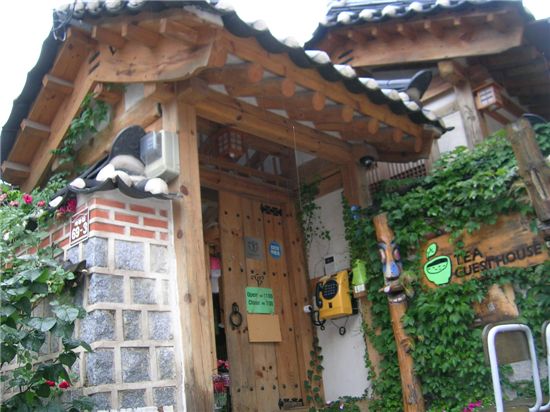 A guesthouse in Jongno-gu, Seoul. The photo is unrelated to the article.
 Photo by Asia Economy DB
[Asia Economy Reporter Lee Junhyung] Due to the impact of the novel coronavirus infection (COVID-19), about 15% of foreign tourist city guesthouses closed last year. Since the implementation of the ‘Foreign Tourist City Guesthouse Designation System’ in 2012, guesthouses that enjoyed a boom in the 2010s with the increase of individual foreign tourists have been struggling due to COVID-19. Including those effectively in a ‘soft opening’ state due to issues like key money, the number of guesthouses pushed to the brink is likely even higher.
According to the Korea Tourism Organization on the 26th, 342 guesthouses nationwide, excluding Jeju, closed last year, and 40 chose to suspend operations. As of December of the previous year, the cumulative number of registered guesthouses nationwide was 2,594, meaning about 15% ceased operations. Considering that guesthouses accounted for 48.27% of all lodging businesses nationwide at the end of last year, this is a significant figure. A Korea Tourism Organization official stated, “Since almost no foreigners are coming in, although it’s hard to estimate, many places are operating but without profit.” In fact, the number of foreign tourists visiting Korea in November last year was 61,764, a 95.8% decrease compared to the same month the previous year, and tourism revenue dropped by 68.5% year-on-year.
Although the guesthouse industry is pushed to the brink, they are in a situation where they can neither advance nor retreat. Jeong (37), who operates a guesthouse in Jung-gu, Seoul, said, “Guesthouses usually have over 90% foreign guests,” and lamented, “With social distancing and COVID-19 spreading, the business itself has disappeared.” He added, “Since May last year, I switched to monthly rent but manage the rent by working part-time jobs as well,” and “Many are trying to hold on until they can at least get key money.”
Regarding the recently heated debate over the loss compensation system, business owners unanimously said, “It would be good if given, but realistically it seems like an impossible policy.” Lee (53), who runs a guesthouse in Mapo-gu, Seoul, raised his voice, saying, “No one opposes giving money, but the damage amounts to tens of trillions of won, which the national budget cannot handle.” He continued, “I hope support for small business damages is not politically exploited and that feasible alternatives are prepared immediately.” Jeong (37) said, “Even just in the lodging industry targeting travelers, the accumulated losses must be enormous,” and “While discussions are welcome, we are not holding high expectations.”
There was also the issue that their voices have not received much attention within the small business community. A representative from the Korea Federation of Micro Enterprises said regarding guesthouses, “We do not have related statistics to grasp the industry’s actual conditions.”
© The Asia Business Daily(www.asiae.co.kr). All rights reserved.
![Clutching a Stolen Dior Bag, Saying "I Hate Being Poor but Real"... The Grotesque Con of a "Human Knockoff" [Slate]](https://cwcontent.asiae.co.kr/asiaresize/183/2026021902243444107_1771435474.jpg)















