[Asia Economy Reporter Jeon Jin-young] The Democratic Party of Korea, the Ministry of Economy and Finance, and the Blue House held a high-level party-government meeting the day before yesterday to discuss measures to compensate small business owners and self-employed individuals for business losses. Voices calling for the legalization of these measures are growing across political parties. The ruling party aims to pass the bill within the February extraordinary session of the National Assembly if it is enacted.
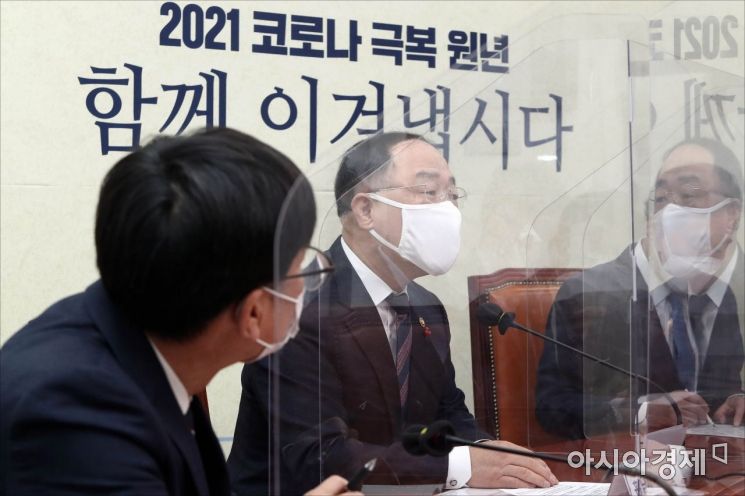 Deputy Prime Minister for Economy Hong Nam-ki is attending the High-level Party-Government Council held at the National Assembly on the 20th and delivering opening remarks. Photo by Yoon Dong-joo doso7@
However, tensions among prominent political figures continue daily over the loss compensation law issue. Furthermore, with Deputy Prime Minister and Minister of Economy and Finance Hong Nam-ki absent from the high-level party-government meeting due to illness, concerns about a power struggle resurfaced, with speculation that the Ministry of Economy and Finance might be expressing dissatisfaction.
Previously, on the 20th, when Deputy Minister Kim Yong-beom of the Ministry of Economy and Finance expressed reluctance to the loss compensation system by saying "there are no overseas cases," Prime Minister Chung Sye-kyun reportedly became angry, saying, "Is this the Ministry of Economy and Finance's country?" When Gyeonggi Province Governor Lee Jae-myung joined the discussion, Deputy Minister Kim Yong-beom reversed his stance on the 21st at the National Assembly, stating, "I will follow the Prime Minister's orders." Amid ongoing pressure surrounding the Ministry of Economy and Finance, Democratic Party leader Lee Nak-yeon appeared on a broadcast program on the 23rd and said, "Scolding the Ministry of Economy and Finance's treasurer won't solve anything," targeting Governor Lee and Prime Minister Chung.
From the beginning of the discussions, the power struggle has raised issues regarding funding and fairness. A senior ruling party lawmaker said on the 25th, "Realistically, (passing the law) will be very difficult," adding, "Business types are diverse, and cooperatives are not properly operated by industry in our country. Setting the criteria for compensation will be very challenging."
A ruling party lawmaker with a legal background also said, "Compensation itself is legally feasible. However, the scope and fairness issues will be the most difficult," adding, "It is necessary to carefully prepare and adjust the segments."
However, Policy Committee Chairman Hong Ik-pyo drew a clear line in an interview with MBC Radio's 'Kim Jong-bae's Focus' on the morning of the same day, saying, "He is not someone who would avoid or evade discussions due to illness or health reasons." He revealed that fairness issues are being sufficiently considered during the discussions. Chairman Hong emphasized, "We are considering legislation based on three principles: speeding up support, minimizing blind spots as much as possible through meticulous measures, and maximizing consideration of fairness issues."
Regarding the plan for the speed of bill processing between the party and government, he said, "There is no disagreement about speeding up," adding, "If the party and government meticulously accelerate their work, payments should be made as soon as possible, ideally within March, and at the latest by early April, following the February extraordinary session of the National Assembly."
© The Asia Business Daily(www.asiae.co.kr). All rights reserved.
![Clutching a Stolen Dior Bag, Saying "I Hate Being Poor but Real"... The Grotesque Con of a "Human Knockoff" [Slate]](https://cwcontent.asiae.co.kr/asiaresize/183/2026021902243444107_1771435474.jpg)
















