[Asia Economy Reporter Kim Eun-byeol] As discussions are underway in the political sphere to legislate compensation for self-employed individuals who suffered losses due to business restrictions amid the COVID-19 pandemic, doubts are growing about whether the economic scale has the capacity to implement such measures, including securing funding. If legislation is pursued without clear details on how to raise funds, how much, and when compensation will be provided, it is likely to face criticism as populism by politicians ahead of elections.
According to OECD statistics, as of 2018, the proportion of self-employed individuals in South Korea was 25.1%, nearly double the G7 (Group of Seven) average of 13.7%. The self-employment rates in the US, Canada, Germany, Japan, France, the UK, and Italy were 6.3%, 8.3%, 9.9%, 10.3%, 11.7%, 15.1%, and 22.9%, respectively, all lower than South Korea.
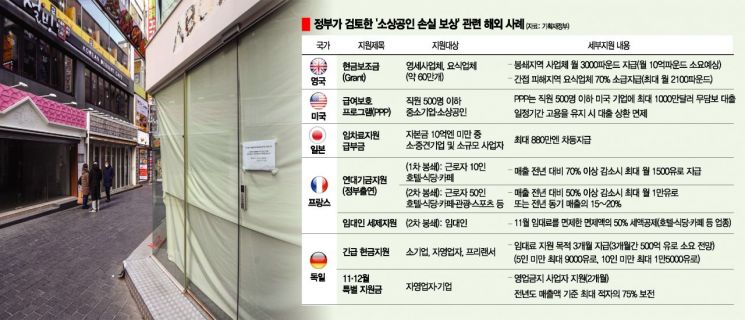
In contrast, the nominal Gross Domestic Product (GDP) estimates for G7 countries last year (based on International Monetary Fund (IMF) data) averaged about $5.4 trillion, more than three times South Korea’s approximately $1.58 trillion. Although the German government provides up to 90% of rent and labor costs to small business owners under business restrictions, and the French government offers up to 10,000 euros (about 13.4 million KRW) per month, these countries have larger economies and fewer self-employed individuals eligible for support than South Korea.
Kim Yong-beom, the First Vice Minister of Strategy and Finance, previously stated regarding the institutionalization of compensation for self-employed losses, "It is not easy to find countries that have legislated such measures." Even advanced countries with larger economies provide one-time support, raising the question of whether the Korean economy can bear the burden if compensation is legislated.
Among the self-employed loss compensation bills currently pending in the National Assembly, the proposal by Min Myung-duk of the Democratic Party requires 24.7 trillion KRW per month. Another bill by Kang Hoon-sik of the same party requires 1.2 trillion KRW per month.
In the current structure of self-employment in Korea, even providing 3 million KRW to 6 million self-employed individuals would require 18 trillion KRW in funding. The budget for the third round of disaster relief funds, which distributed 1 million, 2 million, and 3 million KRW according to general business, restricted business, and prohibited business categories, was 4.1 trillion KRW.
The problem is that while there are plans for spending, there are no plans for securing funding. Short-term methods to cover funding needs include issuing government bonds. In the medium to long term, this implies tax increases. Excessive issuance of government bonds can damage national credit ratings and potentially lead to unprecedented sovereign default. Tax increases require prior national consensus.
Hong Nam-ki, Deputy Prime Minister and Minister of Strategy and Finance, wrote on his Facebook on the 22nd, "We will deeply consider and review the institutionalization of compensation for business restriction losses," but also emphasized, "Ensuring that national finances are used most rationally and efficiently is the role of the country’s steward and a solemn duty and calling requested by the people." He pointed out that fiscal conditions, including the rapid increase in national debt during the COVID-19 crisis, are also important.
Issuance of deficit bonds amounted to 104 trillion KRW last year, 93.5 trillion KRW this year, and is expected to exceed 100 trillion KRW next year. The ratio of national debt to GDP is projected to rise from 43.9% at the end of last year to 47.3% this year, and surpass 50% next year.
© The Asia Business Daily(www.asiae.co.kr). All rights reserved.
![Clutching a Stolen Dior Bag, Saying "I Hate Being Poor but Real"... The Grotesque Con of a "Human Knockoff" [Slate]](https://cwcontent.asiae.co.kr/asiaresize/183/2026021902243444107_1771435474.jpg)
















