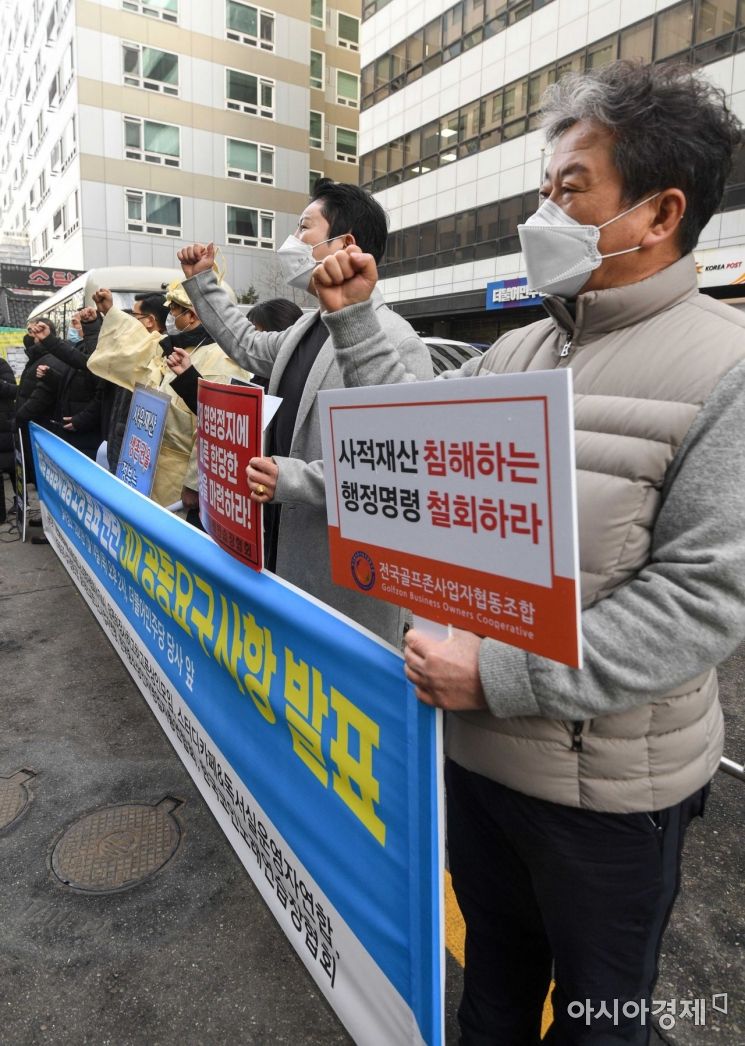
 On the 14th, in front of the Democratic Party of Korea headquarters in Yeouido, Seoul, representatives from gyms, Pilates studios, study cafes, screen golf, and coin karaoke announced the three major joint demands of self-employed business owners regarding the adjustment of restricted business sectors scheduled to be announced on the 16th. Photo by Jinhyung Kang aymsdream@
[Asia Economy Reporter Eunbyeol Kim] The Democratic Party of Korea and the government have begun reviewing legislative measures to compensate self-employed individuals for losses caused by the novel coronavirus infection (COVID-19).
According to political circles and the government on the 24th, the Ministry of Economy and Finance is examining compensation methods for self-employed losses and the scale of necessary funding while considering concrete institutionalization plans. Prime Minister Chung Sye-kyun officially instructed the Ministry of Economy and Finance on the 21st to review the institutionalization of loss compensation, and the ministry is reviewing parliamentary discussions and lawmakers' legislative proposals while calculating the required funds.
However, a specific direction has not yet been established. The legislative proposals mentioned within the ruling party contain varying contents, so it is expected to take time for the government to complete its review and prepare detailed plans.
The Democratic Party has already proposed several related bills.
The "Special Act on Loss Compensation and Coexistence to Overcome Coronavirus Infectious Disease," which is to be proposed by Representative Min Byung-duk, centers on providing compensation of 70% of lost sales for businesses subject to gathering bans, 60% for businesses with operational restrictions, and 50% for general businesses. The "Amendment to the Act on Protection and Support for Small Business Owners," proposed by Representative Kang Hoon-sik, includes provisions to pay the full minimum wage and rent for businesses under gathering bans during the prohibition period, and a certain percentage of minimum wage and rent for businesses with operational restrictions.
The "Special Act on Relief for Small Business Owners Affected by COVID-19," proposed by Representative Lee Dong-joo, establishes a Small Business Loss Compensation Committee under the Minister of SMEs and Startups to determine matters related to loss compensation payments. The "Amendment to the Infectious Disease Prevention and Management Act," proposed by Representative Jeon Yong-gi, provides a legal basis for compensating economic losses of businesses subject to operational restrictions.
These bills can be broadly categorized into those that specify the scale and method of compensation in detail (Representative Min Byung-duk's and Representative Kang Hoon-sik's bills) and those that establish the legal basis for compensation while allowing detailed matters to be decided according to circumstances (Representative Lee Dong-joo's and Representative Jeon Yong-gi's bills).
Among experts, the latter approach is generally considered more appropriate. Considering fiscal burden and flexibility in responding to situations, it is deemed more reasonable to establish only the legal basis for compensation and allow the government to create detailed plans according to disaster situations, rather than specifying amounts and methods of compensation in detail within the law.
Professor Ha Joon-kyung of Hanyang University emphasized, "It is necessary to establish a legal basis and a principle to provide support proportional to damages when an unavoidable situation occurs to prevent ongoing political controversy over compensation. However, since the actual scope of application and amounts vary depending on circumstances, it would be difficult to specify detailed contents in the law." Professor Lee In-ho of Seoul National University said, "Considering situations beyond COVID-19, it would be better to establish the basis and system for damage compensation through general laws rather than temporary special laws. Afterwards, relevant government ministries can create detailed loss compensation plans according to the situation."
An official from a government-funded research institute stated, "It would be better to include provisions in the Infectious Disease Prevention Act or the Small Business Act that allow the state to compensate losses and delegate the rest to the government. If the types of disasters subject to compensation, compensation targets, and compensation details are rigidly defined by law, there is a risk of excessive inflexibility. In such cases, actual execution may take longer, reducing effectiveness."
Experts have mentioned possible funding methods for loss compensation payments that need to be made immediately in response to the COVID-19 situation, including issuing government bonds, increasing taxes on higher-income groups, and creating funds through new levies.
© The Asia Business Daily(www.asiae.co.kr). All rights reserved.

















