Goddess Finance Research Institute
'Trends and Implications of China's Regulations on Big Tech Companies' Report
Financial Companies Should Approach Big Tech Collaboration Cautiously Considering Chinese Regulations
[Asia Economy Reporter Ki Ha-young] Domestic specialized credit finance companies such as card and capital companies are actively pursuing partnerships with big tech (large information and communication companies), but advice has emerged that risks related to future big tech regulatory changes should be considered.
According to the report "Regulatory Trends on Big Tech Companies in China and Implications" recently published by the Credit Finance Research Institute on the 23rd, it was diagnosed that as the market dominance of big tech and fintech strengthens like in China, financial system soundness and consumer protection will emerge as important issues domestically as well. It emphasized the need to approach cooperation with big tech cautiously by referring to regulatory trends in China.
The Chinese government established the "Anti-Unfair Competition Department Joint Conference," an inter-governmental consultative body, at the end of November last year to strengthen antitrust regulations targeting giant internet platform companies such as Alibaba. This was to prevent monopoly damages caused by the expansion of big tech companies' business areas into all aspects of daily life.
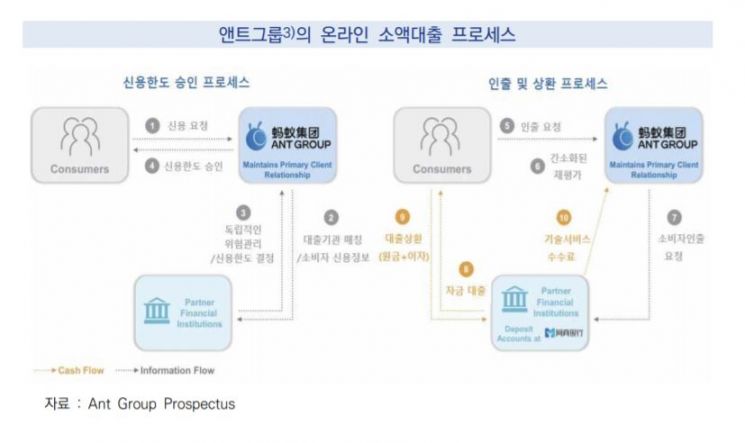
Earlier, Chinese regulatory authorities announced a draft of the "Online Microloan Rules" to suppress rising debt and strengthen management and supervision of online microloans amid the economic impact of the novel coronavirus disease (COVID-19). The draft includes a minimum loan ratio of 30% for online microloans jointly provided by big tech companies and financial institutions, and loan size limits for personal loans not exceeding 300,000 yuan (approximately 50 million KRW) or one-third of the average annual salary over three years. This announcement dealt a heavy blow to Ant Group, whose online microloan platform accounts for 40% of its sales, and its initial public offering (IPO) worth $35 billion was indefinitely postponed two days before listing.
Additionally, China's antitrust regulatory authority, the State Administration for Market Regulation, released a draft of the "Platform Economy Antitrust Guidelines." According to this, internet platform companies are prohibited from restricting search and traffic, abusing big data algorithms for price discrimination, and violators will be fined. Providing consumer-tailored services using artificial intelligence (AI) and big data is also classified as monopolistic behavior, requiring disclosure of related information. Regarding ownership and governance, regulations were imposed on "Variable Interest Entities (VIEs)," paper companies through which big tech companies can exercise management rights by contract without equity stakes. VIEs had enabled big tech companies to acquire promising startups while avoiding monopoly reviews and facilitating sprawling expansion. Following the release of this draft, the stock prices of the five major big tech companies dominating China's platform economy?Alibaba, Tencent, Meituan Dianping, JD.com, and Xiaomi?plummeted, erasing $260 billion (approximately 286 trillion KRW) in market capitalization over two days.
Furthermore, the State Administration for Market Regulation imposed the maximum fine of 500,000 yuan (approximately 85 million KRW) on big tech companies for violating antitrust laws during corporate acquisitions, signaling strengthened antitrust regulations. It also presented "Guidelines on Regional Group Buying" to manage and supervise group buying price setting and unfair competition arising from platform companies' entry into the regional group buying market.
Im Yoon-hwa, senior researcher at the Credit Finance Research Institute, said, "While China's regulations on big tech companies are strong in nature, domestically, efforts are focused on laying the foundation for market development by eliminating overlapping regulations and establishing grounds for data utilization," but advised, "Domestic credit finance companies also need to carefully review China's regulatory concerns and approach partnerships and cooperation with big tech cautiously."
© The Asia Business Daily(www.asiae.co.kr). All rights reserved.

















