National Police Agency's Chief of Investigation Recruitment Process 'Absolute Silence'
"Claims of Recruitment Fairness" but... Number of External Members Also Kept Secret
Investigation Authority Adjustment and Transfer of Counterintelligence Investigation Authority
Independence from Police Commissioner’s Command
Chief of Investigation Acts as a De Facto 'Power Institution'
High Political Neutrality and Morality Required
"Need for External Verification Procedures" Pointed Out
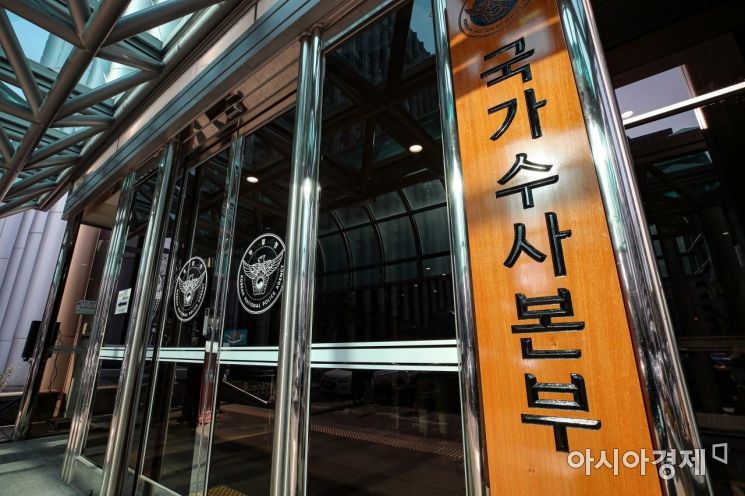 The signboard of the National Investigation Headquarters hung at the Seoul Seodaemun-gu Police Agency./Photo by Hyunmin Kim kimhyun81@
[Asia Economy Reporter Lee Gwan-joo] Concerns are growing over the 'opaque' recruitment process as the selection procedure for the head of the National Investigation Headquarters (NIH), who will oversee police investigations, is underway. While the police maintain that confidentiality in various procedures is inevitable to ensure fair recruitment, opinions are gaining traction that transparent disclosure is necessary given that the NIH head holds a status equivalent to a power institution.
According to the police on the 23rd, the National Police Agency closed applications for the NIH head position on the 11th and is currently conducting document screening and other recruitment procedures. The NIH head is narrowed down to 2-3 candidates through document screening, physical tests, and comprehensive evaluations. Then, the National Police Agency Commissioner recommends one candidate, who is appointed by the President after being proposed by the Ministry of the Interior and Safety and passing through the Prime Minister. Currently, there are five applicants: Lawyer Baek Seung-ho (57, 23rd Judicial Research and Training Institute class), former Chungbuk Police Agency Deputy Commissioner Lee Se-min (60, Police University 1st class), former Chief Judge Lee Jeong-ryeol (52, 23rd class), Lawyer Lee Chang-hwan (54, 29th class), and Lawyer Kim Ji-young (49, 32nd class).
However, the National Police Agency is strictly withholding information on how far the recruitment process has progressed. Document screening is conducted by a committee of two or more members, and comprehensive evaluation by a committee of five or more members. Notably, regulations require that more than half of these members be external. The problem is that the police have not disclosed even the professions of these external members. The police maintain that disclosure is impossible to preserve the fairness of recruitment, fearing that revealing the committee members could lead to external pressures such as personnel solicitations. However, criticism arises that not disclosing even the number or professions of committee members is excessive. Especially since the NIH head oversees police investigations, verifying the political neutrality and morality of the NIH head is essential, but currently, there is no way to confirm the political neutrality of the evaluators.
Ultimately, no one can know the recruitment process until the final candidate is decided. The police reportedly plan to disclose information once the final NIH head candidate is narrowed down to one. This effectively means that external verification occurs only after the appointment is virtually confirmed, implying that no external scrutiny exists for the NIH head. In this regard, the police have stated that since the NIH is an agency under the National Police Agency and the head is appointed as a Police Commissioner, formal hearing procedures are unnecessary.
However, experts emphasize that whether to hold a confirmation hearing cannot be judged solely by rank and affiliation. The nature of the NIH must be considered. The NIH is a special organization that oversees police investigative authority and has received powers transferred from other agencies. The National Intelligence Service's counterintelligence investigative authority will be transferred to the NIH in three years, and with the adjustment of investigative authority between the prosecution and police, the prosecution's direct investigations will be significantly reduced, thereby strengthening the police's investigative authority. The NIH head position demands a high degree of political neutrality, expertise, and morality.
The nature of the NIH head's duties must also be reflected. Although the NIH is an organization under the National Police Agency, it is effectively positioned independently of the Police Commissioner. Specific case commands by the Police Commissioner must be conducted through the NIH head, and the cases subject to command authority are extremely limited to nationwide cases. Thus, the NIH is granted an independent status from the National Police Agency.
It is particularly important to note that the heads of the four major domestic power institutions?the National Intelligence Service, prosecution, police, and National Tax Service?are all subject to National Assembly confirmation hearings regardless of rank. Although the NIH head's rank is lower than the Police Commissioner, given these characteristics and the fact that the NIH head performs duties as a full-fledged power institution, there is a strong call for a public verification process.
Professor Lee Woong-hyuk of Konkuk University's Department of Police Science stated, "The Prosecutor General, Police Commissioner, National Intelligence Service Director, and even the High-ranking Officials' Crime Investigation Department (HOCI) chief are all subject to confirmation hearings. It is illogical that the NIH head, who exercises all investigative powers previously held by these agencies, is exempt from hearings simply due to a lower rank." He added, "This essentially means that the establishment of systems and mechanisms related to the NIH's launch was insufficient."
A bill to introduce confirmation hearings for the NIH head has also been submitted to the National Assembly. Yoon Jae-ok, a member of the People Power Party and former police officer, recently introduced amendments to the 'Act on the Organization and Operation of the National Police and Autonomous Police' and the 'National Assembly Act' to include the NIH head as a subject of National Assembly confirmation hearings.
© The Asia Business Daily(www.asiae.co.kr). All rights reserved.
![Clutching a Stolen Dior Bag, Saying "I Hate Being Poor but Real"... The Grotesque Con of a "Human Knockoff" [Slate]](https://cwcontent.asiae.co.kr/asiaresize/183/2026021902243444107_1771435474.jpg)











