[Asia Economy Reporter Song Seung-seop] The cumulative number of financial authentication service issuances has reached 2.2 million since its full-scale launch on the 10th of last month. The number of authentications was approximately 14 million. On the 21st, the Korea Financial Telecommunications & Clearings Institute (KFTC) announced, "About a month after the financial authentication service was launched, the cumulative issuance exceeded 2 million, establishing itself as a major authentication method."
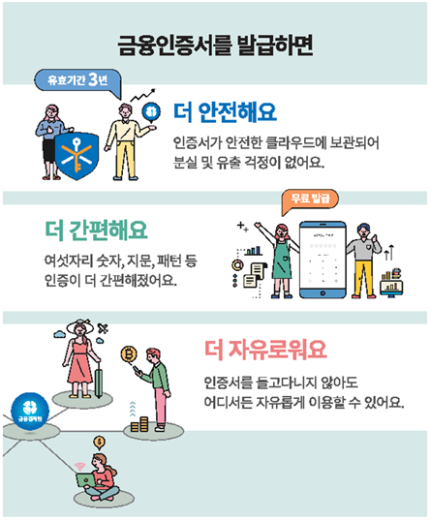
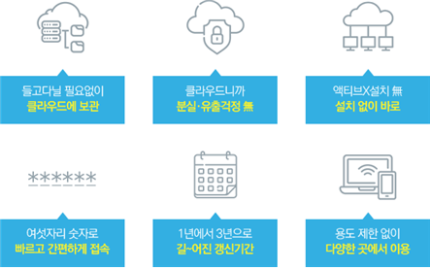
According to the financial sector on the 23rd, the financial authentication service refers to an authentication service provided and stored on KFTC's own cloud. Unlike the Dongin certificate (formerly the public certificate), it does not need to be stored on a computer, mobile device, or USB, and can be used in PC or mobile environments without installing separate applications or programs. It is also characterized by allowing access with a 6-digit password, pattern, or fingerprint instead of entering a password of more than 10 digits. The validity period, which was one year, has also been extended to three years.
The financial authentication certificate was gradually introduced starting with Woori Bank on November 17 last year, and now most banks issue it free of charge. After issuance, it can be used for face-to-face and non-face-to-face banking tasks such as logging into bank websites, transferring funds, and subscribing to financial products. It is also available on government public institution websites, allowing use for services such as the National Tax Service's year-end tax settlement and issuance of resident registration certificates.
In particular, for the year-end tax settlement simplification service implemented this year, the financial authentication certificate can be used on both PC and mobile. It allows users to check data related to actual medical insurance, eyeglass purchase expenses, monthly rent, emergency disaster relief funds, and donations, or to apply for or cancel consent for providing data of dependents. Although private certificates (telecom companies' PASS, Samsung PASS, KakaoTalk, Payco, KB Kookmin Bank) can be used, they cannot be used on the mobile Hometax application.
KFTC plans to gradually expand the application of the financial authentication service. According to KFTC, the service is being introduced in electronic financial tasks of insurance companies and card companies, and as early as February, some securities firms such as Eugene Investment & Securities and Samsung Securities are expected to implement the financial authentication service.
KFTC is also considering adding a function to check usage history of the financial authentication service. This will allow users to verify when and where the certificate was used, preventing illegal use and theft of the certificate in advance. KFTC explained that if a function allowing individuals to directly set the usage region and time of the certificate is added within the first half of the year, customers will be able to manage their certificates proactively.
KFTC stated, "We will expand non-face-to-face electronic financial and electronic transaction services to various fields to become a customer-centered comprehensive authentication center," and added, "We plan to be evaluated as an electronic signature certification operator to provide reliable and secure authentication services to customers and institutions."
© The Asia Business Daily(www.asiae.co.kr). All rights reserved.


















