[Asia Economy Reporter Lee Seon-ae] Although a large-cap stock market is unfolding, there are continuous forecasts that a strong market for small and mid-cap stocks will soon emerge. Accordingly, investor interest is focusing on small and mid-cap stocks, which have high attractiveness.
Relative Underperformance of Small and Mid-Cap Stocks Amid Large-Cap Rally
According to Heungkuk Securities on the 23rd, looking at the average January returns of KOSPI and KOSDAQ, as well as large-cap and small and mid-cap stocks over the past 20 years, KOSPI showed +1.1% and large-cap stocks +1.7%, both underperforming compared to KOSDAQ (+4.9%) and small and mid-cap stocks (+2.2%). However, this year, large-cap stocks are showing relatively better performance compared to small and mid-cap stocks, and the inflow of individual investors, who are strongly leading the market, is concentrated on large-cap stocks, showing a contrasting pattern. So far, individual investors’ cumulative net purchases amount to 10.4 trillion KRW for large-cap stocks and 700 billion KRW for small and mid-cap stocks, indicating a significantly stronger net buying trend focused on large-cap stocks even considering market capitalization.
Increased Valuation Attractiveness of Small and Mid-Cap Stocks
Due to the significantly better relative performance of large-cap stocks compared to small and mid-cap stocks, the valuation attractiveness of small and mid-cap stocks has also increased. Over the past 10 years, the average relative strength of the 12-month forward price-to-earnings ratio (PER) of small and mid-cap stocks compared to large-cap stocks has been around 1.15 times, but currently, it stands at about 0.8 times, marking a historical low. Accordingly, if a full-scale recovery of small and mid-cap stocks becomes visible, it is expected that they will show a higher upward trend compared to large-cap stocks.
Extension of Short-Selling Ban and Increased Pension Fund Investment in KOSDAQ Also Positive
Although nothing has been concretely decided yet regarding short-selling, voices calling for institutional improvements such as preventing illegal short-selling and activating short-selling by individual investors are growing. The government also views that resuming short-selling in March is physically difficult even from the perspective of establishing a system, so the weight is leaning toward extending the short-selling ban. Additionally, according to the 2021 work plan announcement by the Ministry of Economy and Finance and the Financial Services Commission, measures to stabilize the stock market include increasing the pension fund’s investment ratio in KOSDAQ, which is currently at about 1?2%, and including KOSDAQ in the benchmark indices used to evaluate investment performance. These factors are expected to act as elements that increase the investment attractiveness of small and mid-cap stocks compared to large-cap stocks.
Focus on Small and Mid-Cap Stocks with Earnings Improvement and Relatively Poor Price Earnings Performance
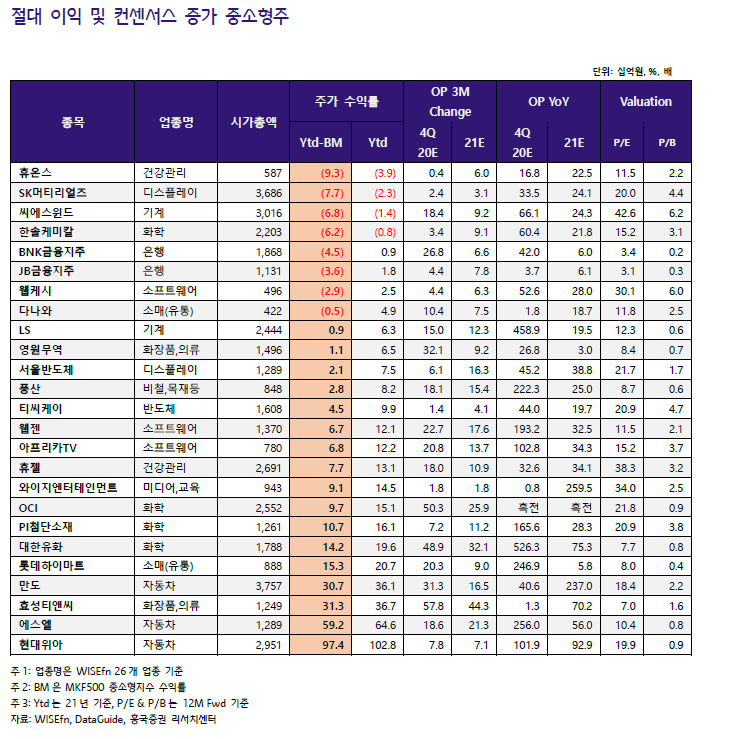
Researcher Lim Seong-cheol of Heungkuk Securities said, "We selected stocks that have consensus from three or more securities firms, show absolute earnings for Q4 2020 and the year 2020, and have recently seen upward revisions in earnings consensus but exhibit poor price earnings performance." He added, "Key stocks include SK Materials, CS Wind, Hansol Chemical, BNK Financial Group, JB Financial Group, Huons, Webcash, and Danawa."
© The Asia Business Daily(www.asiae.co.kr). All rights reserved.
![Clutching a Stolen Dior Bag, Saying "I Hate Being Poor but Real"... The Grotesque Con of a "Human Knockoff" [Slate]](https://cwcontent.asiae.co.kr/asiaresize/183/2026021902243444107_1771435474.jpg)
















