Increased Delivery and Labor Costs
Financial Burden Grows for Small and Medium Enterprises
Commission Fees Passed on to Consumers
Seol Delivery Faces Compliance Test
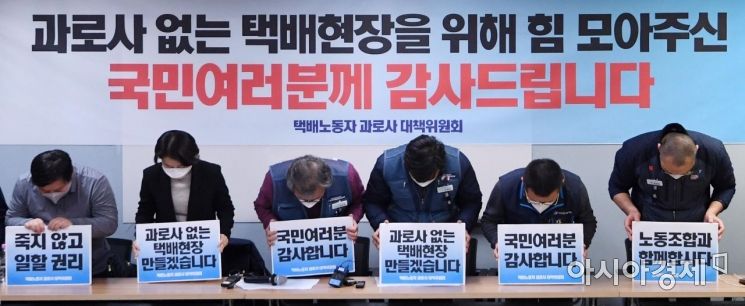 Members of the Delivery Workers' Overwork Death Countermeasures Committee held a press conference on the 21st at the National Service Industry Labor Union Federation in Seodaemun-gu, Seoul, regarding the dramatic settlement of the social agreement body. The delivery industry labor and management have reached a final agreement on issues such as the responsibility for sorting work to prevent overwork deaths of delivery workers. They effectively designated the responsibility for sorting work to the delivery companies and prohibited passing the cost of sorting personnel onto delivery drivers, and also decided to restrict late-night deliveries after 9 p.m. Photo by Kim Hyun-min kimhyun81@
[Asia Economy Reporters Donghoon Jeong, Dongwoo Lee] Although the government and the courier labor-management parties signed the ‘1st Agreement on Measures Against Death from Overwork,’ stakeholders in the courier industry found themselves facing new concerns before the ink had even dried. Debates are erupting as burdens related to courier fees, labor costs, and facility investment costs are anticipated.
◆Industry: Increased manpower and automation make courier fee hikes inevitable=Courier companies must bear the cost burdens associated with increased manpower and automation facilities. According to last October’s agreement and the current one, additional personnel must be deployed ahead of the Lunar New Year deliveries in line with the core agreement that ‘the company is responsible for sorting tasks.’ CJ Logistics, which announced the deployment of 4,000 sorting personnel last year, plans to expand its workforce beyond the current approximately 3,190 employees. Hanjin and Lotte Global Logistics also plan to complete the recruitment of sorting personnel by February or March. The sorting personnel announced so far have been ‘support’ staff for courier drivers, but if the company is to take full responsibility for sorting tasks, even more personnel will be needed. Labor costs are inevitably set to increase. Automation of sorting facilities requires massive capital investment, and before automation, if dedicated sorting personnel are deployed on-site or if courier workers must inevitably take on these tasks, appropriate compensation must be provided. Courier companies say that even with government budget and tax support, they must invest at least several billion won, and financially weak small and medium-sized companies face increased financial burdens. A courier industry official said, “Sorting personnel are needed at about 50% of the number of courier drivers, and although it varies by company size, labor costs alone will increase by an average of 30 billion to 50 billion won or more.” The courier industry views a reasonable increase in courier fees as unavoidable.
◆Drivers: Income decrease vs Consumers: Concerns over courier fee hikes=Restrictions on deliveries after 9 p.m. and a 60-hour workweek agreement are measures to prevent death from overwork, but on the other hand, they raise concerns about income reduction. Courier drivers currently work an average of 71.3 hours per week, and the average commission per delivery is about 782.1 won. If working hours are limited to 60 hours, courier drivers who receive commissions per delivery may see their wages decrease. If courier companies take responsibility for sorting tasks, they may reduce transportation and collection commissions while setting higher sorting commissions. Even if the same volume is delivered, courier drivers’ income could decrease.
The burden of commission increases due to courier fee hikes will inevitably be passed on to consumers. Public reactions are mixed. Online, some say, “I can accept courier fee increases for the sake of courier drivers who deliver until dawn,” while others oppose fee hikes, arguing, “Working hours and volume are decreasing, so wages cannot be fully compensated.”
◆Lunar New Year deliveries: The first test of agreement implementation=Since the October agreement last year, the courier labor union claims that some courier companies have only deployed sorting personnel at branches with unions, while failing to deploy the promised sorting personnel at branches without unions. A representative of the National Courier Labor Union said, “The agreement, including the deployment of sorting personnel, is scheduled to be implemented starting with the Lunar New Year peak season, and we will monitor whether sorting personnel are being recruited.” A representative from the People’s Solidarity for Participatory Democracy said, “Although the Courier Solidarity Union has been established, the primary contractors, the courier companies, have avoided negotiations,” adding, “Efforts are also needed to recognize the worker status of special employment workers through legal and institutional improvements and to guarantee the right to unionize.”
© The Asia Business Daily(www.asiae.co.kr). All rights reserved.

















