Purpose of Fund Inflow through K-New Deal... Concerns over Institutional Investors' Independence
Financial Authorities Prepare Various Incentives... Establish Measures to Mitigate Investment Risks
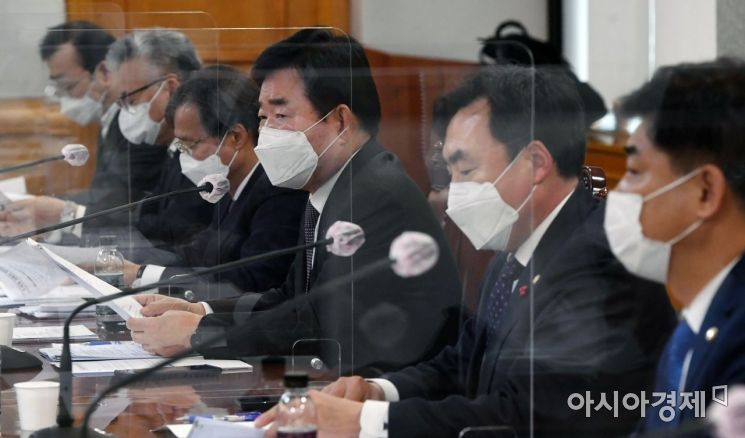 On the morning of the 22nd, Kim Jin-pyo, Chairman of the National Economic Advisory Council, is speaking at the 'K-New Deal Support Measures' meeting held at the Bank Federation Building in Myeongdong, Seoul. At this meeting, the chairpersons of the five major financial groups and heads of financial sector associations discussed matters related to the Korean New Deal project promoted by ruling party figures and the government. Photo by Kang Jin-hyung aymsdream@
[Asia Economy Reporter Kwangho Lee] Ruling party lawmakers met with the chairpersons of the five major financial holding companies?KB, Shinhan, Woori, Hana, and NongHyup?to propose reducing the proportion of real estate loans by institutional investors such as pension funds and mutual aid associations. This is interpreted as an effort to curb the concentration of market liquidity in real estate and to channel funds into the ‘K (Korean version) New Deal,’ a key project of the Moon Jae-in administration. Some voices have raised concerns that the independence of institutional investors could be compromised.
A delegation led by Representative Kim Jin-pyo, chairman of the Democratic Party’s National Economic Advisory Council, discussed the ‘K-New Deal Support Measures’ including this proposal on the 22nd at the Korea Federation of Banks in Jung-gu, Seoul, together with the chairpersons of the five major financial holding companies and heads of financial associations.
In his opening remarks, Representative Kim pointed out, "55% of total financial credit is allocated to real estate finance, which is an undesirable situation," adding, "Half of that, amounting to 1,100 trillion won, is excessively invested in commercial office buildings mainly by pension funds, mutual aid associations, public enterprises, and large corporations." He emphasized, "There is an urgent need for measures that can reduce financial risks for institutional investors while ensuring the success of the K-New Deal." As of the third quarter of last year, real estate finance exposure stood at 2,214.9 trillion won, accounting for 54.6% of total private credit.
A Democratic Party official explained, "At the meeting, suggestions on the macroeconomic direction were mainly exchanged based on the results of the party-government consultation held the previous day." The party-government consultation discussed ways to reduce the proportion of domestic real estate investment by institutional investors, citing increased risks amid overheated investment in domestic office buildings.
In particular, concerns were raised about speculative capital flowing into Korea as Chinese authorities have been strongly regulating the real estate bubble within their country. A Democratic Party official stated, "Chinese financial authorities recently started regulating the total volume of real estate loans. For large banks, the ratio is already maintained at 40% of total loans," adding, "Because of this, speculation on relatively less regulated Korean office buildings is a concern. Domestic financial groups need to cooperate by restraining investments to prevent real estate speculation in advance."
However, the market considers these measures excessive. A pension fund official responded, "The buildings invested in by institutions generally have relatively low vacancy rates," and "Above all, prices have been steadily rising, so it is not appropriate to block investments."
The government plans to establish various incentive systems to direct real estate funds toward the K-New Deal. The Financial Services Commission intends to introduce selective incentive schemes such as priority distribution of excess returns for long-term investments and priority loss compensation, as well as measures to mitigate investment risks.
A Financial Services Commission official said, "We are promoting the establishment of funds totaling 20 trillion won from 2021 to 2025, aiming for up to 4 trillion won this year," adding, "Investment resources should be allocated considering policy priorities and the purposes of investment funds."
Additionally, the Ministry of SMEs and Startups plans to expand the K-Unicorn Project, which nurtures prospective unicorn companies with a corporate value exceeding 100 billion won. Furthermore, it will allow the issuance of multiple voting rights shares by unlisted venture companies and the establishment of special purpose companies (SPCs) for loan purposes by venture funds.
It is reported that the participation plan for the ‘COVID-19 Profit Sharing System’ was not discussed at the meeting.
© The Asia Business Daily(www.asiae.co.kr). All rights reserved.

















