Q3 Sales Increased by 8.8% Last Year with Operating Profit Turning Positive
Rising Demand for Chinese PPL Sponsorship in Korean Dramas
Due to the impact of the novel coronavirus infection (COVID-19), as people spend more time at home, the demand for online video services (OTT) is rapidly increasing. The global OTT company Netflix has surpassed 200 million subscribers worldwide. After exceeding 100 million subscribers in the third quarter of 2017, the number doubled again in just over three years. OTT companies are investing huge amounts of money in content production to increase their subscriber base. Netflix has invested approximately 770 billion KRW since 2015 to secure Hallyu content that has grown influential not only in Asia but worldwide. In December last year, 22 million households worldwide watched "Sweet Home" aired on Netflix. Not only Netflix but also competing OTT companies such as Walt Disney's "Disney+" and WarnerMedia's "HBO Max" have increased content investments, keeping domestic outsourcing production companies busy. Since the beginning of this year, companies like KeyEast and Fan Entertainment plan to produce more dramas than last year. Asia Economy examines the drama production plans, financial structure, and investment capacity of outsourcing production companies this year to gauge their growth potential.
[Asia Economy Reporter Park Hyungsoo] As the leadership in the drama market shifts from traditional terrestrial broadcasters to content production companies, productions with planning and production capabilities are expanding their influence in the market. KeyEast produced six dramas last year and has initially confirmed the production of four dramas this year. As it negotiates with various operators aiming for domestic platforms and global OTT broadcasts, the possibility of improved performance has increased.
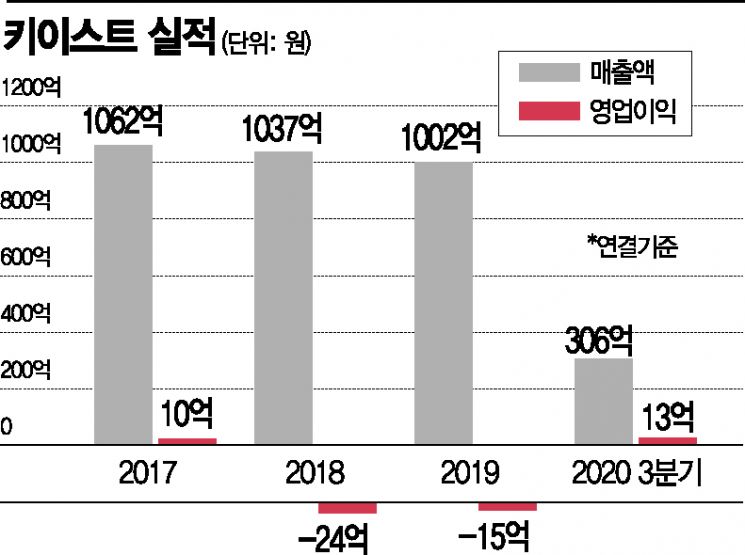
According to the Financial Supervisory Service's electronic disclosure system on the 25th, KeyEast recorded cumulative sales of 30.6 billion KRW and operating profit of 1.3 billion KRW in the third quarter of last year. Sales increased by 8.8% compared to the same period last year, and operating profit turned positive.
KeyEast made a profit last year through the drama "Hyena," which holds intellectual property (IP) rights. The production cost was about 13 billion KRW, and revenue was secured through broadcasts on SBS and Netflix, as well as additional income from product placement (PPL) and sponsorships, achieving a gross profit margin (GPM) of over 25%.
Ji Inhae, a researcher at Hanwha Investment & Securities, explained, "The IP-based dramas currently in development this year have larger production scales than 'Hyena,'" adding, "We expect an increase in overseas licensing fees and improved broadcasting rights rates (recoupment) compared to before."
◆Expectations for performance improvement with blockbuster and IP dramas= KeyEast produced six dramas last year, including "Psychopath Diary," "Hyena," "The School Nurse Files," "My Dangerous Wife," "Live On," and "Hush," and has confirmed the production of four dramas this year.
Park Seonghye, CEO of KeyEast, said, "The first lineup of four works is currently in final negotiations, keeping all business possibilities open with domestic platforms as well as global OTTs," and added, "Since last year, KeyEast's drama business has entered a full-fledged trajectory."
KeyEast is investing over 40 billion KRW this year to produce "Ask the Stars." It is a space-themed drama completed after a three-year preparation period by writer Seo Sookhyang, who wrote "Jealousy Incarnate" and "Pasta." A large portion of the production budget will be spent on building a space station set, and schedules are being coordinated with major star-level actors targeting overseas fans.
They are also preparing the OTT series "Illumination," a K-pop drama depicting the growing pains of idol group members. KeyEast collaborates with top artists from SM Entertainment, its largest shareholder. Last year, KeyEast produced "The School Nurse Files," which aired on Netflix. Considering the operating profit margin was 10% at that time, profitability is expected to improve due to increased competitiveness and recognition of Korean content.
◆Outsourcing production companies’ influence and profitability are directly proportional= The influence of domestic outsourcing production companies is increasing. As Netflix rapidly grows in the OTT market, the world’s largest entertainment company Walt Disney launched the OTT service "Disney+" in December 2019. WarnerMedia, a media subsidiary of the major U.S. telecom company AT&T, introduced "HBO Max" in May last year. A "war of money" has begun to secure competitive content to dominate the global OTT market. In Korea, terrestrial broadcasters, cable, and comprehensive programming channel operators are also strengthening content investments to avoid losing leadership to OTT companies.
Netflix’s content production costs increased by an average of 25.1% annually over eight years from 2011 to 2019. Netflix has recently been rapidly increasing investments in non-English content. Korean content production on Netflix, including dramas, movies, and entertainment shows, increased from two titles in 2017 to eight in 2020. In January this year alone, two movies were released.
Although Korean video content screenings in China remain limited due to the Hanhanryeong (Korean Wave Restriction Order), Chinese OTT companies have expanded investments in Korean content to secure competitiveness in the Asian region. iQIYI purchased overseas rights for about 30 Korean dramas last year and recently secured overseas rights for the drama "Jirisan," produced by Ace Story. Even if it cannot be broadcast in China, Korean content is actively used to target the Asian market. Tencent also invested 100 billion KRW in JTBC Studio. Lee Dongryun, a researcher at KB Securities, explained, "In December last year, two Korean games obtained licenses in China," adding, "expectations for sales of video content in China are increasing."
Chinese companies sponsoring product placements (PPL) in Korean dramas are also increasing. In "True Beauty," currently airing on the cable channel tvN, numerous Chinese company PPLs were exposed, demonstrating the growing influence of Korean dramas in Chinese-speaking countries. Generally, PPL revenue accounts for 10-20% of drama production costs. As Chinese advertisers’ interest grows, it can lead to increased production costs and improved profitability for content production companies.
© The Asia Business Daily(www.asiae.co.kr). All rights reserved.

















