[Sejong=Asia Economy Reporters Haeyoung Kwon, Chaeseok Moon] With the inauguration of the U.S. Joe Biden administration, digital trade is expected to become a major topic in the global trade restructuring. The transition to a non-face-to-face (untact) economy based on digital technology has accelerated since last year's COVID-19 pandemic, increasing attention to this issue from a trade perspective.
In particular, U.S. big tech companies represented by 'FANG (Facebook, Amazon, Netflix, Google)' have rapidly grown due to the pandemic, bringing issues such as digital taxes and internet network usage to the forefront of digital trade negotiations. There are calls for the government and industry to prepare countermeasures.
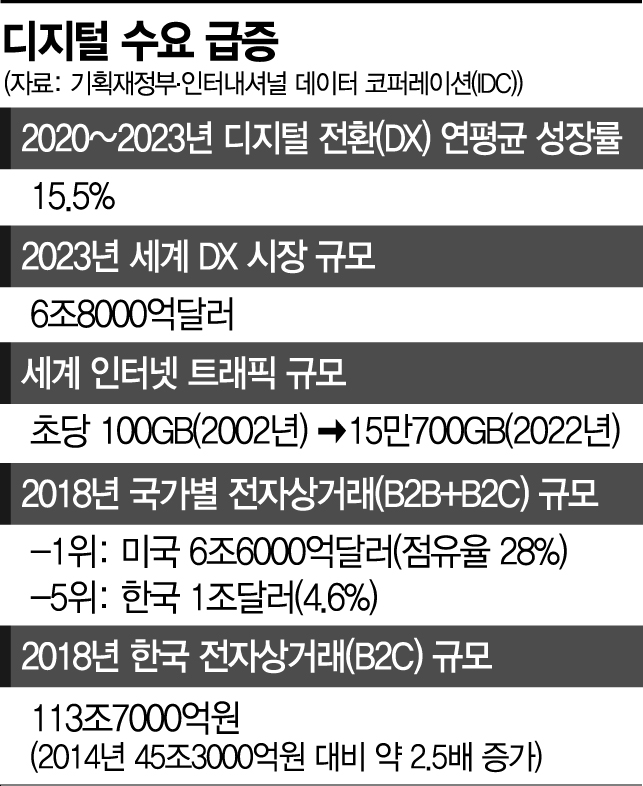
According to the government and market research firm IDC on the 22nd, global investment related to digital transformation is expected to grow at an average annual rate of 15.5% from 2020 to 2023. Considering the World Bank (WB) forecast of 3.8% economic growth rate this year, this figure is four times higher. This indicates the rapid growth speed of the digital sector.
The digital economy refers to the service market that creates new added value such as online commerce based on ICT including the internet, big data, and artificial intelligence (AI). The World Trade Organization (WTO) estimated that the global ICT-based service market grew from $1.86 trillion in 2008 to $2.96 trillion in 2018.
As the digital economy grows rapidly, cross-border movement also becomes more active. The fact that Netflix's global subscribers recently exceeded 200 million shows how active data movement between countries has become.
Digital trade is a sensitive issue for South Korea, which is pursuing membership in the Comprehensive and Progressive Agreement for Trans-Pacific Partnership (CPTPP).
A future contentious issue is expected to be the demand for expanded data openness. The U.S. actively supports free cross-border data movement to improve services of big data-based companies such as Google and Amazon. On the other hand, the South Korean government is sensitive about information protection and emphasizes data sovereignty to protect domestic companies (such as Naver) and industries.
The issue of 'free network usage' is also contentious. Domestic companies like Naver and Kakao pay hundreds of billions of won annually to telecom companies for network usage fees, whereas U.S. IT companies like Google and Netflix, which cause a surge in traffic, pay no network usage fees.
The digital tax debate is another noteworthy point. European countries, including France, are pushing to introduce digital taxes that levy a portion of the revenue earned by U.S. IT companies within their regions.
© The Asia Business Daily(www.asiae.co.kr). All rights reserved.
![Clutching a Stolen Dior Bag, Saying "I Hate Being Poor but Real"... The Grotesque Con of a "Human Knockoff" [Slate]](https://cwcontent.asiae.co.kr/asiaresize/183/2026021902243444107_1771435474.jpg)
















