A Total of 37 Billion Won Invested in Angang-eup and Hwangseong-dong Areas... Selected for Ministry of Land, Infrastructure and Transport Public Project
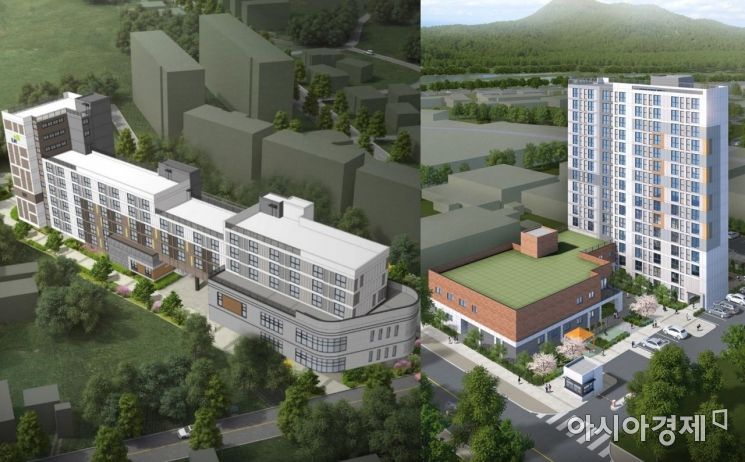 From the left in the photo, Angang-eup Elderly Welfare Housing, Hwangseong-dong Elderly Welfare Housing bird's-eye view.
[Asia Economy Yeongnam Reporting Headquarters Reporter Choi Jae-ho] Gyeongju City will sequentially begin construction this year of senior welfare housing for elderly people in vulnerable housing situations in two locations: Angang-eup and Hwangseong-dong.
According to Gyeongju City on the 21st, follow-up measures will be implemented this year following the selection of Angang-eup in April 2019 and Hwangseong-dong in May last year in the Ministry of Land, Infrastructure and Transport's public contest project.
The senior welfare housing project is a public rental housing supply initiative that combines elderly-customized welfare housing and social welfare facilities, aimed at resolving housing blind spots for vulnerable elderly groups.
Recently, Gyeongju City is investing a total of 17.2 billion KRW to build 103 units of permanent rental apartments (exclusive area 26㎡) and social welfare facilities (962.4㎡) in the Sandae-ri 2020 area of Angang-eup. This site will include customized welfare service spaces such as a multipurpose auditorium, physical therapy room, and program room. Move-in is expected around the end of next year.
The 'Hwangseong-dong Senior Welfare Housing' will begin construction at the end of this year. With a total investment of 19.8 billion KRW, it will be built as 137 units of permanent rental apartments (exclusive area 36㎡) and social welfare facilities (1517㎡). The expected move-in date is the end of December 2023.
Both senior welfare housing sites prioritize move-in for elderly people aged 65 and over who are homeless and belong to vulnerable groups, with rental conditions set at 30% of the surrounding market price and a 50-year permanent lease.
In the Gyeongju area, the elderly population aged 65 and over is 57,713 (as of December last year), accounting for 22.61% of the total population, showing a super-aged society structure.
© The Asia Business Daily(www.asiae.co.kr). All rights reserved.

















