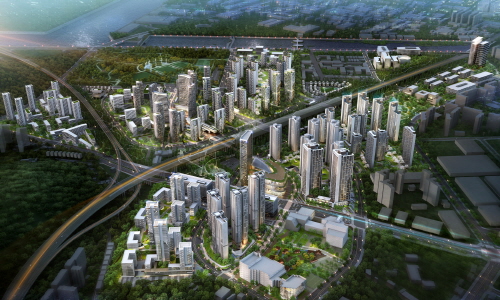
The urban development project ‘City OCELE’ in Michuhol-gu, Incheon, will be developed into a place where history and culture come alive. Historical modern and contemporary buildings scattered throughout the district will be preserved through remodeling, and a new modern cultural space called ‘Incheon Museum Park’ will also be established, transforming the area into a space where history and culture coexist.
Modern historical buildings located within City OCELE in Michuhol-gu, such as the former Far East Broadcasting foreign missionary residences, Songam Art Museum, and OCI headquarters, will be preserved. The old Far East Broadcasting building was the first place in South Korea to broadcast overseas in December 1956. Currently, eight brick-structured buildings of one to two stories remain, including the former Far East Broadcasting transmission room and the foreign missionary residences related to broadcasting work. Originally, the site of the former Far East Broadcasting building was planned as residential land, but following the district’s opinion that it was worth preserving as a modern architectural asset, the land use was changed to cultural facility land.
The OCI (Oriental Chemical Industries) headquarters building will also be preserved. The OCI headquarters is a steel-framed building with one basement floor and four above-ground floors, constructed in 1987. The OCI Incheon plant is a historic building symbolizing the industrial city of Incheon. The late Lee Hoe-rim, former chairman of OCI and known as the ‘last merchant of Kaesong,’ played a significant role in developing the heavy chemical industry in Incheon, giving the building considerable economic historical significance.
The OCI headquarters building, along with the former Far East Broadcasting foreign missionary residences, will be preserved and remodeled to create a cultural hub space where visitors can enjoy exhibitions, sales, and cultural experiences.
Additionally, City OCELE includes cultural facilities. Among them is the ‘Songam Art Museum,’ which exhibits over 9,000 artworks collected over 50 years by the late OCI chairman Lee Hoe-rim. The Songam Art Museum was donated to the city of Incheon by Chairman Lee in June 2005 and currently operates as a branch of the Incheon Metropolitan Museum.
The Songam Art Museum began in 1987 when Chairman Lee established the Songam Cultural Foundation and remodeled his house in Susong-dong (Songam Hall) to open the museum in 1989. As the collection grew, he built a new Songam Art Museum in 1992 in Nam-gu, Incheon (now Michuhol-gu), the site of the Oriental Chemical Town.
A modern cultural space will also be created. On the land (54,121㎡) donated by the project implementer DCRE to Incheon City, the city’s first ‘Incheon Museum Park’ will be established, offering various exhibitions, appreciation, and cultural experiences. The Incheon Museum Park project involves relocating and expanding the Incheon Metropolitan Museum and establishing the Incheon Metropolitan Art Museum, consisting of the art museum, museum, and an arts park.
City OCELE is a mini-new town-scale private urban development project covering 1,546,747㎡ in Hakik-dong and nearby areas of Michuhol-gu, Incheon. The project implementer DCRE, together with leading domestic construction companies HDC Hyundai Development Company, Hyundai Engineering & Construction, and POSCO Engineering & Construction, plans to build over 13,000 residential units along with schools, parks, offices, and cultural facilities.
City OCELE consists of only 35% residential areas, with about 48% dedicated to urban infrastructure such as roads, parks, and green spaces. Notably, nine parks (six cultural parks, two neighborhood parks, and one children’s park) will be established throughout the area, allowing residents to enjoy urban living. The approximately 370,000㎡ Grand Park will feature various sports and recreational facilities, including soccer fields, baseball fields, basketball courts, and fitness centers.
School sites for elementary, middle, and high schools are also planned, enabling children to commute to school easily. A large commercial area (about 71,659㎡) will be developed with various shopping and convenience facilities, allowing residents to enjoy culture, commerce, and education all within the district.
© The Asia Business Daily(www.asiae.co.kr). All rights reserved.

















