2019 Gender Equality Index Rises by 0.5 Points from Previous Year
Significant Increase in Proportion of Women in Appointed and Senior Public Officials
Steady Growth in Paternity Leave Among Men
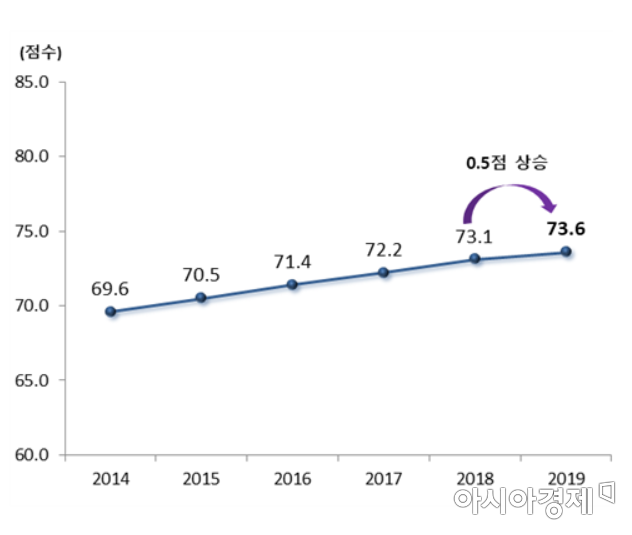
[Asia Economy Reporter Han Jinju] South Korea's gender equality index scored 73.6 out of 100, an increase of 0.5 points compared to the previous year.
On the 21st, the Ministry of Gender Equality and Family announced the results of the national and regional gender equality index measurements based on 2019 data. The national gender equality index was 73.6 points, and the regional gender equality index was 76.4 points, both showing an upward trend every year. In 2018, the scores were 73.1 and 75.7 respectively.
The Ministry of Gender Equality and Family has been surveying and publishing the index since 2010 to measure the level of gender equality at the national and provincial levels and to establish policy directions from a gender equality perspective. The gender equality index consists of three areas: gender-equal social participation, women's human rights and welfare, and gender equality awareness and culture, covering eight fields including economic activity, welfare, and family.
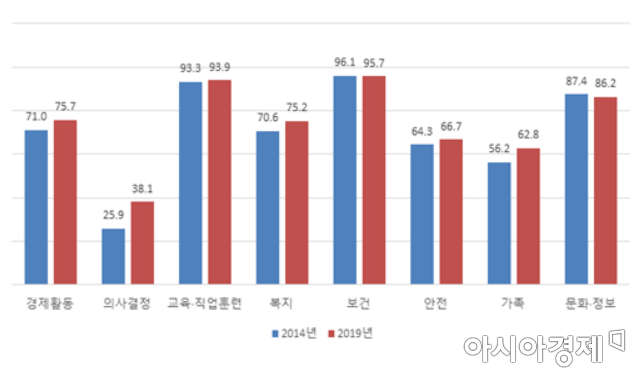
By area, the scores were highest in women's human rights and welfare at 79.2 points, followed by gender equality awareness and culture at 74.5 points, and social participation at 69.2 points. The decision-making field score rose significantly from 36.2 points in 2018 to 38.1 points, influenced by an increase in the proportion of appointed members of government committees and public officials at grade 4 or higher. The proportion of female appointed members increased from 41.9% to 43.0%.
As safety awareness indicators improved across society, the safety field score rose by 1.8 points from the previous year to 66.7 points, and the family field score increased from 61.2 to 62.8 points due to a rise in male parental leave takers. The number of men taking parental leave increased significantly from 17,662 in 2018 to 22,297 in 2019.
The regional gender equality index, reflecting regional characteristics, was highest in Gwangju, Daejeon, Busan, and Jeju in that order. The lowest regions were Gyeongnam, Gyeongbuk, Jeonnam, and Chungnam. Compared to the previous year, Gwangju rose from the lower-middle to the upper region, while Daegu and Seoul dropped from the upper to the upper-middle region.
Jung Young-ae, Minister of Gender Equality and Family, stated, "Although the level of gender equality has continuously improved as a result of actively promoting policies such as enhancing women's representation and work-life balance, there are still significant disparities across fields. We are actively pursuing effective policies to raise the level of gender equality in all areas, including decision-making and safety, by one step further, and we are also working on revising the national gender equality index to reflect the changed social landscape and increase policy utilization."
© The Asia Business Daily(www.asiae.co.kr). All rights reserved.
![Clutching a Stolen Dior Bag, Saying "I Hate Being Poor but Real"... The Grotesque Con of a "Human Knockoff" [Slate]](https://cwcontent.asiae.co.kr/asiaresize/183/2026021902243444107_1771435474.jpg)

















