Fresh Eggs Imported Before Lunar New Year for Required Supply... Large Mart Eggs Sold at 20% Discount
"Sufficient Supply Capacity for Chicken, Beef, and Pork but Supply Expansion Eases Concerns"
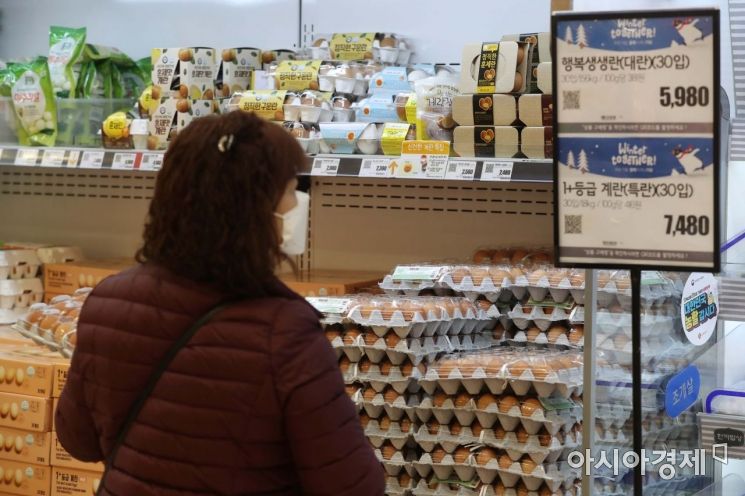 Due to the spread of highly pathogenic avian influenza (AI), the price of a carton of eggs has surpassed 6,000 won. According to the Korea Agro-Fisheries & Food Trade Corporation (aT) on the 11th, the retail price of a carton of eggs was recorded at 6,082 won as of the 8th. As the AI outbreak shows no signs of slowing down, concerns are rising that the prices of chicken and eggs, which affect meal costs, may increase further. Citizens are seen examining eggs at a large supermarket in Seoul on this day.
 Photo by Moon Honam munonam@
[Asia Economy Reporter Moon Chae-seok] As highly pathogenic avian influenza (AI) spreads and egg prices soar, the government has decided to exempt tariffs on fresh eggs and eight processed egg products until the end of June.
In particular, fresh eggs will be imported in quantities needed before the Lunar New Year, and large supermarkets will offer a 20% discount sale to ease the burden on consumers.
Additionally, although the supply capacity for chicken, duck meat, beef, and pork is sufficient, considering the rising prices due to market anxiety and increased household demand, proactive measures to stabilize supply and demand will be implemented.
On the 20th, the Ministry of Agriculture, Food and Rural Affairs announced that it will promote measures to stabilize the supply and demand of livestock products, whose prices have risen due to recent outbreaks of highly pathogenic AI, following the resolution of the 27th Emergency Economic Central Countermeasures Headquarters.
Due to highly pathogenic AI, as of this morning, 8,788,000 laying hens have been culled, reducing egg supply by 11.0% compared to the average year.
On the other hand, since the outbreak of COVID-19, demand for eggs for household use and baking has greatly increased, with the consumer price for 10 premium eggs reaching 2,177 won, 22.4% higher than the average year.
Although supply capacity, including frozen stock, is sufficient for chicken and duck meat, market sentiment is unstable due to concerns about expanded culling, causing consumer prices to rise by 8.5% and 15.1% respectively compared to the average year.
Despite higher-than-average livestock numbers and stock for beef and pork, prolonged COVID-19 has increased household demand, resulting in consumer prices rising by 8.0% and 18.0% respectively.
The government will first apply a 0% emergency tariff quota on eight items, including fresh eggs and processed egg products, within a 50,000-ton limit. The basic tariff rates for these items range from 8% to 30%, but tariffs will be waived for the quota volume.
The eight items are fresh eggs, smoked eggs, egg yolk powder, frozen egg yolk, whole egg powder, frozen whole egg, egg white powder, and frozen egg white.
This measure will be applied temporarily until June 30, with flexible operation depending on market conditions.
In particular, fresh eggs will be imported first in quantities needed before the Lunar New Year, considering supply and demand conditions.
The tariff quota applied to egg imports is a tariff imposed based on a certain quota of imported goods. It can be flexibly applied according to domestic and international conditions and is used to actively import or suppress imports of specific goods to facilitate supply and demand.
When increasing imports, the tariff rate can be reduced by 40% of the basic tariff rate up to the quota volume.
Previously, during the so-called "egg crisis" in 2016-2017, when the price of a carton of eggs approached 10,000 won, the government exempted import tariffs from January 2017 and imported eggs and egg products from the United States and Spain.
Afterward, egg prices gradually fell, entering the 5,000 won range around September of that year.
To reduce the burden on consumers, large supermarkets will sell eggs at a 20% discount.
Furthermore, the government has requested cooperation from the baking industry, one of the major egg consumers, to use processed egg products instead of fresh eggs and plans to inspect distribution companies for illegal distribution activities to ensure smooth egg supply.
Since supply capacity for chicken and duck meat is still sufficient, affiliated companies will be encouraged to ship frozen stock, and daily shipment volumes by company will be monitored.
Beef and pork will be supplied in larger quantities than usual during the Lunar New Year livelihood stabilization period.
Beef shipments will be 929 tons, 1.4 times the usual amount, and pork shipments will be 3,180 tons, 1.2 times the usual amount.
A Ministry of Agriculture, Food and Rural Affairs official emphasized, "We will closely monitor market trends and actively cooperate with producer organizations and distribution industries to ensure smooth implementation of livestock supply stabilization measures and prevent supply instability."
© The Asia Business Daily(www.asiae.co.kr). All rights reserved.
![Clutching a Stolen Dior Bag, Saying "I Hate Being Poor but Real"... The Grotesque Con of a "Human Knockoff" [Slate]](https://cwcontent.asiae.co.kr/asiaresize/183/2026021902243444107_1771435474.jpg)
















