IMF Global Pandemic Uncertainty Index for Q4 Last Year
Global Index Falls by 8.68P... Korea Rebounds by 2.40P
Uncertainty Grows Due to Slow Vaccine Procurement, Rising Household Debt, and Zombie Companies
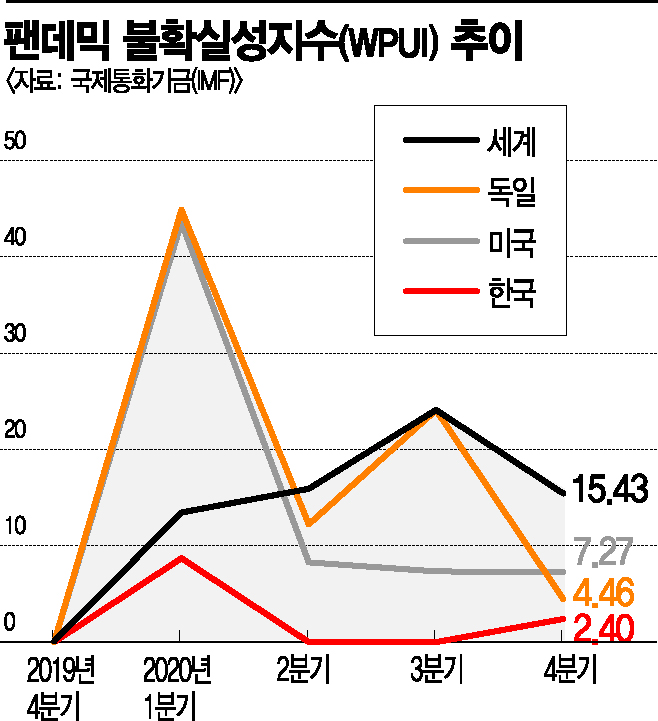
[Asia Economy Reporter Kim Eunbyeol] Global uncertainty caused by the novel coronavirus disease (COVID-19) crisis peaked in the third quarter of last year and has been on a downward trend since. In contrast, pandemic-related uncertainty in Korea showed an upward trend during the same period. This is attributed to Korea’s relatively slower vaccine procurement compared to major advanced countries such as the United States, the United Kingdom, and Germany, as well as rising household debt and a surge in marginal companies, which are factors increasing uncertainty.
The International Monetary Fund (IMF) announced on the 19th (local time) the “World Pandemic Uncertainty Index (WPUI),” surveyed across 143 countries worldwide. The WPUI stood at 15.43 in the fourth quarter of last year, down 8.68 points from 24.11 in the previous quarter. Although the absolute level of uncertainty remains high?about 24 times that during the Ebola virus outbreak and 3.5 times that during the Severe Acute Respiratory Syndrome (SARS) epidemic?the significance lies in the fact that it peaked in the third quarter and then declined.
The IMF has been publishing the World Uncertainty Index (WUI) since 1996. It analyzes reports from the global economic information service Economist Intelligence Unit (EIU) using text mining methods and then indexes the results. The WPUI is a sub-index of the WUI reflecting the COVID-19 situation, created to measure the level of infectious disease-related uncertainty by country.
By country, uncertainty in advanced countries such as the United States and Europe has relatively decreased, whereas Korea’s uncertainty, which remained at zero throughout the second and third quarters of last year, rebounded in the fourth quarter. Korea’s WPUI was 8.71 in the first quarter of last year, dropped to 0.00 in the second and third quarters, and then rose to 2.40 in the fourth quarter. This contrasts with Germany’s WPUI, which sharply fell from 24.09 in the third quarter to 4.46 in the fourth quarter, and the United States, which decreased slightly from 7.34 to 7.27 during the same period.
Reasons for Korea’s increased uncertainty despite the containment of COVID-19 spread include slower vaccine procurement compared to advanced countries, excessive debt, and significant influence from the United States and China. The EIU, which forms the basis for the IMF’s index estimation, predicted that Asian countries including Korea may not see positive economic effects from vaccines until 2022 due to slow vaccine procurement. It also expressed concern over the increase in marginal companies?those unable to cover interest expenses with operating profits for three consecutive years?despite massive financial input to respond to COVID-19.
Regarding Korea’s financial system, the IMF stated, “The proportion of non-performing loans is low, so banking risks are minimal,” but added, “Rapidly increasing household debt and soaring real estate markets are factors that amplify downside risks.” According to the Bank of Korea, the outstanding household loans at banks reached 988.8 trillion won at the end of last year, surging by 100.5 trillion won in one year?the largest increase since statistics began in 2004. While some of this is for living expenses in response to COVID-19, many have borrowed to invest in stocks or real estate, raising concerns. If the market fluctuates after borrowing to invest, the impact can be significant. Korea’s fundamental risks, such as North Korea?U.S. and U.S.?China relations, also contribute to increased uncertainty.
Meanwhile, the IMF identified the United States and the United Kingdom as countries that increase global uncertainty in this analysis. It also noted that China influences some Asian countries. The IMF pointed out, “Historically, the United States has contributed about 23% to global uncertainty, and the United Kingdom has increased world uncertainty by about 11% over the past four years due to the Brexit issue.”
© The Asia Business Daily(www.asiae.co.kr). All rights reserved.

















