1.91 Million Newly Registered Vehicles, 6.2% Increase Year-on-Year
Continuous Growth in Eco-Friendly Cars...460,000 in 2018 → 600,000 in 2019 → 820,000 in 2020
Hydrogen Vehicles Surpass 10,000 Units, Double Compared to Previous Year
3.87 Million Used Car Transactions, 7.2% Increase Year-on-Year
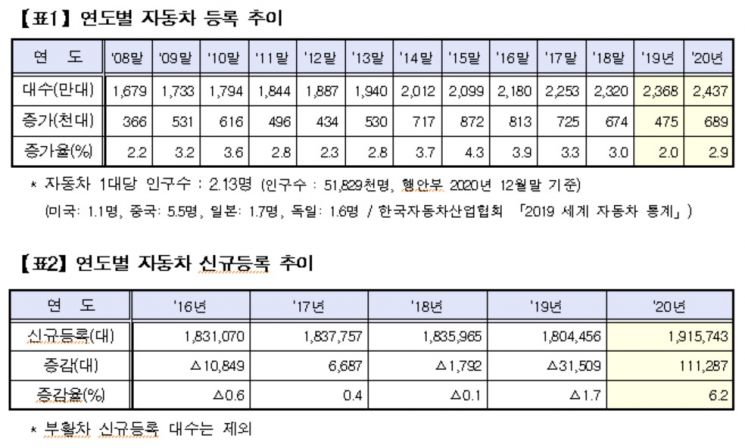
[Asia Economy Reporter Jo Gang-wook] Last year, the number of registered vehicles in South Korea surpassed 24.3 million, indicating that there is one vehicle for every 2.13 people. Interest in hydrogen and electric vehicles has grown, with the number of eco-friendly vehicle registrations exceeding 800,000.
The Ministry of Land, Infrastructure and Transport announced on the 20th that as of the end of last year, the number of registered vehicles reached 24,365,979 (excluding 2.29 million two-wheelers), marking a 2.9% (690,000 vehicles) increase compared to the end of 2019 (23.68 million vehicles).
This means there is one vehicle for every 2.13 people, which is slightly lower compared to the United States (1.1 people), Japan (1.7 people), and Germany (1.6 people).
The growth rate of vehicle registrations showed a somewhat slowing trend with 4.3% in 2015, 3.9% in 2016, 3.3% in 2017, 3.0% in 2018, and 2.0% in 2019. However, despite the impact of COVID-19, last year saw an increase of 690,000 vehicles, which is 1.45 times the growth rate of the previous year (470,000 vehicles).
In particular, new vehicle registrations increased from 1.8 million in 2019 to 1.91 million last year, which the Ministry attributes to the effects of new car launches and reductions in individual consumption tax.
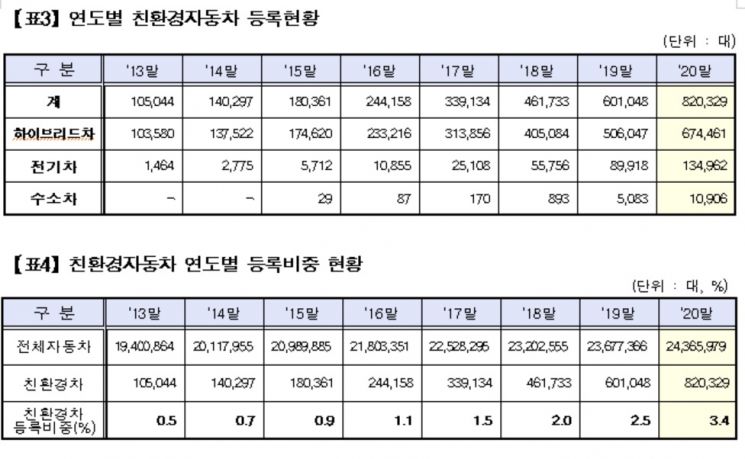
Eco-friendly vehicles, classified as electric, hybrid, and hydrogen vehicles, reached 820,000 units, accounting for 3.4% of the total, up 0.9 percentage points from 2.5% the previous year. The share of eco-friendly vehicle registrations has been increasing annually: 0.7% in 2014, 0.9% in 2015, 1.1% in 2016, 1.5% in 2017, 2.0% in 2018, 2.5% in 2019, and 3.4% last year.
Due to recent government efforts to expand eco-friendly vehicle distribution and high public interest, electric vehicles (134,962 units) increased by 50%, hybrid vehicles (674,461 units) by 33%, and hydrogen vehicles (10,906 units) by 115% compared to 2019.
Among electric vehicles, passenger cars increased by 34% (29,690 units), vans by 122% (1,009 units), and notably, cargo trucks surged by 1,254% (from 1,140 units to 15,436 units). The significant increase in electric cargo trucks is attributed to the removal of restrictions on the number of permits for commercial use of electric cargo trucks under 1.5 tons since July 2019, and the launch of 1-ton electric cargo trucks by major manufacturers (Hyundai Porter EV in December 2019 and Kia Bongo EV in January last year).
Hydrogen vehicles, which had fewer than 1,000 registrations (893 units) at the end of 2018, surpassed 10,000 units within two years, indicating that their distribution is gaining momentum. By region, registrations were 1,671 in Seoul, 1,578 in Gyeonggi, 1,819 in Ulsan, 908 in Gyeongnam, and 916 in Busan.
Looking at new vehicle registrations by fuel type, the share of eco-friendly vehicles steadily increased from 6.8% in 2018 to 11.8% last year, while the share of diesel vehicles declined from 43% to 31% during the same period.
The decline in diesel vehicle share is mainly due to a significant decrease in multi-purpose diesel passenger vehicles (SUVs), which had a large registration share, dropping from 330,000 units in 2018 to 250,000 units in 2020. The demand for these reduced multi-purpose diesel passenger vehicles shifted to multi-purpose gasoline vehicles (110,000 units in 2018 to 250,000 units in 2020) and hybrid vehicles (7,000 units in 2018 to 54,000 units in 2020).
Among the total registered vehicles, domestic cars accounted for 21.68 million units (89.0%), and imported cars accounted for 2.68 million units (11.0%). The market share of imported cars steadily increased from 9.4% at the end of 2018, 10.2% at the end of 2019, to 11.0% last year.
The number of used car transactions reached 3.874 million units at the end of last year, a 7.2% increase compared to 3.614 million units the previous year. However, due to the impact of COVID-19, used car exports decreased, with deregistration of used car exports dropping by 20.8% to 278,000 cases last year from 351,000 cases the previous year.
Lee Jung-gi, Director of the Automobile Operation and Insurance Division at the Ministry of Land, Infrastructure and Transport, stated, "The increase in eco-friendly vehicles such as electric and hydrogen cars appears to be accelerating due to growing public interest in environmental issues and the government's Green New Deal policies. We will continue to make efforts to provide systematic statistical management and customized statistics in line with these market trends and changes."
© The Asia Business Daily(www.asiae.co.kr). All rights reserved.


















